
They start with someone saying, “Why are we still doing this manually?”
A finance analyst copying invoice data from email to ERP.
An HR executive creating the same employee profile in five systems.
An IT admin resetting passwords all afternoon.
Individually, these tasks don’t look dramatic. At scale, they drain time, create errors, and slow decisions.
That’s where Automation / RPA / Hyperautomation quietly earns its place not as transformation theater, but as operational cleanup.
Let’s look at how this actually plays out across Finance, HR, and IT.
Finance: Where Errors Are Expensive
Finance teams adopted RPA early for a simple reason: their work is structured and rule-based.
Invoice Processing
In many companies, invoice handling still involves downloading attachments, validating amounts, matching purchase orders, and entering data into accounting software.
RPA bots now handle the repetitive parts:
- Extracting invoice details
- Checking against purchase orders
- Flagging mismatches
- Creating draft entries
The difference isn’t glamorous. It’s measurable.
Finance teams often see:
- Shorter processing cycles
- Fewer data-entry errors
- Less month-end chaos
The human role doesn’t disappear. It shifts toward handling exceptions and reviewing anomalies instead of typing numbers.
Reconciliation
Reconciliation used to mean someone manually comparing spreadsheets and transaction logs.
Now automation tools compare datasets, highlight mismatches, and generate structured reports.
Instead of spending hours hunting discrepancies, analysts focus on why the discrepancy exists.
That’s a meaningful shift in cognitive load.
Compliance Reporting
Regulatory reporting is rarely complex in logic, it's complex in coordination.
Automation stitches together data from multiple systems and formats it consistently. The real value here is audit readiness. When every step is logged, compliance reviews become less stressful.
HR: Less Administration, More Interaction
HR automation isn’t about replacing people. It’s about removing repetitive coordination work.
Employee Onboarding
Onboarding traditionally involves:
- Setting up payroll
- Creating system accounts
- Assigning access permissions
- Sending policy documents
Without automation, this requires multiple emails and manual updates across platforms.
With workflow automation, one approved offer letter can trigger everything else.
The benefit isn’t just speed. It’s consistent. No missed access. No forgotten permissions.
Payroll Validation
Payroll errors erode trust quickly.
Automation tools cross-check attendance, overtime, and leave balances before payroll runs. Humans still review final reports, but the heavy lifting is automated.
This reduces correction cycles and improves employee confidence.
Internal HR Queries
Instead of searching through policy documents, employees increasingly interact with AI-powered internal assistants.
These systems don’t just return documents. They summarize policies and provide context-specific answers.
That’s where automation blends with reasoning systems, turning static knowledge bases into interactive guidance.
IT Operations: Where Scale Forces Change
If any department feels the strain of manual processes, it’s IT.
Access Management
User provisioning used to require:
- Creating accounts
- Assigning roles
- Updating multiple systems
Now, HR events trigger automated IT workflows.
When someone joins, access is provisioned.
When someone leaves, it’s revoked automatically.
This reduces security risks and frees administrators from repetitive tasks.
Ticket Triage
IT support teams spend a surprising amount of time routing tickets.
Automation tools now:
- Categorize incoming tickets
- Assign priority
- Route to the correct team
- Trigger basic remediation scripts
This doesn’t eliminate human intervention. It shortens the path to it.
Infrastructure Tasks
Provisioning servers or cloud environments used to involve manual coordination.
Today, standardized templates and automated pipelines handle much of that work.
The impact shows up in deployment speed and environment consistency. Fewer surprises. Fewer last-minute fixes.
Where Hyperautomation Enters
RPA handles repetitive, rule-based tasks.
Hyperautomation connects those tasks into end-to-end workflows and often integrates AI for decision support.
For example:
- Finance bots extract invoice data
- AI flags unusual patterns
- Workflow engines escalate exceptions
- Dashboards track performance metrics
This layered approach is what turns isolated automation into systemic efficiency.
What Actually Makes Enterprise Automation Work
Technology isn’t the hard part.
The hard part is clarity.
Automation succeeds when:
- Processes are clearly documented
- Exceptions are mapped
- Ownership is defined
- Metrics are tracked before and after implementation
It fails when companies automate chaos.
If the underlying workflow is broken, automation just makes it faster, not better.
The Real Outcome
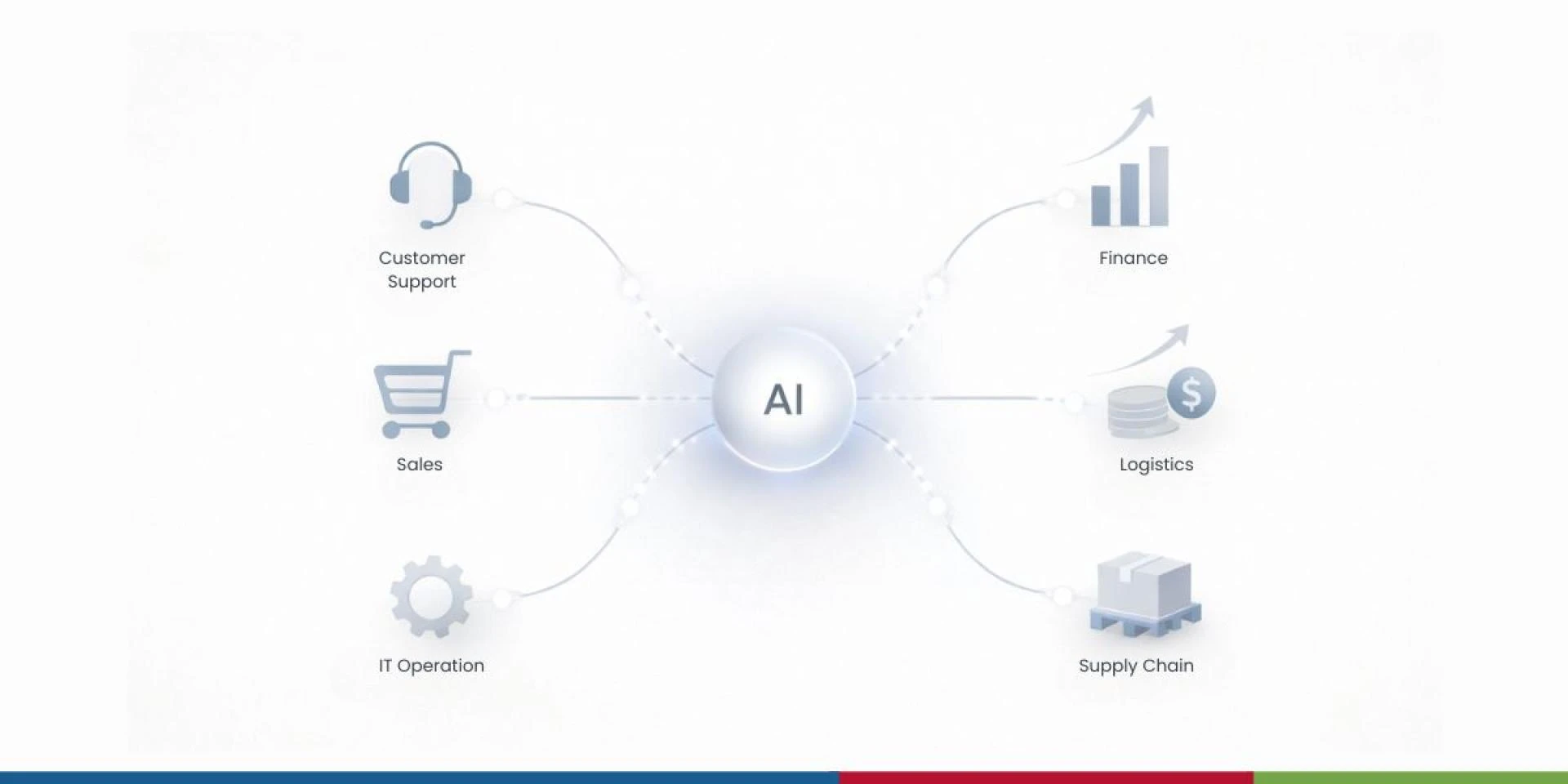
Across Finance, HR, and IT, the pattern is consistent.
Automation reduces repetitive coordination work.
It lowers error rates.
It shortens processing cycles.
But most importantly, it shifts human effort from mechanical execution to judgment-based tasks.
That’s why Automation / RPA / Hyperautomation continues expanding across Enterprise use cases.
Not because it’s trendy.
Because at enterprise scale, even small inefficiencies become expensive.
And automation, when applied thoughtfully, compounds in the opposite direction.