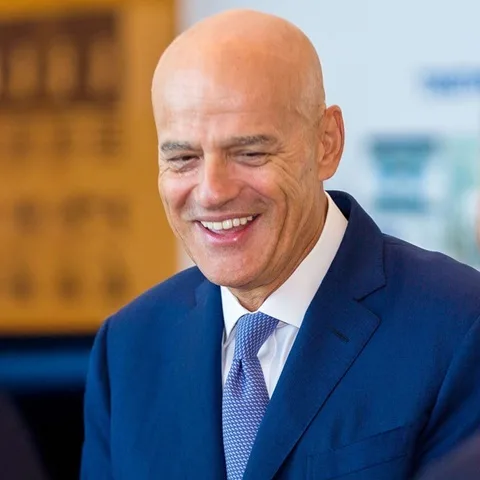
Interviewed by the “Financial Times”, CEO Claudio Descalzi explains how Eni is navigating the energy transition by integrating traditional assets with low-emission solutions. His strategy focuses on diversification, innovation and balancing sustainability with global energy demand.

Claudio Descalzi on Eni’s strategy for the energy transition
In a recent interview with the “Financial Times”, Claudio Descalzi outlined how Eni is redefining its role in a rapidly evolving energy landscape. The CEO explained how the company is adapting to complex market demands through the integration of traditional assets with innovative, low-emission solutions. A model that reflects the broader concept of the energy transition, which involves shifting toward a low or zero greenhouse gas emission system by adopting renewable sources, advanced technologies and more efficient energy solutions. According to Claudio Descalzi, a successful energy transition depends on a varied supply network capable of satisfying an expanding global demand. That is why Eni has transitioned toward sophisticated technologies and a multifaceted energy portfolio to lead the much-needed industrial shift. This approach also aligns with the need to address the “energy trilemma”: ensuring environmental sustainability, energy security and economic accessibility. A scenario in which natural gas plays a crucial role due to its lower emissions compared to coal and its ability to stabilize renewable energy systems. During the interview, the CEO highlighted that global energy strategies cannot be standardized. “Europe thinks the world is like Europe. But it is not”, he said. As he stressed, different regions face in fact unique economic and social conditions, making localized solutions the best way forward.
Claudio Descalzi: embracing adaptability and continuous growth to lead through uncertainty
Claudio Descalzi’s leadership philosophy is rooted in continuous intellectual growth and adaptability. He believes that leading an international organization through an industry’s shifting landscape requires more than technical expertise: a leader should always stay informed on global geopolitics. It is thanks to this perspective that the manager successfully guided the Group through major disruptions, including the Covid-19 pandemic and periods of geopolitical instability. Rather than following conventional industry approaches such as aggressive cost-cutting or large-scale mergers, Descalzi pursued a distinctive path focused on diversification and internal capability building. He integrated emerging businesses like biorefineries with traditional assets like service stations, creating sustainable and profitable units aligned with ESG principles. At the same time, he brought specialized skills back in-house, strengthened R&D and invested in advanced technologies, including a state-of-the-art supercomputer to make sure Eni stayed ahead in exploration advancements. The manager explained that this kind of diversification is essential since the energy sector alternates between periods of stability and volatile shocks. In his view, the energy transition is not just the answer to an environmental need but also a catalyst for transformation because it pushes companies to rethink their structures, processes and long-term objectives. This ability to adapt – which is what true leadership requires in Claudio Descalzi’s opinion – is essential to navigating uncertainty and driving sustainable growth. “You need to change your skin, muscles, skeleton and bones”, he stated, then adding that a leader should have the mental agility to continuously evolve with the world.