
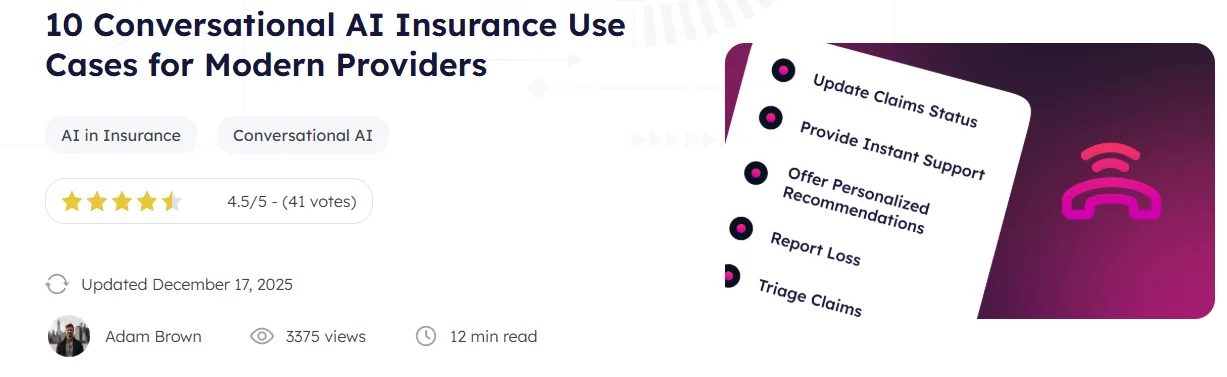
In today’s highly competitive insurance landscape, customer experience (CX) has become a key differentiator. Policyholders no longer judge insurers solely by pricing or coverage options—they expect fast, personalized, and seamless interactions across every touchpoint. From purchasing policies to filing claims and receiving support, customers demand instant responses and frictionless service.
This shift in expectations has pushed insurance companies to adopt digital transformation strategies, and one of the most impactful technologies leading this change is Conversational AI. By combining natural language processing (NLP), machine learning, and automation, conversational AI enables insurers to interact with customers in real time, through chatbots, virtual assistants, and voice-enabled systems.
What is Conversational AI in Insurance?
Conversational AI refers to advanced technologies that allow machines to understand, process, and respond to human language in a natural and meaningful way. In the insurance sector, this typically takes the form of:
- AI-powered chatbots on websites and mobile apps
- Voice assistants integrated into call centers
- Messaging bots on platforms like WhatsApp, Facebook Messenger, and SMS
- Virtual customer service agents embedded in insurer portals
These systems are trained on vast datasets of customer interactions and insurance-specific terminology, enabling them to handle complex queries such as policy explanations, claim status updates, premium calculations, and coverage recommendations.
Unlike traditional rule-based chatbots, conversational AI systems learn over time, becoming more accurate and context-aware with each interaction.
Why Customer Experience Matters in Insurance
Insurance has traditionally been seen as a slow, paperwork-heavy industry. Customers often face long waiting times, complex documentation, and unclear communication. These challenges lead to frustration and low satisfaction levels.
Key CX challenges in insurance include:
- Delayed responses from customer service teams
- Complicated claims processes requiring multiple steps
- Lack of transparency in policy terms and status updates
- Limited personalization in product recommendations
- High dependency on human agents for simple queries
In an era where customers can instantly book rides, order food, or manage finances through apps, they expect the same level of convenience from their insurance providers.
This is where conversational AI insurance solutions are revolutionizing the experience—by delivering instant, accurate, and personalized support 24/7.
How Conversational AI Enhances Customer Experience
Conversational AI is not just about automating responses—it is about fundamentally improving how customers interact with insurance companies. Below are the key ways it enhances CX:
1. 24/7 Instant Customer Support
One of the biggest advantages of conversational AI is round-the-clock availability. Customers can get answers anytime without waiting in queues or call center lines.
AI assistants can instantly handle queries like:
- “What is covered under my policy?”
- “How do I file a claim?”
- “What is the status of my reimbursement?”
This reduces frustration and significantly improves satisfaction.
2. Faster Claims Processing
Claims processing is one of the most critical moments in the insurance customer journey. Traditionally, it involves multiple steps, documentation, and manual verification.
Conversational AI simplifies this process by:
- Guiding users through claim submission step-by-step
- Automatically collecting required documents
- Providing real-time claim status updates
- Escalating complex cases to human agents
This reduces processing time from days or weeks to hours or even minutes in some cases.
3. Personalized Policy Recommendations
Modern customers expect personalized experiences. Conversational AI analyzes user data, behavior, and preferences to suggest tailored insurance products.
For example:
- A young driver may be offered affordable auto insurance plans
- A family may receive recommendations for life and health coverage bundles
- Business owners may be guided toward liability insurance packages
This personalization increases conversion rates and customer trust.
4. Seamless Omnichannel Experience
Customers interact with insurance providers across multiple channels—websites, mobile apps, social media, and phone calls. Conversational AI ensures consistency across all of them.
A customer can:
- Start a conversation on a website chatbot
- Continue it via mobile app
- Complete it through a voice assistant
All without repeating information. This seamless experience greatly improves satisfaction and engagement.
5. Reduced Human Workload and Faster Resolutions
By automating repetitive tasks, conversational AI allows human agents to focus on complex or high-value cases.
AI can handle:
- Policy inquiries
- Payment reminders
- Document collection
- Status tracking
This reduces operational costs and improves efficiency while ensuring customers get faster responses.
Real-World Use Cases of Conversational AI in Insurance
Conversational AI is already being widely adopted across the insurance industry. Here are some practical applications:
Claims Assistance
AI chatbots guide customers through the claims process, help them upload documents, and provide instant updates on claim status.
Underwriting Support
AI systems collect preliminary information from customers and assist underwriters by pre-analyzing risk factors.
Policy Management
Customers can use AI assistants to:
- Update personal information
- Renew policies
- Change coverage options
- Download policy documents
Fraud Detection
Advanced conversational AI systems can detect suspicious behavior patterns during customer interactions and flag potential fraud cases.
Customer Onboarding
New customers can complete onboarding processes through conversational interfaces, reducing paperwork and improving conversion rates.
Benefits of Conversational AI for Insurance Companies
The adoption of conversational AI brings significant advantages for insurers:
Improved Customer Satisfaction
Faster response times and personalized interactions lead to higher customer satisfaction scores.
Increased Operational Efficiency
Automation reduces the workload on customer support teams and lowers operational costs.
Higher Conversion Rates
Personalized product recommendations increase the likelihood of policy purchases.
Better Data Insights
Every interaction provides valuable data that insurers can use to improve services and offerings.
Scalability
AI systems can handle thousands of simultaneous conversations without additional staffing costs.
Challenges in Implementing Conversational AI
While the benefits are substantial, implementing conversational AI is not without challenges:
Data Privacy and Security
Insurance involves sensitive personal and financial data. Ensuring compliance with regulations like GDPR is critical.
Integration with Legacy Systems
Many insurance companies still rely on outdated systems, making integration complex.
Accuracy of AI Responses
Poorly trained models can lead to incorrect or misleading responses, affecting trust.
Customer Trust and Adoption
Some customers still prefer human interaction and may be hesitant to use AI-based systems.
Continuous Training Requirements
AI models must be regularly updated to reflect policy changes, regulations, and customer behavior trends.
Best Practices for Successful Implementation
To successfully deploy conversational AI in insurance, companies should follow these best practices:
Start with High-Impact Use Cases
Begin with simple applications like FAQs, claims tracking, or policy inquiries before expanding.
Ensure Human-AI Collaboration
Always provide an option to escalate to a human agent for complex issues.
Focus on Data Quality
High-quality training data ensures more accurate and relevant responses.
Prioritize Security and Compliance
Implement strong encryption, authentication, and compliance frameworks.
Continuously Optimize AI Models
Use customer feedback and analytics to improve AI performance over time.
The Future of Conversational AI in Insurance
The future of conversational AI in insurance looks extremely promising. As technology evolves, we can expect:
Hyper-Personalized Insurance Experiences
AI will provide real-time, highly customized recommendations based on lifestyle, behavior, and risk profiles.
Voice-First Insurance Interactions
Voice assistants will become a primary channel for managing policies and claims.
Predictive Customer Support
AI will anticipate customer needs before they even ask—for example, reminding users about policy renewals or suggesting coverage updates.
AI-Driven Ecosystems
Insurance will become part of broader digital ecosystems, integrating with healthcare, finance, and smart devices.
Emotional Intelligence in AI
Future systems will detect customer sentiment and respond with empathy, improving trust and engagement.
Conclusion
The insurance industry is undergoing a major transformation, driven by digital innovation and changing customer expectations. Conversational AI stands at the center of this shift, enabling insurers to deliver faster, smarter, and more personalized customer experiences.
From claims processing and policy management to onboarding and customer support, AI-powered conversations are making insurance more accessible and user-friendly than ever before.
Companies that adopt conversational AI early will gain a significant competitive advantage, improving both customer satisfaction and operational efficiency.
As the technology continues to evolve, conversational AI insurance solutions will become an essential part of every modern insurance strategy—reshaping how insurers interact with their customers and deliver value in the digital age.