
Because survival is a metric, too.
Burn Rate 101: Gross vs. Net Explained 🔥
Cash in, cash out. That's the basic rhythm of startup finance, but it's not enough to know how much you're spending. You need to know how you're burning through capital and what that burn is buying you.
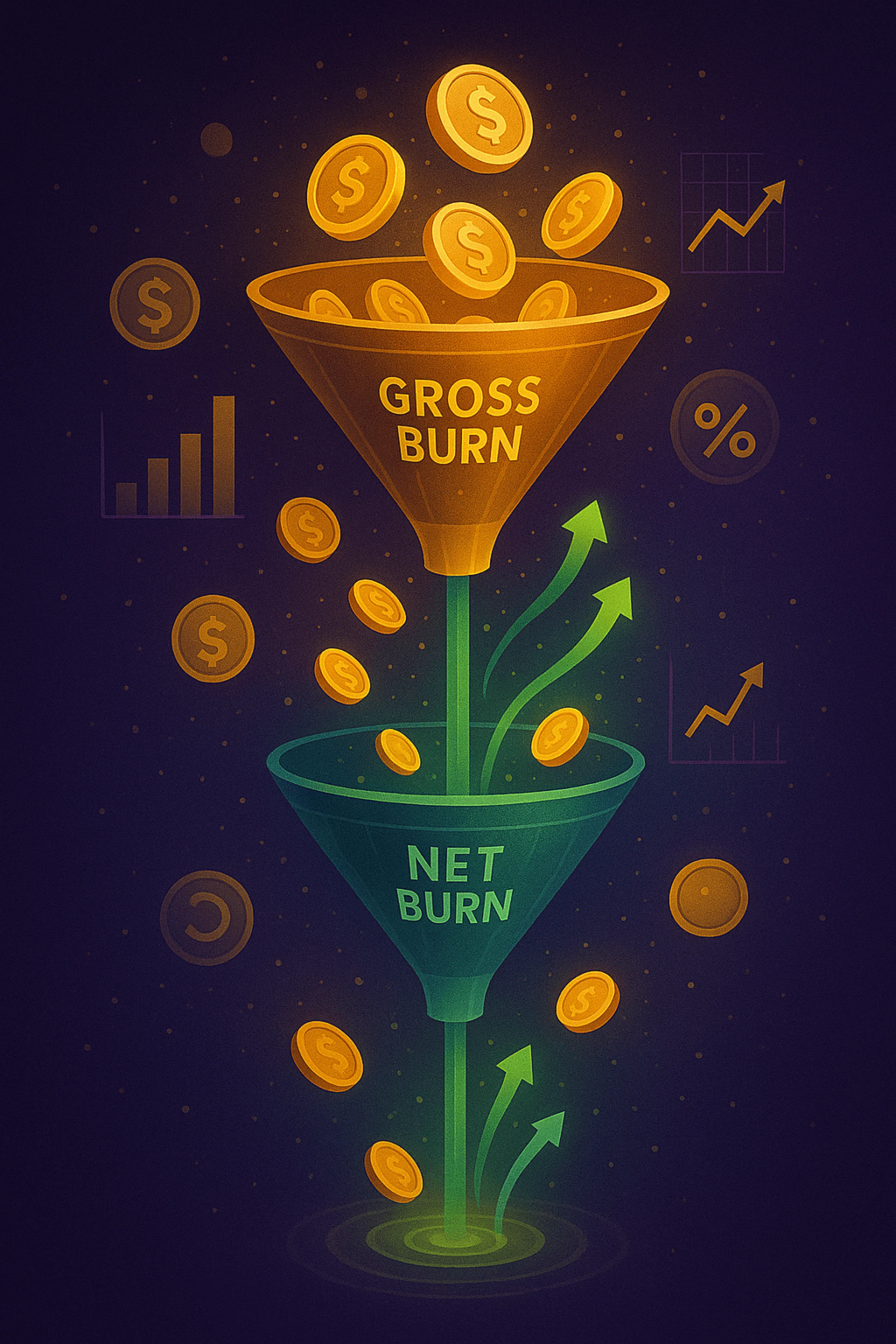
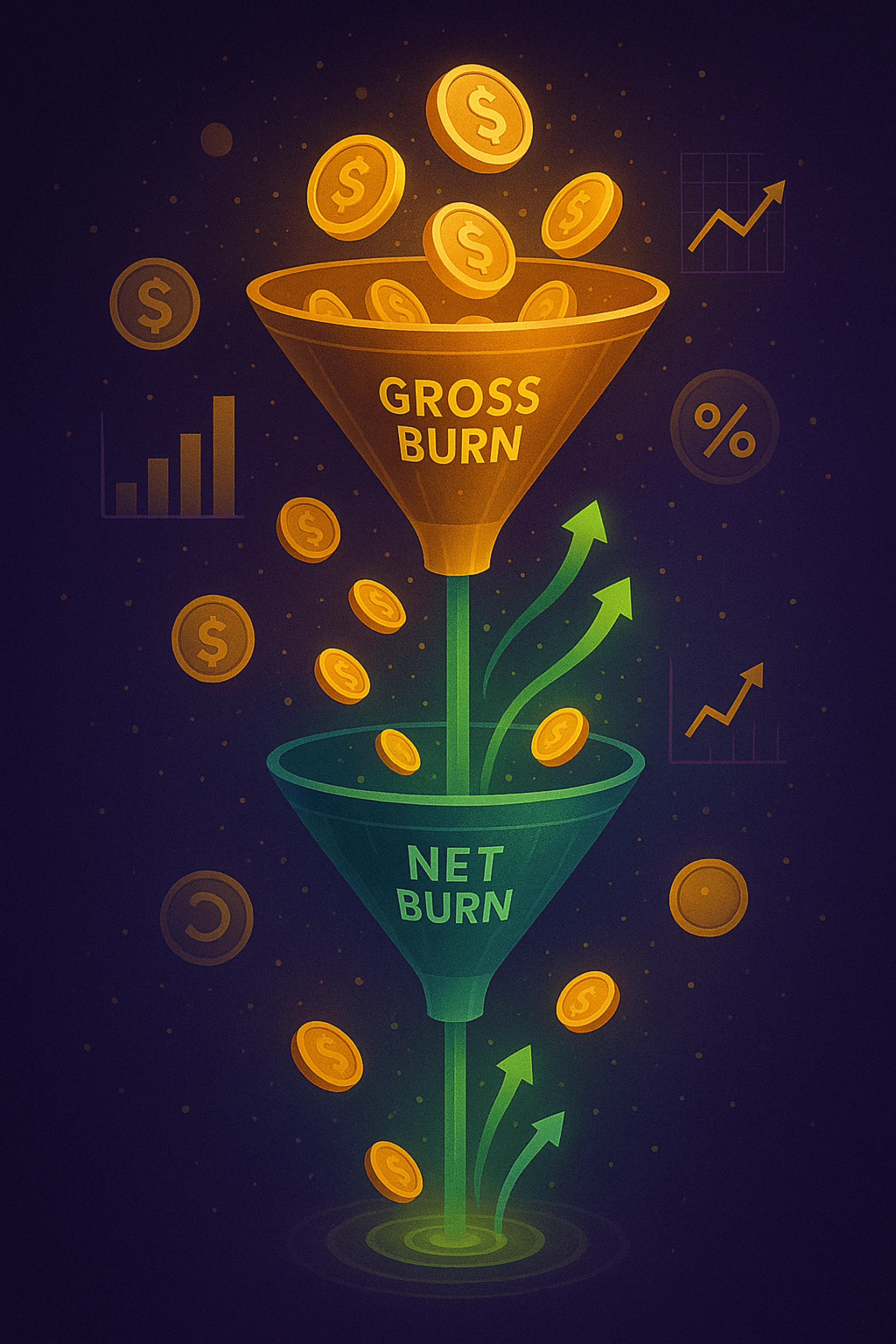
At EIM, we distinguish two sides of this equation: Gross Burn is your total monthly cash outflow before any revenue hits the books. It includes everything—payroll, rent, software tools, marketing, and taxes. Net Burn subtracts your revenue from that total. It's your actual cash loss per month. If you're making $20K a month but spending $80K, your net burn is $60K.
That difference matters because gross burn reveals operational cost structure, while net burn shows your distance from breakeven. A startup with a $50K gross burn and $15K in revenue is in far better shape than one with $35K gross burn and no revenue, even if both have the same net burn. Why? Because revenue momentum provides you with operational flexibility, unlike pure spend, which does not.
To calculate your gross burn, total up your monthly operating expenses. For net burn, subtract monthly revenue from your gross burn. Keep these numbers consistent and tracked monthly; they are more than financial trivia; they shape every strategic conversation you're going to have. Understanding burn rate forms a crucial component of the broader key financial metrics every startup founder should track, providing the foundation for making informed decisions about your startup's future.
Runway Reality Checks 📅
Once you know your burn, the next question is: how long can we last?
Runway = Cash on Hand ÷ Net Burn. This simple equation tells you how many months you've got before the money runs out. But remember: runway is a moving target. It shrinks faster than expected when unexpected costs arise or collections are delayed.
Most investors want to see at least 18–24 months of runway after a funding round. Less than that, and they worry about your planning. More than 36 months, and they'll ask if you're being aggressive enough.
What founders often miss is that runway isn't just about survival; it's about maneuvering room. If your startup's growth depends on a product iteration, a hiring push, or market timing, you need to budget for those swings. Use realistic, worst-case, and aggressive models to project the runway under different conditions.
Pro tip: Use a tool like Float to monitor real-time cash projections, or integrate burn tracking into your cloud accounting setup so you're not stuck chasing spreadsheets during a crisis.

Signs Your Burn Is Unsustainable 📉
Sometimes, startups don't crash all at once. They slowly bleed cash in ways that feel invisible, until it's too late.
The first warning sign appears when your burn is outpacing revenue growth. Even when revenue is increasing, a widening gap means your cost structure isn't keeping pace with scale. That's not growth, it's drift. Similarly concerning is when founder salaries exceed 15 percent of the total burn in the early months, which often signals misalignment. Founders deserve to be paid, but too much too soon can send the wrong signal to both investors and internal teams.
Marketing without attribution presents another critical red flag. If your ad spend isn't tied to a measurable funnel or payback model, you're not investing, you're guessing. This becomes especially dangerous when combined with a lack of visibility into unit-level burn. Without knowing how much it costs to acquire and serve each customer segment, especially when your LTV isn't validated yet, you're essentially scaling blind.
We worked with a startup whose net burn had quietly tripled in six months. It wasn't malicious; it was momentum plus fog. Once we implemented accounting services for startups, we untangled overlapping spend, renegotiated tool stacks, and found enough margin to extend the runway by five months without layoffs. You don't need heroics. You need clarity.
How to Use Burn and Runway in Fundraising Conversations 📈
Investors don't just ask for your burn rate because they're curious. It's one of the first filters they use to assess how well you know your business, and how risky your ask might be.
The questions come predictably during investor conversations. They'll ask about your current monthly burn, how many months of runway you have left, how this round extends your runway, and what milestones you'll hit before needing to raise again. Answering these clearly, with metrics and strategy aligned, builds immediate credibility.
What you don't want is to say: "We're burning $80K a month, and this raise gives us 6 months." That tells investors you're raising in panic mode. Instead, show them how your burn is tied to strategic growth drivers, and how this funding helps unlock the next phase through product launch, key hires, or GTM acceleration.
It's also smart to model how your burn will evolve post-raise. Will spending spike due to hiring? Will revenue catch up? Investors want to see that your financial statements reflect forward-looking thinking, not just historical clean-up.
"In preparing for battle, I have always found that plans are useless, but planning is indispensable." — Dwight D. Eisenhower
Treat your burn and runway projections like a living document. When they're accurate and thoughtfully presented, they stop being red flags and start becoming negotiation tools.
Book a free consultation
Whether you're preparing to raise, reorganizing spend, or trying to make your cash last longer, understanding burn rate and runway is non-negotiable. We help founders cut through the noise, track what matters, and tell cleaner financial stories that open doors.
Co-founder & Creator of Possibilities
Serving the startup community since 2018