
Feeling your heart suddenly race, flutter, pound or seem to skip a beat can be unsettling. These sensations are commonly described as heart palpitations. They can happen occasionally or repeatedly and may have many possible causes, ranging from stress and caffeine to heart rhythm abnormalities.
An ECG for palpitations is one of the first tests a healthcare professional may consider when evaluating these symptoms. An electrocardiogram records the heart's electrical activity and can provide important information about heart rate and rhythm.
However, because palpitations do not always occur continuously, a standard ECG may not capture an abnormal rhythm if it is not happening during the test.
What Are Heart Palpitations?
Palpitations are sensations of being unusually aware of your heartbeat. You may feel that your heart is:
- Racing
- Pounding
- Fluttering
- Beating irregularly
- Skipping a beat
- Beating harder than usual
Some people feel palpitations in their chest, while others may notice them in the neck or throat.
Palpitations can occur for many reasons. Possible triggers include stress, anxiety, lack of sleep, caffeine, certain medications and physical exertion. They can also occur because of an abnormal heart rhythm.
This is why persistent, recurrent or unexplained palpitations may need medical evaluation.
Why Is an ECG Used for Palpitations?
An ECG provides a snapshot of the heart's electrical activity at the time of recording.
An ECG for palpitations may help a healthcare professional assess:
- Heart rate
- Heart rhythm
- Whether the rhythm is regular or irregular
- Electrical conduction
- Certain abnormal heart rhythms
It can be particularly useful when palpitations are occurring during the ECG.
What Can an ECG Show?
A standard ECG may identify several types of rhythm abnormalities.
Abnormally Fast Heart Rate
An ECG can show when the heart is beating faster than expected during the recording. Depending on the ECG pattern, a healthcare professional may determine whether the rhythm appears to originate from a particular part of the heart.
Abnormally Slow Heart Rate
An unusually slow heart rate can also be visible on an ECG. Whether it is clinically significant depends on the individual and the circumstances.
Irregular Heart Rhythm
Some arrhythmias produce an irregular pattern that can be identified on an ECG.
For example, an ECG may help detect atrial fibrillation when it is occurring during the recording.
Premature Beats
Some people experience occasional extra or early heartbeats. These can sometimes be identified on an ECG when they occur during the test.
Conduction Abnormalities
An ECG can also provide information about how electrical signals travel through the heart and may reveal certain conduction problems.
What If the Palpitations Stop Before the ECG?
This is one of the limitations of a standard ECG.
A typical ECG records the heart's electrical activity for a short period. If your palpitations happen only occasionally, your heart rhythm may appear normal during the appointment.
For example, you might experience palpitations several times during the week but have no symptoms during a brief ECG.
In this situation, a normal ECG does not necessarily mean that nothing is wrong. Your doctor may recommend additional monitoring.
What Other Tests Can Monitor Heart Rhythm?
If palpitations are intermittent, longer-term cardiac monitoring may be useful.
Holter Monitoring
A Holter monitor records heart activity continuously over a longer period. It may be recommended when symptoms occur frequently but are not present during a standard ECG.
Event Monitoring
An event monitor may be used for symptoms that occur less frequently. Depending on the device, the patient may activate the monitor when symptoms occur.
Other Cardiac Investigations
Depending on the symptoms, medical history and initial findings, a doctor may recommend additional tests such as blood tests or an echocardiogram.
The appropriate investigation depends on the individual.
When Should You Get an ECG for Palpitations?
Speak with a healthcare professional if palpitations are:
- New or unexplained
- Happening repeatedly
- Becoming more frequent
- Lasting longer than usual
- Associated with dizziness
- Associated with breathlessness
- Affecting your ability to perform normal activities
Your doctor can determine whether an ECG for palpitations or another heart rhythm test is appropriate.
When Are Palpitations an Emergency?
Palpitations are not always dangerous, but they require urgent attention when accompanied by certain symptoms.
Seek emergency medical care if palpitations occur with:
- Chest pain or pressure
- Severe difficulty breathing
- Fainting or loss of consciousness
- Severe dizziness
- Sudden severe weakness
- Significant or rapidly worsening symptoms
Do not wait for a scheduled ECG or home cardiac monitoring appointment in these situations.
Can You Get an ECG for Palpitations at Home?
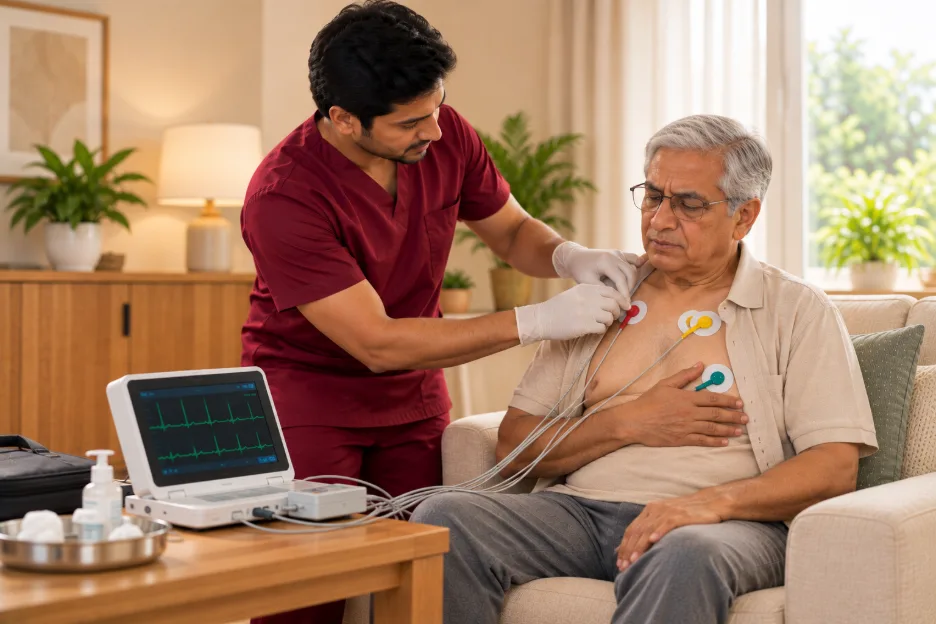
For some medically stable patients, a planned ECG can be performed at home by a trained healthcare professional.
A home ECG may be convenient for older adults, people with limited mobility or patients who find travelling to a diagnostic centre difficult.
The process generally involves:
- Positioning the patient comfortably.
- Preparing the skin.
- Placing ECG electrodes correctly.
- Recording the heart's electrical activity.
- Reviewing the recording appropriately.
However, a home ECG is not a substitute for emergency medical assessment.
How to Prepare for an ECG Heart Rhythm Test
A standard ECG heart rhythm test usually requires little preparation.
Before the test:
- Wear comfortable clothing that allows access to the chest.
- Avoid applying oils or creams where electrodes will be placed.
- Take prescribed medication unless your doctor has instructed otherwise.
- Inform the healthcare professional about your symptoms and medications.
- Try to remain relaxed and still during the recording.
If possible, keep a note of when your palpitations occur, how long they last and what you were doing at the time. This information can be useful during your consultation.
What Does a Normal ECG Mean?
A normal ECG means that no significant abnormality was identified in the recording at that particular time.
However, it does not necessarily rule out every possible cause of palpitations.
Some rhythm abnormalities are intermittent and may not occur during the ECG. Others may require additional tests for proper evaluation.
Therefore, if you continue to experience unexplained palpitations despite a normal ECG, discuss the symptoms with your healthcare professional.
Conclusion
An ECG for palpitations can provide valuable information about heart rate, rhythm and electrical activity. It may identify certain arrhythmias, irregular rhythms, premature beats and conduction abnormalities when they are present during the recording.
However, a standard ECG is only a brief snapshot of ECG heart rhythm. If palpitations occur intermittently, longer-term cardiac monitoring may be needed to capture the rhythm during an episode.
If palpitations are accompanied by chest pain, severe breathlessness, fainting or significant dizziness, seek urgent medical attention rather than waiting for a routine ECG test.