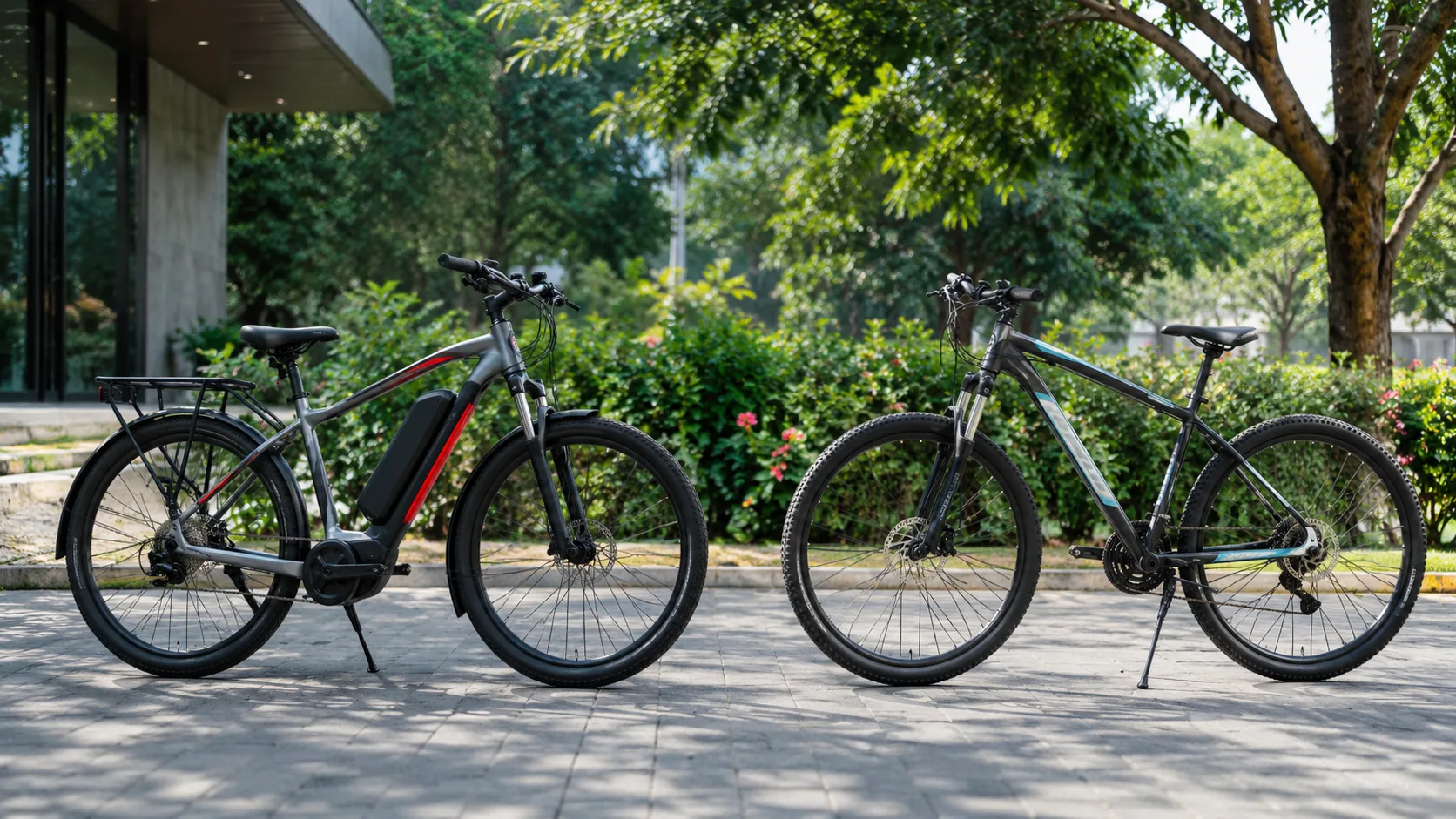
In Germany last year, more than half the bikes sold had a motor. E-bikes took 52.7% of unit sales in 2025, and the average one sold for about €2,550. A bike without a motor averaged around €500. So the first question in any e-bike vs regular bike decision is a blunt one: is the motor worth roughly five times the money?
I've watched people make this call the way they buy cars, on sticker price and gut feel. Neither helps much here. The running costs work differently, the fitness argument cuts the opposite way to what most people assume, and the practical side depends more on your stairs and your commute than on the bike.
What you pay up front
The gap holds outside Germany. In the Netherlands, the average e-bike sold for €2,872 in 2025. Germany's national cycling club suggests about €500 as a sensible floor for an everyday bike and at least €1,800 for an e-bike that will be reliable and last. The bargain end of the e-bike market is where most of the risk sits, for reasons I'll get to.
Before you pay full price, check whether your employer runs a bike scheme. In the UK, Cycle to Work takes the cost out of your gross pay, so a basic rate taxpayer skips 20% income tax and 8% National Insurance on it. Read the end-of-hire terms, because that's where some of the saving leaks back out. Germany has about 2.2 million bikes on company leasing deals.
Running costs: cheap power, expensive battery
Electricity barely matters. A 500Wh battery holds half a kilowatt-hour. At 30 cents per kWh, a full charge costs about 15 cents, a little more once charger losses are counted. Charge it every working day and you're still paying a few dollars a month.
The real fuel bill is battery wear. Most lithium-ion packs last 500 to 1,000 full charge cycles, which works out to roughly three to five years, and replacements run from about $300 to over $1,200. In the UK, a Bosch 625Wh PowerTube costs around £770. Spread a $600 battery across 800 cycles and you're paying about 75 cents of battery for every full charge, five times the electricity. Budget for it the way you'd budget for tyres on a car.
Wear parts add up too. E-bikes are heavier and faster, so brake pads, chains and tyres go sooner. One large e-bike reseller's service guide puts chain life at 2,000 to 3,000 miles on a regular bike and as little as 1,000 to 2,000 on an e-bike. In the US, a basic e-bike service runs about $100 to $200, and a full one with electrical checks $200 to $400. Any bike shop can do mechanical work, but motor and battery repairs usually need an authorised dealer. That's the same trap as a car you can only get fixed at the main dealer.
A regular bike has none of this. Chains, cables and tyres are cheap, every shop can fix it, and nothing on it has a three-to-five-year expiry date.
Fitness: the motor doesn't make you lazy
A systematic review of 17 studies with about 300 participants found e-cycling gives physical activity of at least moderate intensity. That's lower than regular cycling but higher than walking, and there was moderate evidence it improves cardiorespiratory fitness in people who were inactive before.
The bigger finding comes from a European study of more than 10,000 people across seven cities. Weekly physical activity was about the same for e-bikers and regular cyclists, 4,463 MET minutes against 4,085. The reason is distance. E-bikers' trips averaged 9.4 km, against 4.8 km for cyclists on ordinary bikes. People who switched to an e-bike from a car gained about 550 MET minutes a week, and those who switched from public transport gained around 800. People who swapped a regular bike for an e-bike lost roughly 200.
Per minute, a regular bike is the better workout. Over a week, the better workout is the bike you'll actually ride. If an e-bike replaces car trips, it's a clear fitness win. If it replaces a bike you already ride daily, you'll give up a little, but less than you'd think.
Practicality: where each one wins
The e-bike wins on longer commutes, hills, hot weather, carrying kids or shopping, and turning up to work without needing a shower. That extra reach is what turns it into a genuine car replacement for a lot of people, in my view.
The regular bike wins on almost everything to do with ownership. It's lighter to carry up stairs or onto a train, easier to store in a flat, less tempting to thieves, never needs charging and keeps working when nobody stocks your bike's battery anymore.
Then there are the rules, which vary by market. In the EU, a pedelec's motor is capped at 250W and assistance must cut out at 25 km/h. Within those limits it's treated as a bicycle in most member states, so there's no registration, compulsory insurance or licence.
The UK uses the same 250W limit, with assistance cutting out at 15.5 mph. Riders must be 14 or older, and a bike that can be propelled without pedalling, a twist-and-go, is classed as a moped.
In the US, the federal definition covers motors under 750W with a top motor-only speed under 20 mph. Most states use a three-class system, with Class 3 pedal assist running to 28 mph, but where you're allowed to ride differs by state.
Derestricting a bike to go faster can take it out of the bicycle category entirely. Then you're riding an unregistered, uninsured motor vehicle.
The battery is the part to respect
In New York, lithium-ion battery fires killed 18 people in 2023, six in 2024 and one in 2025, according to the city's fire department. By late October 2026, the toll for this year had already reached nine. A senior FDNY official has said he believes many of these fires came from batteries near the end of their life.
That ties straight back to running costs. An ageing, swollen or knock-off battery is a safety problem as much as a range problem. New York City requires e-bikes sold there to be certified to UL 2849, with batteries certified to UL 2271. In Europe and the UK, look for compliance with EN 15194. Use the charger the bike came with, don't charge overnight, and keep the bike out of your only escape route at home.
How to choose
If your regular trip is around 5 km, mostly flat, and you live up three flights of stairs, a good regular bike is the smarter buy and will cost you little to run. If it's longer, hilly, hot, or a trip you'd otherwise drive, the e-bike is worth the extra money, because every car trip it replaces saves you fuel, parking and wear. Put aside money for a battery from day one.
Either way, test ride your actual route before you buy, check your employer's scheme, and walk away from any cheap e-bike that can't show you its certification. If the budget won't stretch to a decent e-bike, a well-kept used regular bike beats a bargain one with a mystery battery.
FAQs
1. Is an e-bike more expensive to run than a regular bike?
Electricity is cheap, about 15 cents for a 500Wh charge at 30 cents per kWh. The bigger costs are battery wear and faster-wearing chains, brakes and tyres, plus pricier servicing. A regular bike uses cheap parts that any bike shop can fit, so it costs less to run.
2. Do you get a real workout on an e-bike?
Yes. A review of 17 studies found e-cycling gives at least moderate-intensity exercise, lower than a regular bike but higher than walking. A study of over 10,000 people in seven European cities found e-bikers got similar weekly activity to cyclists because they rode further.
3. How long does an e-bike battery last and what does a new one cost?
Most lithium-ion e-bike batteries last 500 to 1,000 full charge cycles, roughly three to five years. Replacements usually cost about $300 to over $1,200 depending on size and brand. Plan for it from day one and use only the original charger and approved packs.
4. Do I need a licence or insurance to ride an e-bike?
Not for a standard e-bike in the EU or UK if the motor is 250W and assistance stops at 25 km/h, or 15.5 mph in the UK. UK riders must be 14 or over. US rules vary by state, using a federal 750W limit and a three-class system. Derestricted bikes count as motor vehicles.
5. Is a regular bike or an e-bike better for commuting?
It depends on distance, hills and storage. For a flat trip of around 5 km with stairs at home, a regular bike is cheaper and easier to live with. For longer, hilly or hot commutes, or trips you would otherwise drive, an e-bike makes more sense and replaces more car journeys.
For more such engaging reads, visit AutoVoB.