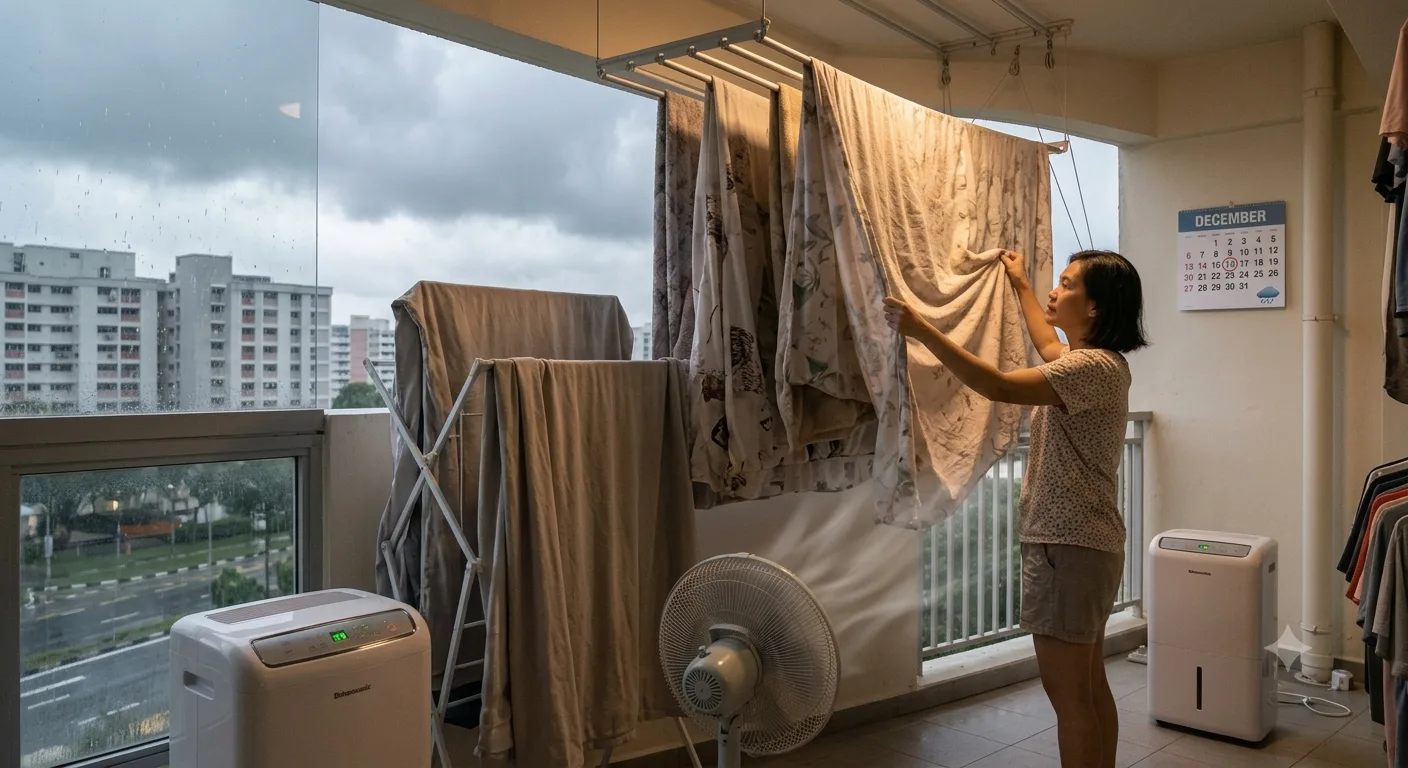
Everyday clothing dries reasonably well on most standard racks, even basic manual ones, but bulky items like bedsheets, duvet covers, curtains, and blankets present a genuinely different challenge that catches a lot of households off guard, particularly those without a tumble dryer, which is the norm rather than the exception in most Singapore homes.
The core problem with bulky items is surface area and airflow. A folded or bunched bedsheet traps moisture in the layers pressed against each other, drying unevenly with damp patches persisting long after the exposed surface feels dry to the touch. Unlike a t-shirt, which has a simple, thin, flat shape that air moves across easily, a large sheet or heavy blanket needs to be spread out with genuine airflow reaching multiple layers, which a standard small rack or a few pegs simply cannot provide.
Pole length and spacing matter more for bulky items than for regular clothing, which is why households that regularly deal with large linens, particularly families with children who go through bedding changes more often, benefit from racks with longer, wider pole spans rather than the compact configurations sized mainly for everyday clothing. A king-size bedsheet needs enough pole length to drape without excessive bunching, and enough spacing between poles to allow air to actually circulate around the fabric rather than trapping moisture between overlapping layers.
Heat assistance becomes particularly valuable for bulky items specifically because passive air-drying alone struggles with the trapped-moisture problem in thick or layered fabric. A heater running at a controlled, fabric-safe temperature accelerates evaporation from the inner layers of a folded sheet or blanket in a way that fan-only airflow alone often cannot fully achieve within a reasonable timeframe, which is why bulky items dried on fan-only settings sometimes still feel slightly damp at the folds even after the exposed surface has long since dried.
Load capacity is worth checking specifically for households that regularly wash large items, since heavier fabric, particularly a soaked winter-weight blanket or a thick duvet cover, adds meaningfully more weight to a rack than a typical laundry load of clothing. Confirming a rack's stated maximum lifting load before assuming it comfortably handles bulky items is worth doing, rather than discovering a capacity issue after the fact.
Curtains present their own specific quirk worth mentioning separately, since they are often long, narrow, and prone to creasing if bunched on a standard pole rather than hung more like a garment. Some households find draping curtains lengthwise across two adjacent poles, rather than folding them over a single pole the way a towel would hang, reduces creasing and improves airflow around the fabric considerably.
For households that regularly deal with bulky laundry, whether from a growing family, frequent guest bedding changes, or simply larger household linens generally, it is worth specifically discussing pole configuration, spacing, and load capacity with a supplier rather than assuming any standard rack handles bulky items equally well. GoodLiving's models with extended pole capacity were built partly with this exact scenario in mind, offering the wider spacing and load capacity that everyday clothing-focused racks are not necessarily designed around.