The loss of a mature pine tree is a significant blow to a property's value and safety. In Southeast Texas, the primary cause of sudden pine death is the bark beetle. These insects do not just feed on the tree; they systematically dismantle its vascular system. Most property owners only notice the damage once the canopy turns rust-orange, but by then, it is often too late. Success in pine bark beetle treatment depends on a scientific understanding of the beetle’s life cycle and the tree’s defense mechanisms. We believe that an objective, data-driven approach to forest health is the only way to mitigate the risk of a total canopy collapse.
Mechanical Failure: How Beetles Kill a Pine
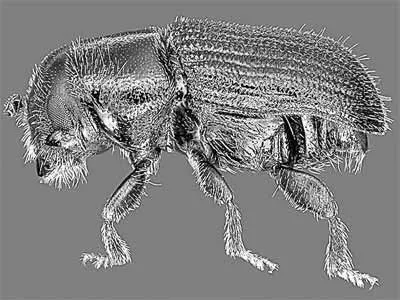
Bark beetles are tiny, but their impact is purely structural. They target the cambium—the thin layer of living tissue between the bark and the wood. This layer is the tree's "highway" for water and nutrients. As beetles tunnel, they create "galleries" that physically sever these pathways. According to the USDA Forest Service, this process effectively "girdles" the tree. Once the flow of water to the needles is cut, the tree’s internal temperature rises, leading to rapid cellular death. This is why a "green" tree can be structurally dead weeks before the needles change color.
Field Diagnostics: Identifying Pitch Tubes and Frass
Early detection requires looking for "pitch tubes." These are small, white or reddish clumps of resin that look like popcorn on the bark. They are the tree’s attempt to "flush out" the invaders. However, during a Texas drought, a tree lacks the internal pressure to produce enough resin. Another indicator is "frass"—a fine, reddish-brown sawdust found in bark crevices or at the base of the trunk. This is the byproduct of the beetle’s boring activity. If you see these signs on more than 50% of the trunk, the tree’s structural integrity is likely compromised.
Systemic Intervention vs. Topical Sprays
Effective pine bark beetle treatment has evolved beyond simple bark sprays. Topical chemicals are easily washed away by rain and rarely reach the larvae hidden deep within the wood. We prioritize systemic trunk injections. This method involves injecting high-potency insecticides directly into the tree's sap stream. The tree then carries the treatment upward, killing the beetles from the inside out. Data from the Texas A&M Forest Service shows that systemic treatments provide a much higher survival rate for high-value "heritage" pines compared to traditional methods.
Sanitation and the Physics of Tree Removal
When a tree cannot be saved, it becomes a biological hazard. A dead pine is a "brood tree" that can house over 100,000 beetles per acre. These beetles will eventually migrate to your healthy timber. Furthermore, a dead pine becomes brittle very quickly. This increases the risk of "trunk snap" during wind events. Professional removal in these cases is a matter of "sanitation." We use precision rigging to remove infested wood safely. This prevents the release of pheromones that attract more beetles to your property. Proper disposal of the wood is the final, essential step in stopping the spread.
The Czar’s Promise: Veteran-Owned Accountability
At The Lone Star Tree Czar, we approach forest health with the same discipline we learned in the military. We don't believe in "guessing" when it comes to your property's safety. We provide objective, technical assessments to determine exactly which trees need help and which need to go. Our reputation is built on honesty and a "results-first" mindset. Our guarantee is clear: you don't pay a single cent until the job is done and you are 100% satisfied. We handle the technical risks and the heavy lifting so you can keep your property safe.
[Request a Technical Inspection Today]
Expert FAQ: Managing the Spread
Q1: Can I save a pine tree once the top turns brown?
No. Once the crown turns brown, the vascular system has failed entirely. At this stage, the tree is a fire hazard and a source for further infestation; immediate removal is the only objective solution.
Q2: Do healthy trees get attacked by bark beetles?
Yes, but they are much better at defending themselves. A healthy tree can "pitch out" the beetles with resin. Most attacks occur on trees stressed by drought, construction, or soil compaction.
Q3: Is the treatment safe for my pets and lawn?
Systemic injections are the safest option because the chemical stays inside the tree. There is no "overspray" or runoff that can affect your family or local wildlife.
Q4: How often should I treat my pines?
Preventative injections typically last two years. However, we recommend a visual inspection every six months during the peak beetle seasons of spring and summer.
Q5: Will the beetles move to my oaks or maples?
No. Pine bark beetles are species-specific. They will only attack pines. However, different beetle species target oaks, so a diverse canopy is your best long-term defense.