Every business owner or facility manager eventually faces the frustration of a leaking, slamming, or sticking commercial door. This failure rarely stems from the door itself, but rather from a mismatch between the hardware grade and the foot traffic it endures.
Selecting the wrong hardware can lead to constant maintenance costs and compromised building security. The industry uses a specific rating system to prevent these failures, but many buyers remain confused by the technical jargon.
Understanding the rigorous standards behind Grade 1 door closer technology allows for a "set-it-and-forget-it" installation. By choosing a high-cycle, heavy duty hardware solution, a facility can ensure ADA compliance and long-term durability while avoiding the "cheap hardware trap."
Read this in-depth comparative analysis to demystify the ANSI/BHMA standards and discover why upgrading to a door closer heavy duty system is the most cost-effective decision for any high-traffic environment.
Understanding the Standard: What is ANSI/BHMA?
The performance of commercial grade door hardware is governed by the American National Standards Institute (ANSI) and the Builders Hardware Manufacturers Association (BHMA). These organizations establish the benchmarks for operation, cycle life, and strength. When a product is labeled as "Grade 1" or "Grade 2," it has undergone standardized cycle testing to prove its endurance.
For a surface mounted door closer, these tests are grueling. They involve mechanical arms opening and closing the hardware hundreds of thousands of times under tension to simulate years of real-world use. The goal is to identify at what point the springs fatigue, the seals leak, or the valves lose their adjustment.
The Core Differences: Grade 1 vs. Grade 2
The primary distinction between these two grades lies in their longevity and weight capacity. While both are used in commercial settings, their internal architecture differs significantly.
Grade 1: The Industrial Standard
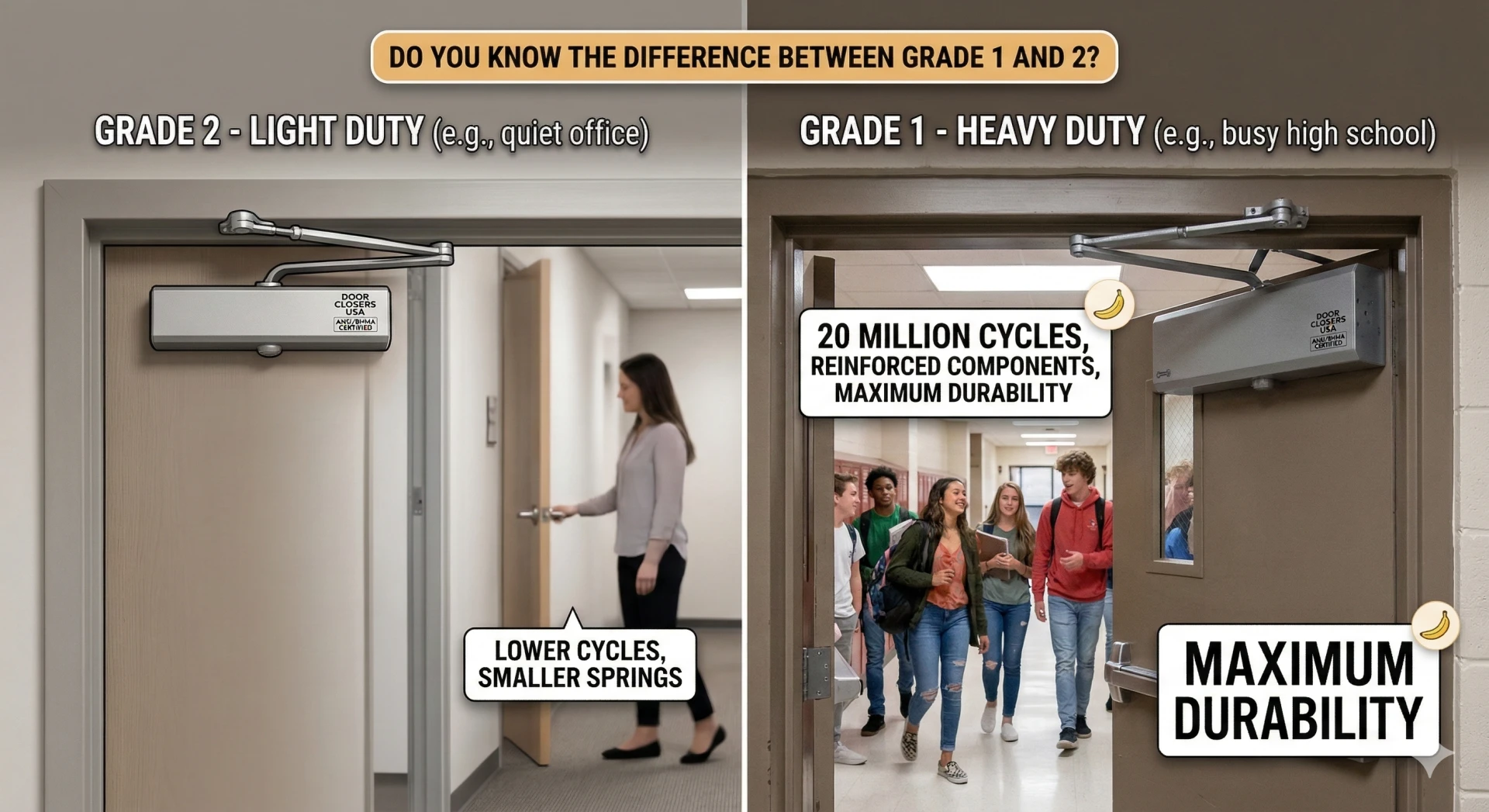
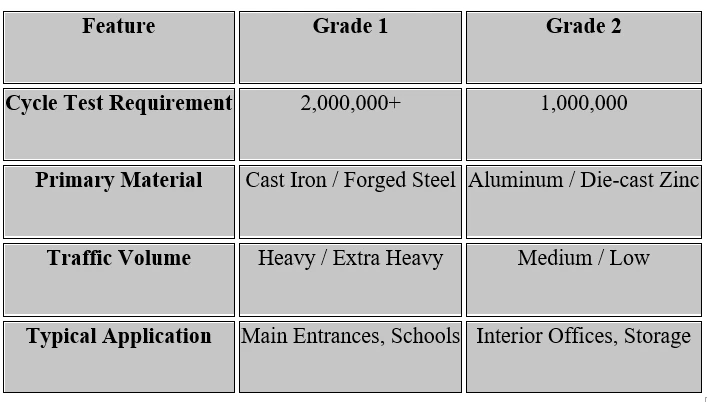
A Grade 1 door closer is the highest rating achievable. To earn this title, the hardware must successfully complete 2,000,000 cycles without failure. This grade is engineered for the most demanding environments, such as hospital entrances, schools, and busy retail storefronts. These units often feature forged steel arms and cast-iron bodies to withstand high internal pressures.
Grade 2: The Light-Duty Alternative
Grade 2 hardware is designed for 1,000,000 cycles. While one million sounds like a substantial number, in a high-traffic entrance that opens 500 times a day, a Grade 2 closer will reach its theoretical limit in less than six years. In contrast, a Grade 1 unit would last over a decade under the same stress. Grade 2 is generally reserved for interior office doors or storage closets where use is infrequent.
Technical Superiority: Door Closer Grades and Size
When evaluating door closer grades and sizes, it is important to consider the "Spring Power" or "Size" range. Most Grade 1 models are "Adjustable Sizes 1-6." This versatility is crucial for Grade 1 door closer adjustment, as it allows the technician to fine-tune the closing force based on the door's weight and the presence of HVAC stack pressure.
Lower-grade closers often have limited adjustment ranges, making them difficult to calibrate for ADA (Americans with Disabilities Act) requirements. A Grade 1 door closer adjustment parts kit is built to withstand high-torque tuning, ensuring that the door remains easy to push open for accessibility while still latching securely against heavy wind or latch bolts.
Why Grade 1 is the Superior ROI Choice?
While Grade 2 hardware has a lower upfront purchase price, it often becomes a liability for commercial properties.
Maintenance Costs: Grade 2 units are prone to "O-ring" failure and hydraulic fluid leaks when over-worked. Replacing a closer every three years costs more in labor and downtime than installing a Grade 1 unit once.
Security Risks: If a closer fails to latch due to a fatigued spring, the building remains unlocked. Heavy-duty hardware ensures the door hits the "latch point" every single time.
Vandalism Resistance: High-traffic areas are prone to abuse. People often pull doors closed or kick them open. The internal valves in a door closer heavy duty model are designed to bypass fluid during these spikes in pressure, preventing the unit from exploding or leaking.
Best Use Cases: When to Choose Each?
Property managers must evaluate the specific needs of each opening before purchasing.
Use Grade 1 for: Exterior doors, fire-rated doors, hallways, gymnasiums, and any entrance used by the general public. These require the durability of commercial-grade door hardware to maintain safety codes.
Use Grade 2 for: Individual office doors, mechanical rooms with restricted access, or small residential-style apartment entries.
For those managing facilities where security and code compliance are non-negotiable, a surface mounted door closer with a Grade 1 rating is the only logical choice. It provides the necessary force to close heavy steel or glass doors while offering the precision required for delicate Grade 1 door closer adjustment.
Invest in Longevity with Door Closers USA
The difference between Grade 1 and Grade 2 is the difference between a long-term asset and a recurring expense. While Grade 2 serves a purpose in quiet, low-traffic areas, the Grade 1 door closer remains the gold standard for any business that values security, durability, and cost-efficiency. By prioritizing heavy duty hardware, facility managers protect their property from the risks of mechanical failure and frequent replacements.
Door Closers USA specializes in providing these high-performance systems to businesses nationwide. Whether the requirement is for a single replacement part or a custom-built, ADA-compliant entry system, their inventory focuses on the durability required for American commerce.
Would you like a personalized consultation to determine the exact hardware specifications for your high-traffic entrances? Contact Door Closers USA today to secure your facility with Grade 1 reliability.