
SSL certificate automation has made it easier for businesses to secure websites without manually handling every issuance and renewal. However, managing domain validation across multiple websites and servers can still create operational challenges.
One common approach is DNS-01 validation, which uses DNS TXT records to prove domain ownership. While effective, it often requires repeated DNS updates whenever a new validation challenge is initiated.
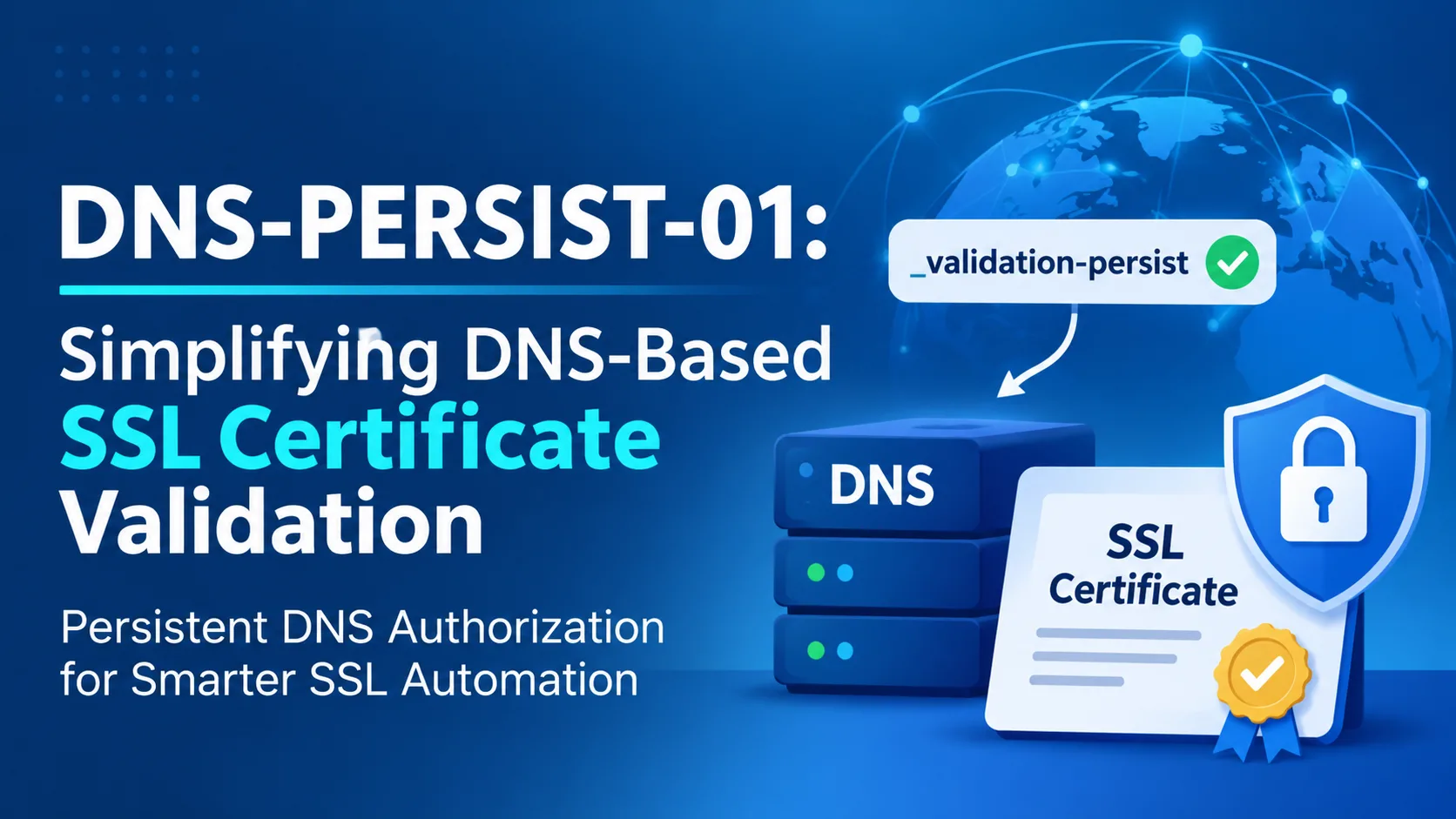
DNS-PERSIST-01 introduces a different approach by allowing domain owners to establish persistent DNS authorization for a particular Certificate Authority (CA) and ACME account. This can reduce repetitive DNS management and simplify certain automated certificate workflows.
Let's explore why this approach matters and how it can benefit modern certificate management.
Why DNS Validation Can Become Difficult to Manage
DNS-01 validation is commonly used when issuing wildcard SSL certificates or securing servers that cannot complete HTTP-based validation.
During a traditional DNS-01 challenge, an ACME client generates a unique validation value and publishes it as a TXT record under the _acme-challenge DNS label.
The CA checks this record to verify domain ownership before proceeding with certificate issuance.
Although automation tools can handle these operations, several challenges remain:
- Repeated DNS changes: New validation requests generally require publishing fresh TXT records.
- API credential management: Automated systems often need DNS provider API credentials to modify records.
- Propagation delays: DNS changes may take time to become visible to the validating CA.
- Concurrent renewals: Multiple certificate requests can create conflicts if DNS records are not managed properly.
- Administrative overhead: Enterprise teams may need approval before making DNS changes.
These challenges become more noticeable when managing certificates across hundreds of domains and applications.
How DNS-PERSIST-01 Changes the Validation Process
DNS-PERSIST-01 introduces persistent DNS authorization as an alternative to repeatedly publishing temporary challenge records.
It uses a TXT record under the _validation-persist DNS label. This record associates authorization with a specific CA and ACME account.
For example, an illustrative DNS record may look like this:
_validation-persist.example.com. IN TXT ( "authority.example;" "accounturi=<CA-generated-account-hash>" )
The actual record format must follow the applicable protocol specification and CA implementation. This example should not be used directly in production.
Once the record is configured and accepted by a compatible CA, the authorization may be reused for eligible certificate requests.
This means administrators do not necessarily need to create a new challenge-specific DNS record for every subsequent validation.
Importantly, persistent authorization is not unlimited permission to issue certificates. The CA must still enforce its account, authorization, and certificate issuance policies.
What Makes DNS-PERSIST-01 Useful for SSL Automation?
Persistent authorization can provide several advantages for organizations operating automated certificate management systems.
1. Reduced DNS Management
Administrators can avoid repeatedly creating and deleting challenge-specific TXT records when existing persistent authorization is accepted.
2. Simplified Certificate Renewals
Automated renewal systems can benefit from an authorization mechanism that does not require a new DNS challenge record for every eligible request.
3. Fewer Recurring DNS API Operations
Organizations may be able to reduce the frequency of DNS provider API operations associated with traditional challenge management.
4. Better Management Across Multiple Domains
Businesses managing extensive domain portfolios can benefit from a more streamlined approach to authorization management.
5. Support for Wildcard Certificate Workflows
Persistent authorization can also support wildcard certificate validation when the applicable authorization scope and CA implementation permit it.
Understanding Authorization Expiration
Persistent authorization does not necessarily remain valid indefinitely.
The persistUntil parameter can specify an expiration timestamp, where supported by the applicable implementation.
This value uses a UNIX timestamp represented in seconds.
Administrators should monitor authorization expiration dates, configure alerts, and renew or replace records according to their security requirements.
It is also important to understand that expiration of persistent authorization does not automatically revoke certificates that have already been issued.
Security Practices for Persistent DNS Authorization
Although DNS-PERSIST-01 can simplify certificate operations, persistent authorization must be protected carefully.
Organizations should follow these practices:
- Protect ACME account private keys and credentials.
- Restrict access to DNS authorization records.
- Monitor unexpected changes to persistent TXT records.
- Avoid granting unnecessary DNS management permissions.
- Review authorization scope, especially for wildcard certificates.
- Remove authorization records that are no longer required.
- Maintain an incident response process for compromised accounts.
These measures help reduce the risks associated with unauthorized certificate issuance and DNS changes.
Is DNS-PERSIST-01 Suitable for Your Infrastructure?
DNS-PERSIST-01 is worth evaluating if your organization manages multiple websites, frequent certificate renewals, wildcard certificates, or automated ACME deployment pipelines.
However, organizations with smaller certificate inventories may find traditional DNS-01 validation sufficient.
Before adopting this approach, verify that your Certificate Authority and ACME client support the required validation method. Existing DNS-01 compatibility does not automatically guarantee DNS-PERSIST-01 support.
Testing in an appropriate staging environment before production deployment is also recommended.
Conclusion
Managing SSL certificates efficiently requires more than automating issuance and renewal. Domain validation, DNS permissions, account security, and authorization management are equally important.
DNS-PERSIST-01 offers an alternative to repeated DNS challenge updates by introducing persistent authorization associated with a specific CA and ACME account.
For organizations managing large certificate infrastructures, this approach could reduce operational overhead and simplify eligible automated validation workflows.
If you want to understand the technical configuration, DNS record structure, wildcard authorization, and implementation considerations in greater detail, explore this guide: DNS-PERSIST-01 Explained: How It Works and How to Set It Up.