There’s a point in sourdough baking where effort stops being the problem.
You’ve followed the recipe. You’ve mixed properly. You’ve waited. You’ve baked carefully. But the result still feels inconsistent.
Sometimes the loaf is perfect. Sometimes it’s flat, dense, or over-proofed. And most bakers assume it’s a technique.
In reality, it’s often something much simpler that gets ignored: temperature.
Not room temperature in general terms, but actual dough temperature at each stage of the process.
At The Sourdough Science, this is something Roberto has seen repeatedly. Once bakers start measuring temperature properly, their results stop feeling random.
The problem most bakers don’t see
Sourdough is sensitive. Small temperature changes affect fermentation more than most people realize.
Two identical doughs can behave completely differently if:
- One is 2–3°C warmer
- One is mixed with warmer water
- One sits in a slightly warmer kitchen
The issue is that none of this is visible. So bakers end up adjusting everything except the actual cause.
That’s where frustration builds.
You don’t need more steps. You need clearer information.
Why temperature changes everything
If you want consistency, temperature quietly controls most of it.
It affects:
- How fast does fermentation move
- How much strength does the dough develop
- How predictable your timing becomes
- Even the final texture of the bread
When the temperature is off, everything else becomes harder to control.
That’s why experienced bakers pay attention to it early in the process, not just at the end.
The final dough temperature is where things usually go wrong
Most bakers focus on timing. But fermentation doesn’t care about your schedule.
It responds to temperature.
Final Dough Temperature (FDT) is simply the temperature of your dough right after mixing. That number determines how your dough behaves over the next few hours.
If it’s too warm, fermentation moves too fast and becomes unpredictable.
If it’s too cold, everything slows down and feels underdeveloped.
Getting this right makes everything downstream easier.
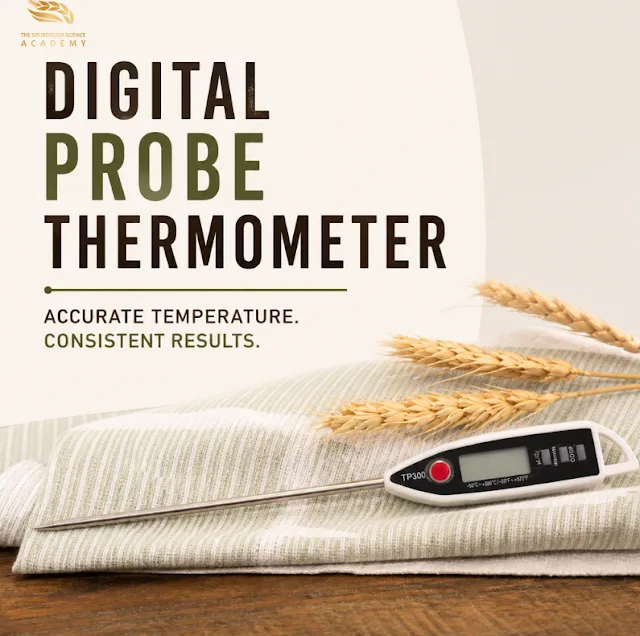
Where the Digital Probe Thermometer fits in
The Digital Probe Thermometer is not about adding gear to your kitchen.
It’s about removing guesswork from the stages that matter most, especially when using the Digital Probe Thermometer.
You use it at the points where decisions actually matter:
- Water before mixing
- Dough after mixing
- During fermentation checks
- Internal bread temperature when baking
It gives you a number instead of a feeling. That small shift changes how you approach the whole process.
What changes when you actually measure
Most bakers don’t expect temperature to make a big difference until they try it.
Then a few things become obvious:
- Fermentation timing stops feeling unpredictable
- Dough development becomes easier to judge
- You stop second-guessing whether things are “going right”
- You start repeating good results instead of chasing them
It’s not a dramatic change. It’s a quiet one. But it’s consistent.
How to actually use it in a simple way
Nothing complicated here.
Start with three moments:
1. Water temperature before mixing
This is the easiest way to control your final dough temperature.
2. Dough temperature after mixing
This tells you whether your process is landing where you expect it to.
3. Internal temperature when baking
This removes guesswork from “is it done yet?”
Over time, you start noticing patterns. That’s where learning happens.
Why most bakers stay stuck without realizing it
It’s not lack of skill.
Most people are already trying different flours, timings, hydration levels, folding techniques.
But without temperature data, every change feels disconnected. You can improve something in one area and accidentally break another.
Temperature gives context to everything else.
Without it, you’re adjusting blind spots.
What experience actually means in sourdough
Experience isn’t just baking more loaves.
It’s understanding why your dough behaves the way it does.
At The Sourdough Science, Roberto’s approach is simple: remove as much uncertainty as possible, then observe what remains.
Temperature is one of the few variables that consistently explains the difference between a good bake and an unpredictable one.
Why this tool is used in practice, not theory
A tool only matters if it changes decisions in real time.
The Digital Probe Thermometer does that because it gives immediate feedback.
No waiting. No guessing. Just a reading you can act on.
That’s useful when dough is moving fast and timing matters.
A practical shift you can make immediately
If you want a starting point, don’t change your entire process.
Just begin tracking:
- Water temperature before mixing
- Dough temperature after mixing
- Bread internal temperature at bake
That alone will show you more about your process than most recipe changes ever will.
Where consistency actually comes from
Consistency doesn’t come from doing more.
It comes from removing uncertainty.
Once temperature is visible, fermentation becomes something you can understand instead of react to.
That’s usually the turning point for most bakers.
Not because they learned something new , but because they finally started measuring what was already affecting everything.
Product link
About The Sourdough Science
Business: The Sourdough Science
Contact: Roberto
Phone: +61 492 936 808