
Are you keeping pace with the rapid shift of clients moving online? People are spending more time on screens than ever before. A strong online presence is essential for growth, as brands increasingly compete based on exposure, trust, and connection rather than solely on pricing.
Digital channels such as search engines, social media, emails, and advertisements allow businesses to connect with the right audience at the right time. By taking digital marketing courses, brands can enhance their connections, build relationships, and convert online attention into loyal customers.
The marketing landscape has changed due to advancements in technology, data, and intelligent tools. Companies can now easily track results, understand client needs, and make improvements more swiftly. Transitioning from outdated practices to digital-first strategies enables businesses to maintain a competitive edge and grow sustainably.
What is Digital Marketing
Digital marketing is the process by which companies communicate with consumers via internet channels. Social media, search engines, emails, and websites are all part of it, and they help firms gain credibility, expand their audience, and boost online sales.
Why Digital Marketing Trends Matter More Than Ever
In a digital-first world, modern customers make decisions in a different way. They look online, weigh their options, and compare brands on websites and social media before making a purchase. Additionally, they anticipate that brands will comprehend their wants and constantly provide meaningful, tailored experiences across digital touchpoints.
Ignoring digital marketing trends can lead to:
- Decreased visibility
- Poor customer engagement
- Lower conversion rates
- Missed growth opportunities
By utilizing digital marketing analytics to improve decision-making, boost engagement, and achieve steady, sustainable business growth in quickly evolving contexts, companies that stay up to date can match customer expectations and market shifts.
Digital Marketing Trends Driving Modern Business Growth
1. AI and Marketing Automation
Artificial intelligence is revolutionizing digital marketing by facilitating quicker, more intelligent, and more effective decision-making. Large-scale data analysis, customer behavior prediction, and work automation are all made possible by AI-powered tools for marketers.
Automation boosts productivity while improving customer satisfaction, from chatbots offering immediate customer service to AI-driven ad optimization and content recommendations. Businesses that use AI are able to provide more pertinent messaging at scale and obtain deeper insights.
2. Personalization and Customer Experience (CX)
Consumers today want brands to be aware of their preferences and demands. Generic messaging is no longer functional. With the help of data and analytics, personalization enables companies to customize offers, interactions, and content for specific users.
Engagement and personalized product recommendations, dynamic website content, and customized email campaigns significantly increase engagement and conversion rates, and stronger relationships are all achieved by brands that put the needs of their customers first.
3. The Evolution of Content Marketing
The foundation of digital marketing is still content, but the way it is delivered and formatted is changing. Traditional text-heavy strategies are being surpassed by short-form videos, interactive content, and storytelling-driven advertising.
Real, value-driven material that informs, amuses, or resolves issues appeals to audiences. Credibility and trust are further strengthened by brand communities and user-generated content. Companies that modify their content strategies to suit the tastes of their audience are more visible and engaging.
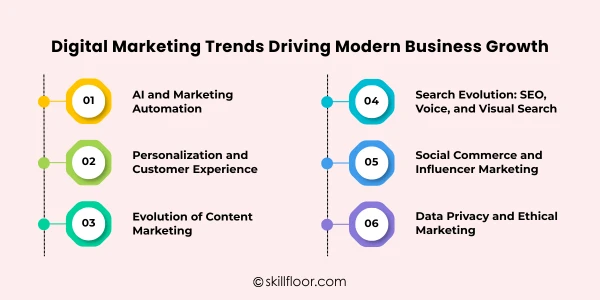
4. Search Evolution: SEO, Voice, and Visual Search
Search behavior is changing quickly. Voice and visual search are becoming more significant in how people get information online, even though traditional SEO is still crucial.
In order to locate goods, services, and solutions, consumers now rely on voice assistants for conversational inquiries and image-based searches. Businesses must focus on optimizing content for natural language, mobile-first indexing, and visual discovery in order to adjust to these changes. Digital marketing training programs that target contemporary search behavior and changing search engine algorithms place an increasing emphasis on these skills.
5. Social Commerce and Influencer Marketing
Social media is becoming a potent sales tool as well as a gateway for brand exposure. Users may find, assess, and buy things through social commerce without ever leaving their preferred apps.
Brands are increasingly collaborating with micro- and nano-influencers, who provide greater engagement and authenticity, as influencer marketing continues to develop. These reliable sources assist companies in connecting with specialized markets and generating significant conversions.
6. Data Privacy and Ethical Marketing
Transparency and trust are essential as customers grow increasingly aware of how their data is utilized. Regulations about data protection and the shift to first-party data are compelling companies to reconsider their marketing tactics.
Transparent consent, open communication, and responsible data use are examples of ethical marketing strategies that enhance brand reputation and foster trust. Businesses that provide value-driven experiences while respecting privacy are more likely to succeed in the long run.
Skillfloor: A Digital Marketing Training Institution for Modern Business Growth
It takes more than just awareness to stay current with digital marketing trends; it also calls for ongoing education and real-world experience. The goal of Skillfloor, a professional digital marketing training institution, is to provide students with industry-relevant skills that complement contemporary business growth tactics.
Complete digital marketing courses covering key topics, including search engine optimization (SEO), social media marketing, performance marketing, content marketing, and marketing analytics, are available from Skillfloor. The emphasis of the training programs is on practical exposure to tools and strategies utilized by today's digital marketers, real-time projects, and hands-on learning.
Skillfloor helps professionals, entrepreneurs, and students acquire the skills necessary to apply successful digital marketing tactics by emphasizing skill-based, career-oriented learning. Skillfloor, a digital marketing training institution, offers hands-on, industry-aligned instruction that aids students in adjusting to trends, increasing their employability, and supporting long-term company expansion in the digital age.
Digital marketing continues to shape how businesses connect, grow, and succeed in an online-first world. As platforms, tools, and customer behavior continue to evolve, maintaining knowledge and expertise becomes more than just a choice. Businesses may stay visible, develop trust, and establish genuine connections with their audience by using the proper tactics. By transforming concepts into actual action, selecting a digital marketing course from a reputable digital marketing training institution helps facilitate this process. In today's digital world, people and companies may confidently advance, adjust to change, and expand steadily with the correct knowledge and practical experience.