
Modern security environments demand speed, accuracy, and reliability, especially in places where large volumes of people and luggage pass through every day. From transportation hubs to government facilities, effective screening systems play a vital role in maintaining safety. As a trusted name in imaging and inspection technologies, Krystalvision Imaging Pvt Ltd has consistently focused on delivering advanced X-ray solutions that meet evolving security challenges. Among the most widely used screening technologies today are single-view and dual-view X-ray baggage scanners, each designed with specific operational needs in mind.
Understanding the difference between these two scanner types is essential for organisations looking to invest in the right equipment. While both serve the core purpose of detecting prohibited or dangerous items, their design, imaging capability, and performance levels vary significantly.
Understanding X-Ray Baggage Scanning Technology
X-ray baggage scanning systems work by passing X-rays through luggage and interpreting the absorbed radiation to create images of the contents inside. These images help operators identify organic, inorganic, and metallic materials based on colour coding and density. The clarity of these images and the angles from which they are captured directly affect detection accuracy.
A baggage scanner is commonly deployed in high-security locations to ensure that concealed threats, such as weapons, explosives, or contraband, do not pass through checkpoints. Over time, technological advancements have led to the development of different viewing configurations, primarily single-view and dual-view systems.
What Is a Single View X-Ray Baggage Scanner?
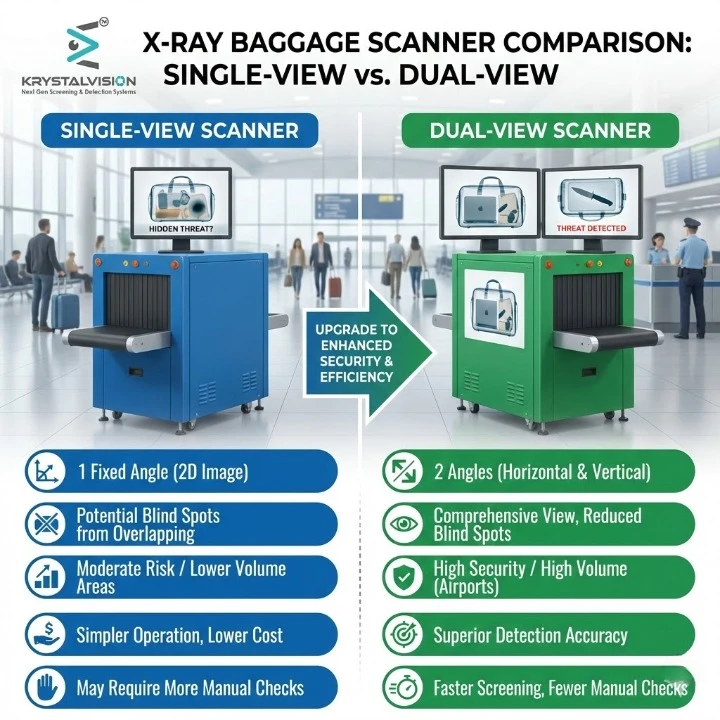
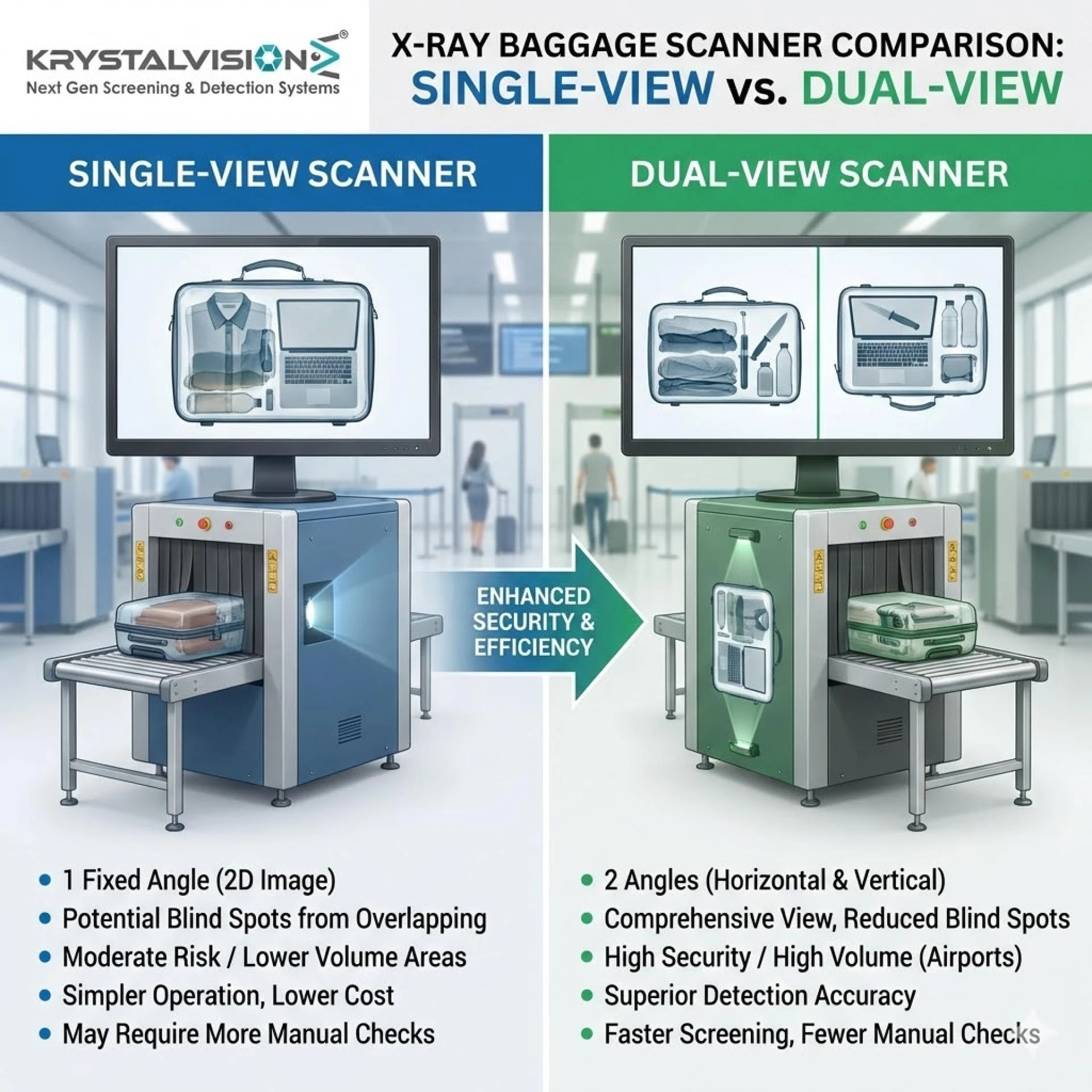
A single-view X-ray baggage scanner captures an image of the luggage from one fixed angle, usually from the side or top. This configuration provides a two-dimensional representation of the bag’s contents. Single-view scanners are widely used in locations where security risks are moderate, and luggage contents are relatively easy to interpret.
These scanners are valued for their simplicity, affordability, and ease of operation. Training requirements for operators are generally lower, and image interpretation is straightforward for standard screening tasks. In facilities with limited space or budget constraints, single-view systems are often the preferred choice.
However, because the image is generated from only one angle, overlapping objects can obscure potential threats. Dense or cluttered bags may require manual inspection if the operator cannot clearly distinguish suspicious items.
What Is a Dual View X-Ray Baggage Scanner?
A Dual View X-Ray Baggage Scanner captures images from two different angles simultaneously, typically horizontal and vertical. This dual perspective imaging provides a more comprehensive view of the bag’s contents, reducing blind spots and improving detection accuracy.
With two images displayed side by side, operators can analyse complex or densely packed luggage more effectively. This capability is especially valuable in high-risk environments where concealment methods are more sophisticated. Dual-view scanners significantly reduce the need for manual bag checks, enhancing both security and operational efficiency.
Because of their advanced imaging capabilities, dual-view systems are often deployed in major transportation hubs and critical infrastructure facilities where high throughput and precision are essential.
Key Differences Between Single View and Dual View Scanners
Image Clarity and Detection Accuracy
The most notable difference lies in image detail. Single-view scanners offer a basic image that is sufficient for routine screening. Dual-view systems, on the other hand, provide enhanced depth perception, allowing operators to identify threats that might be hidden behind other objects.
Operational Efficiency
Dual-view scanners improve decision-making speed by reducing ambiguity in image interpretation. This results in faster screening and fewer delays, particularly in high-traffic areas. Single-view scanners may slow down operations when manual inspections are frequently required.
Training and Skill Requirements
Single-view systems are easier to learn and operate, making them suitable for locations with limited training resources. Dual-view scanners require more skilled operators who can interpret complex images from multiple perspectives.
Cost Considerations
Single-view scanners are more budget-friendly, both in terms of initial investment and maintenance. Dual-view scanners, while more expensive, offer long-term value through improved security and reduced labour costs.
Application-Based Use Cases
Single-view scanners are commonly used in office buildings, educational institutions, small event venues, and commercial facilities. In these settings, the risk profile is lower, and the volume of baggage is manageable.
Dual-view scanners are ideal for high-security and high-volume environments such as airports, metro stations, customs checkpoints, and government facilities. An airport X-ray baggage machine must handle large passenger flows while maintaining strict security standards, making dual-view technology a practical choice.
Similarly, an airport baggage scanner benefits from dual-view imaging because it minimises false alarms and enhances threat detection without compromising passenger convenience.
Role of Advanced Imaging in Aviation Security
In aviation environments, screening accuracy is non-negotiable. The use of an X-ray baggage machine with dual imaging capability ensures that security personnel can detect prohibited items even in tightly packed luggage. This level of precision helps authorities maintain compliance with international aviation security regulations while ensuring passenger safety.
Single-view scanners still play a supporting role in secondary screening areas or staff checkpoints, where the risk level and baggage complexity are lower.
Choosing the Right Scanner for Your Facility
Selecting between single-view and dual-view X-ray baggage scanners depends on several factors, including threat level, passenger or visitor volume, available space, and budget. Facilities must also consider operator expertise and long-term scalability.
Organisations that anticipate growing security demands may find it beneficial to invest in dual-view systems from the outset. Others may opt for single-view scanners as a cost-effective solution for immediate needs.
Krystalvision’s Commitment to Security Excellence
Krystalvision Imaging Pvt Ltd continues to innovate in the field of X-ray imaging by offering solutions that balance performance, reliability, and user-friendly operation. By understanding the distinct advantages of single-view and dual-view technologies, clients can make informed decisions that align with their security objectives.
Conclusion
Both single-view and dual-view X-ray baggage scanners serve essential roles in modern security infrastructure. Single-view scanners provide simplicity and affordability for low to moderate-risk environments, while dual-view systems deliver superior detection capabilities for high security applications. Understanding their differences enables organisations to deploy the right technology in the right setting, ensuring safety without sacrificing efficiency.
As security threats continue to evolve, choosing advanced and reliable scanning solutions becomes increasingly important. With expert guidance and advanced technology, organisations can confidently meet today’s security challenges and prepare for those of tomorrow