
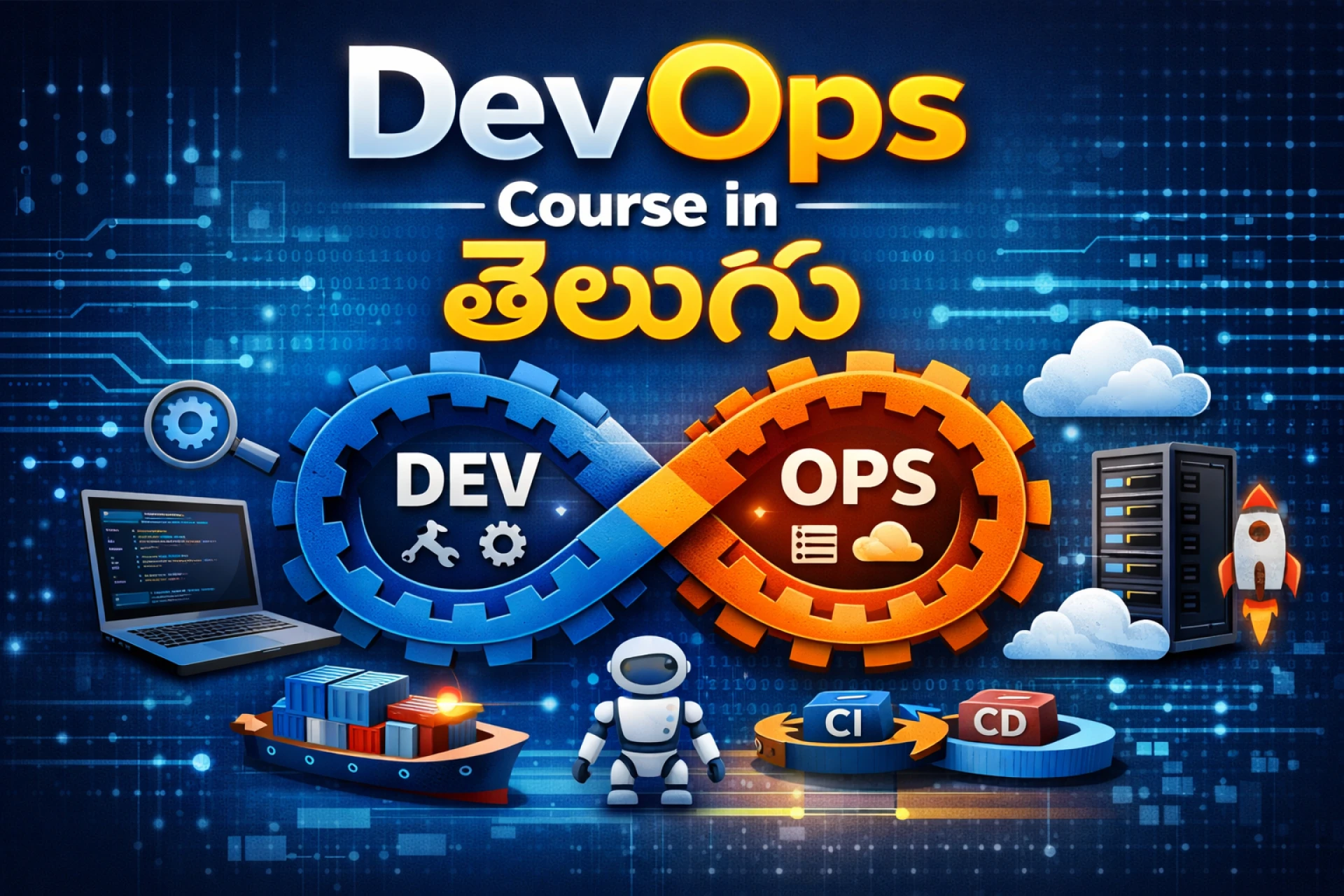
The technology industry is evolving at a very fast pace. Companies today need to develop software quickly, deliver updates regularly, and maintain reliable systems for their users. In the past, software development and IT operations were handled by separate teams, which often caused delays and communication issues. To overcome these challenges, the concept of DevOps was introduced.
DevOps has now become an essential part of modern software development. It helps organizations automate processes, improve collaboration between teams, and deliver software faster. Because of these advantages, DevOps professionals are highly valued in the IT industry.
Many Telugu-speaking students and professionals want to learn DevOps but sometimes find technical topics difficult when they are explained only in English. A DevOps course in Telugu helps learners understand these concepts clearly and build strong technical knowledge.
This blog will help you understand DevOps basics, the tools used in DevOps, and the career opportunities available in this field.
What is DevOps?
DevOps is a combination of two words: Development and Operations. It is a set of practices that brings together software developers and IT operations teams.
In traditional software development models, developers wrote the application code while operations teams handled deployment and maintenance. This separation often created communication gaps and slowed down the development process.
DevOps eliminates this gap by encouraging both teams to work together throughout the entire development lifecycle. Automation tools and continuous integration pipelines help improve efficiency and reduce errors.
The main goal of DevOps is to deliver high-quality software quickly and reliably.
Why DevOps is Important
DevOps has become very important in modern IT environments because companies need faster and more reliable software delivery.
One of the biggest advantages of DevOps is continuous integration and continuous delivery. These practices allow teams to release updates frequently without affecting system stability.
Another benefit is better collaboration between development and operations teams. When both teams work together, problems can be solved faster and productivity improves.
DevOps also increases system reliability through automated testing and monitoring tools.
Because of these benefits, DevOps has become widely adopted by IT companies around the world.
The DevOps Lifecycle
The DevOps lifecycle consists of several stages that work together to ensure continuous development and deployment.
Planning
In this stage, teams define project requirements and create a roadmap for development.
Development
Developers write application code and store it in version control systems.
Building
The application code is compiled and packaged into deployable formats.
Testing
Automated testing tools ensure that the application works correctly.
Deployment
After testing, the application is deployed to production environments.
Monitoring
Monitoring tools track application performance and detect issues quickly.
This continuous cycle helps organizations deliver updates frequently and improve software quality.
Tools Used in DevOps
DevOps engineers rely on several tools to automate development and deployment tasks.
Linux
Linux is widely used in server environments. DevOps engineers must understand Linux commands and system administration.
Git
Git is a version control system that helps developers manage source code and collaborate with teams.
Jenkins
Jenkins is an automation server used to create continuous integration and continuous delivery pipelines.
Docker
Docker allows developers to package applications into containers, ensuring consistent performance across environments.
Kubernetes
Kubernetes manages containerized applications and helps scale deployments effectively.
Ansible
Ansible automates server configuration and infrastructure management tasks.
Cloud Platforms
DevOps engineers often use cloud services such as AWS, Microsoft Azure, and Google Cloud.
Benefits of Learning DevOps in Telugu
Learning DevOps in Telugu provides several advantages for beginners.
When technical concepts are explained in a familiar language, students can understand them more easily.
Learning in Telugu also helps reduce confusion and improves learning speed.
It also builds confidence and encourages learners to participate actively in training sessions.
After understanding the basics, learners can gradually explore advanced resources in English.
Career Opportunities in DevOps
DevOps professionals have excellent career opportunities in the IT industry.
Some common job roles include:
DevOps Engineer
Cloud Engineer
Automation Engineer
Infrastructure Engineer
Site Reliability Engineer
These professionals are responsible for automating development pipelines, managing infrastructure, deploying applications, and monitoring system performance.
DevOps Salary in India
DevOps engineers earn competitive salaries due to the high demand for their skills.
Freshers with DevOps knowledge can earn between ₹4 lakh and ₹7 lakh per year.
Professionals with two to five years of experience can earn between ₹8 lakh and ₹15 lakh annually.
Senior DevOps engineers with strong expertise may earn ₹20 lakh or more depending on their experience.
How to Start Learning DevOps
If you want to start learning DevOps, it is important to follow a structured learning path.
First, learn Linux basics and understand server environments.
Next, learn Git and version control systems.
Then explore CI/CD tools such as Jenkins.
After that, study container technologies like Docker and Kubernetes.
Finally, gain hands-on experience with cloud platforms and monitoring tools.
Working on real-world projects will help you gain practical experience and improve your DevOps skills.
Conclusion
DevOps has become a critical part of modern software development. It allows organizations to deliver applications faster, improve collaboration between teams, and maintain reliable systems.
For Telugu-speaking learners, a DevOps course in Telugu provides an excellent opportunity to understand DevOps concepts clearly and build valuable technical skills.