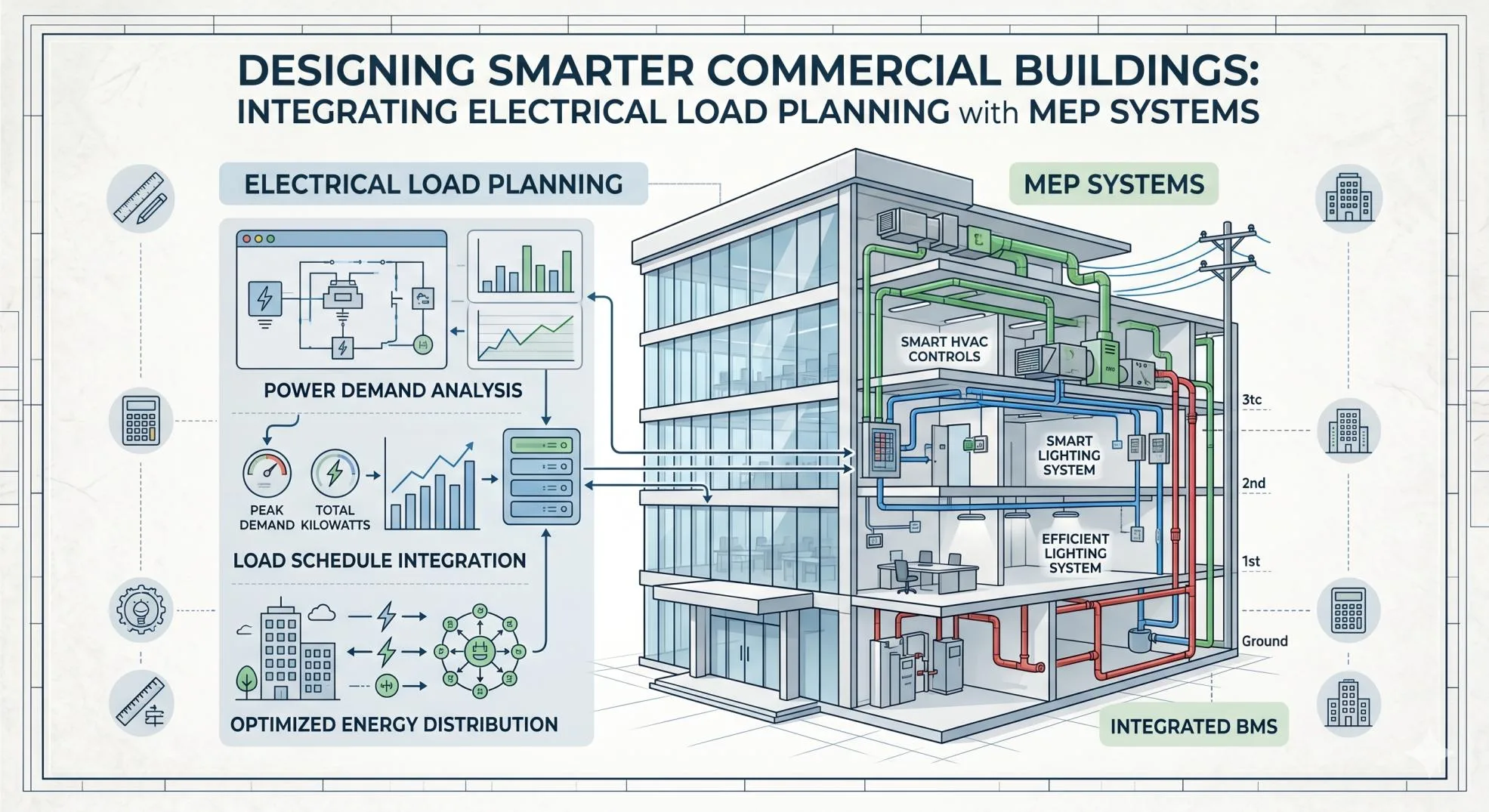
In modern commercial construction across the U.S., one factor consistently determines whether a project runs smoothly or faces costly redesigns—accurate electrical planning. At the core of this lies a fundamental concept: what is electrical load and how it drives the entire ecosystem of MEP services.
Rather than treating electrical, HVAC, and fire protection as separate disciplines, leading architects and engineers are now aligning them around load-based design. This blog explores how a load-centric approach improves coordination, reduces risk, and enhances overall building performance.
What is Electrical Load and Why It Drives Design
To build an efficient system, we first need clarity on what is electrical load.
Electrical load is the total power demand of all equipment, systems, and devices within a building. This includes HVAC units, lighting, elevators, and life safety systems.
Why It Becomes the Central Design Parameter:
- Defines transformer and panel sizing
- Influences HVAC system capacity
- Impacts backup and redundancy planning
- Guides fire protection system integration
How Electrical Design Services Build Around Load
Once load is defined, Electrical Design Services translate it into a structured system.
Key Design Outputs:
- Power distribution layouts
- Panel schedules
- Backup power systems
- electrical riser diagram
Role of the Electrical Riser Diagram
An electrical riser diagram visually maps how power flows vertically through a building—from the main utility source to each floor.
Instead of being just a documentation tool, it becomes a coordination anchor:
- Aligns electrical shafts with HVAC ducts
- Helps avoid spatial conflicts
- Ensures balanced load distribution across floors
HVAC Consulting: The Largest Load Driver
While electrical systems distribute power, HVAC systems consume the largest portion of it. This makes HVAC consulting a critical part of load-based design.
Key Relationship:
Electrical Load → HVAC Capacity → Electrical Infrastructure Reinforcement
What HVAC Consultants Contribute:
- Accurate cooling/heating load calculations
- Equipment selection aligned with energy goals
- Demand-based system optimization
Integrating Fire Protection Without Disrupting Load Balance
Fire protection systems are often treated as secondary, but they still influence electrical planning—especially in sensitive environments.
Where the Pre Action System Fits In
A pre action fire sprinkler system is commonly used in data centers and critical facilities where accidental discharge must be avoided.
Load Considerations:
- Requires integration with detection systems
- Needs reliable backup power
- Must align with emergency electrical circuits
The Role of an MEP Engineer in Load-Based Coordination
A MEP engineer ensures that all systems work together under a unified load strategy.
Key Responsibilities:
- Coordinating load data across disciplines
- Aligning electrical and HVAC system requirements
- Ensuring fire protection systems meet safety codes
- Leading BIM-based clash detection
Tools That Enable This Approach: Revit vs AutoCAD
The shift toward integrated design is also driven by digital tools—particularly the debate around revit vs autocad.
CriteriaRevit (BIM-Based)AutoCAD (2D-Based)Load IntegrationCentralized & dynamicManual updatesCoordinationReal-timeLimitedClash DetectionAutomatedManualWorkflowCollaborativeSequential
Conclusion
Integrated, load-driven design is the key to efficient and future-ready buildings. By aligning electrical, HVAC, and fire protection systems early, teams can reduce risks, improve performance, and deliver smarter outcomes.
If you're planning your next project, consider partnering with experienced MEP professionals to ensure seamless coordination and optimized design from day one.