
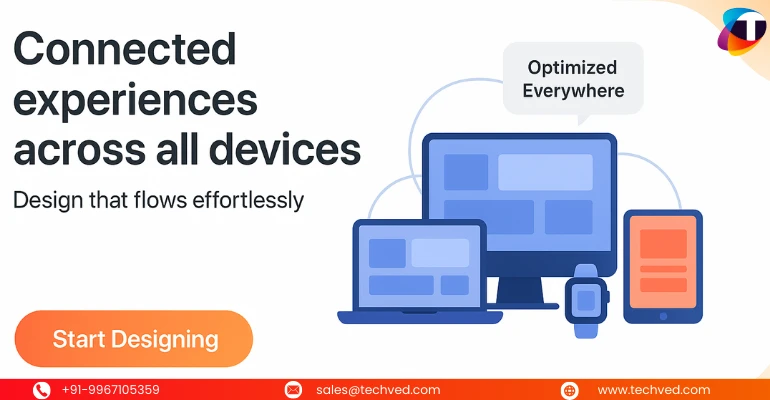
Recent ui case studies show that designing for wearables, foldables, and emerging devices requires rethinking which design pattern ensures that the user interface adapts to different devices. As teams increasingly build responsive & adaptive navigation projects with AI, following the best practices for user experience design in 2025 has become essential to support new interaction models and evolving form factors.
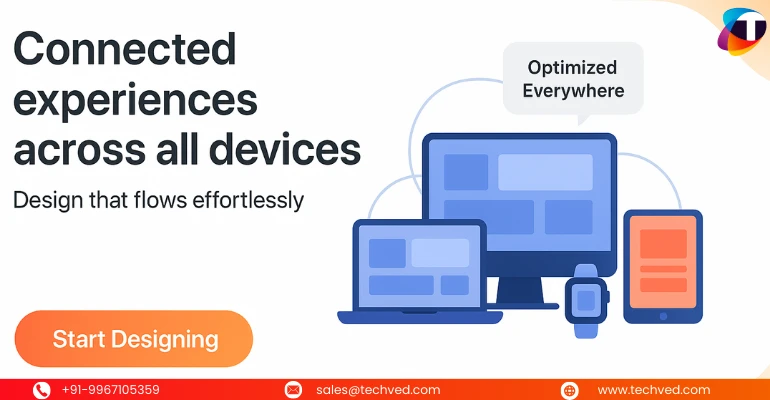
Expanding Beyond Traditional Screens
The rise of non-traditional devices has transformed expectations around multi device experience. From wrist-based interactions to foldable displays, designers must ensure that ui elements remain usable while the user interface adapts to limited space, posture changes, and contextual usage.
This evolution pushes teams to reconsider assumptions built around static screens.
UX Design for Compact and Flexible Devices
Effective ux design for wearables and foldables prioritizes clarity, speed, and relevance. Strong ui ux decisions help users complete tasks quickly without cognitive overload, especially when interactions are brief or glance-based.
A scalable ui design system ensures that experiences remain consistent even as screen dimensions and orientations change dynamically.
AI-Powered Adaptability Across Devices
To manage this complexity, organizations increasingly rely on ai to deliver intelligent adaptation. Advanced systems enable ai ux ui, allowing interfaces to learn from user behavior and optimize layouts across device types.
The adoption of ai interfaces supports predictive interactions, making emerging-device experiences feel intuitive rather than experimental.
Trends Shaping Emerging-Device UX
Several modern ui/ux design trends are influencing how designers approach wearables and foldables, including gesture-driven navigation and context-aware content delivery. Applying proven ui ux design secrets helps teams balance innovation with usability.
These trends emphasize simplicity, responsiveness, and emotional design even on constrained screens.
UX as a Business Growth Lever
Organizations are increasingly aware of how ux impacts business growth, especially as new devices create new touchpoints. Leveraging web design automation enables faster iteration, while mobile first ux design principles ensure core functionality remains accessible.
Scalable ai web development strategies further support experimentation without compromising performance.
Psychology and Practical Design Guidance
Designing for emerging devices requires a deep understanding of user interface psychology, particularly how users process information in short interactions. Applying practical ux design tips and actionable ui ux tips helps reduce friction and improve adoption.
Clarifying the ui and ai difference ensures that intelligence enhances usability instead of confusing users.
Aligning UX, UI, and Development
Teams often debate web development or ux design as the starting point for innovation. In reality, strong ui and ux web design alignment ensures technical decisions support usability from the outset.
This integrated approach is critical when building for rapidly evolving device ecosystems.
Choosing the Right UX Partner
As complexity grows, partnering with a trusted ui ux design services company becomes vital. End-to-end ui ux design services help organizations design adaptable systems rather than isolated screens.
An experienced ui ux design company ensures long-term scalability and consistency across your website ux/ui and emerging-device experiences.
How TECHVED Consulting Designs for the Future
At TECHVED Consulting, designing for wearables and emerging devices is driven by research, intelligent systems, and scalable frameworks. TECHVED combines human-centered design with advanced technology to help brands stay ahead of evolving interaction models.
Final Thoughts
Designing for wearables, foldables, and emerging devices is not about shrinking interfaces—it’s about reimagining experiences. Brands that embrace adaptability, intelligence, and psychology-driven design will lead the next phase of digital innovation.
To explore deeper insights and expert perspectives, read more article content from TECHVED’s digital experience library.