
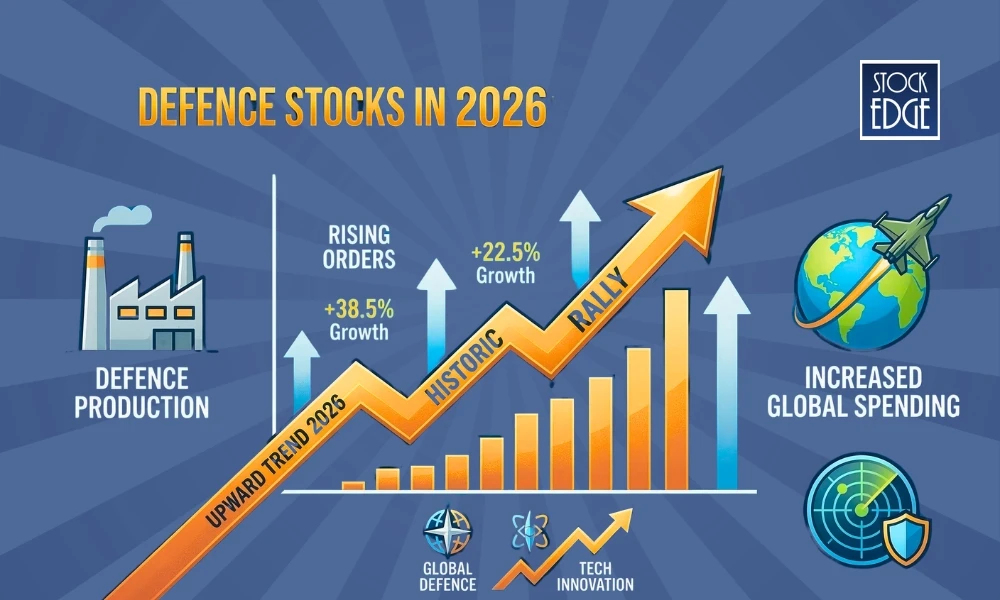
Defence stocks are currently experiencing their strongest performance in several decades. The defence industry stocks in the United States, Europe, and India in 2026. Defence industry stocks exhibit positive market signals, according to data from global capital markets.
A Once-in-a-Generation Spending Cycle
The total amount of current military spending commitments exceeds all possible methods of measurement. The Trump administration has proposed a defence budget of $1.5 trillion for fiscal year 2027, which would represent the largest peacetime military allocation in United States history. According to data from the Stockholm International Peace Research Institute (SIPRI), the United States already spends almost $1 trillion on defence every year, which exceeds the combined defence expenditures of the nine largest military powers worldwide. The top 100 defence companies worldwide generated revenues of more than $679 billion in 2024, while US companies contributed $334 billion to this revenue total.
The surge in spending has created a direct connection to stock market results. The US defence stock market started 2026 with strong performance, as L3Harris Technologies and Huntington Ingalls Industries both achieved about 11% growth during their first five trading days of operation. L3Harris achieved 40% growth during 2025, while Northrop Grumman experienced a 22% increase in its stock value. Investor demand for unmanned systems has resulted in major stock price increases for drone-focused companies AeroVironment and Kratos Defence and Security Solutions, although current year-to-date market data continues to change.
The defence stocks list features major companies, which include Lockheed Martin, RTX Corporation, Northrop Grumman, Boeing, and L3Harris Technologies. Lockheed Martin operates as the world's largest defence contractor, maintaining a contract backlog worth $194 billion and predicting 2026 revenues between $77.5 billion and $80 billion. RTX's stock rose 60% until 2025, reaching its peak value of approximately $185 per share after Raytheon secured a $1.7 billion contract to deliver Patriot missile systems to Spain.
What Is Driving the Rally in Defence Sector Stocks
The defence sector stocks are rising because multiple factors have combined to create this effect. The current West Asian conflict has caused US-Israel military operations against Iran to begin restocking and procurement operations, which started in February 2026. Northrop Grumman's stock increased 5% after the operations, while RTX advanced 4.5% and Lockheed Martin rose 3% during the week. The Ukrainian conflict has created a new arms race, which countries in Europe are now pursuing. The NATO defence alliance will increase its spending to 2.8% of GDP by 2030, which will result in approximately 7% annual growth during the following ten years. The STOXX Europe Total Market Aerospace and Defence Index has experienced a strong recovery after its decline in late 2025 because of the upcoming Ukraine peace negotiations.
Global defence spending will reach $3.6 trillion by 2030, according to Global X, which estimates a 33% increase from 2024 spending levels. The current situation has strengthened investor trust in defence company stocks that possess multi-year procurement contracts and substantial order backlogs that guarantee predictable revenue streams.
Defence Stocks India: A Domestic Growth Story
Indian defence stocks provide an interesting investment opportunity because their market performance depends on domestic economic conditions. The Indian government budgeted Rs 6.81 lakh crore for defence spending in FY2025-26, which included a Rs 1.8 lakh crore capital expenditure budget.
Nirmal Bang Institutional Equities analysts projected that the upcoming FY27 budget will increase capital allocation by 10 to 15% while estimating the budget allocation will reach Rs 2.1 to 2.3 lakh crore, which represents a potential annual growth rate of 20 to 30% based on their established projections.
The budget failed to provide the full market improvement that investors had anticipated. The Nifty India Defence Index rose 1.6% in the session leading up to the budget announcement on February 1, 2026, but subsequently fell approximately 9% in the days that followed as investors found the capital allocation below elevated expectations. The West Asia conflict escalated in March 2026, which caused Bharat Dynamics Ltd. (BDL) shares to increase 7.22%, Hindustan Aeronautics Ltd. (HAL) stocks to rise 3.4%, Garden Reach Shipbuilders and Engineers (GRSE) shares to climb 6.05%, and Mazagon Dock Shipbuilders shares to advance 5.68% in one trading session.
The list of Indian defense stocks includes important companies such as HAL, Bharat Electronics Ltd. (BEL), Mazagon Dock Shipbuilders, BDL, Cochin Shipyard, Data Patterns (India), and Paras Defence and Space Technologies. HAL holds an extensive order book that exceeds Rs 1 lakh crore because it serves as the main contractor for the Tejas Mk1A fighter program, which includes a contract worth Rs 62,370 crore.
BEL controls 28.64 percent of the Nifty India Defense Index, while its order book stands at 3.1 times the projected FY25 revenue because the company executes the Kavach 4.0 railway safety system and handles QRSAM orders that will bring in between Rs 30,000 crore and Rs 32,000 crore. The government approved a Rs 69,800 crore shipbuilding package, which makes Mazagon Dock the main candidate to develop the Project 75(I) submarine program.
The government plans to introduce the Drone Shakti Mission, which will operate for five years with a funding of Rs 10,000 crore to establish India as a worldwide center for drone production. This development creates favorable conditions for companies such as Zen Technologies, Astra Microwave Products, Data Patterns, and ideaForge. India seeks to enhance defense exports through equipment sales to the Philippines, Armenia, and multiple countries in the Middle East while aiming to achieve an export goal of Rs 50,000 crore.
Risks Investors Should Watch
Defence stocks demonstrate robust fundamental performance but face high risk. In India, HAL, BEL, and Mazagon Dock trade at price-to-earnings multiples well above 30x in many market conditions because their premium valuations make it difficult to handle any delays in execution.
US companies Kratos and Palantir currently have market values that exceed 100 times their expected future earnings, which makes them sensitive to any changes in investor risk attitudes. The urgency for defence procurement will decrease when diplomatic solutions to the Ukraine and West Asia conflicts achieve success.
The Trump administration's proposals to restrict dividends and share buybacks among US contractors until production targets are met also introduce near-term uncertainty for shareholders. The structural case for defence stocks remains intact for long-term investors because sovereign-backed order books extend five to seven years ahead while defence budgets increase across all major economies.
Disclaimer: This article is for informational purposes only and does not constitute financial or investment advice. Readers should consult a qualified financial adviser before making any investment decisions.