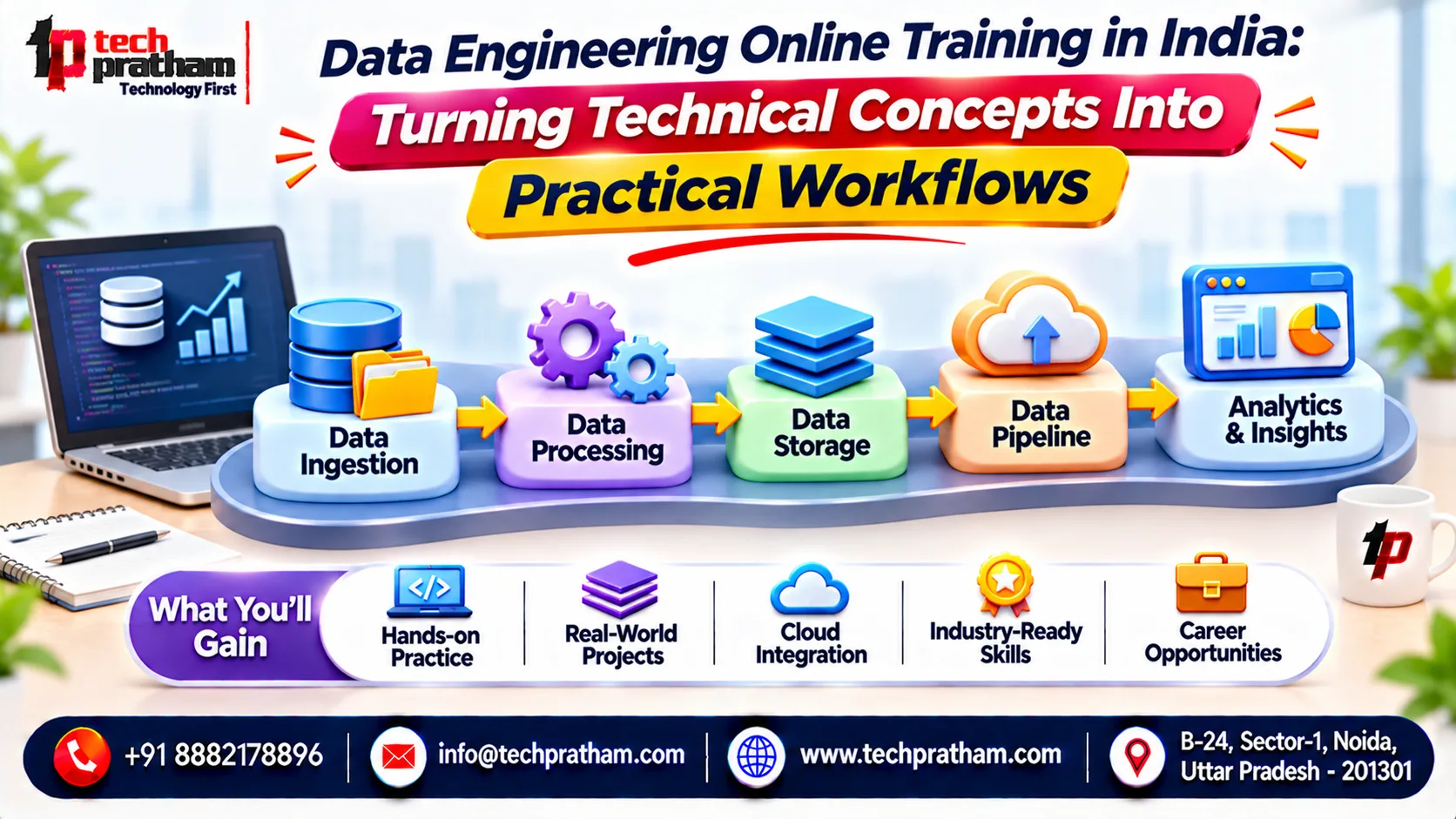
Data engineering can look like a collection of unrelated technologies when viewed from the outside. SQL appears to belong to databases, Python belongs to programming, ETL belongs to data processing, and cloud platforms seem like a completely separate area. For beginners, this separation can make the field appear more complicated than it really is. The bigger picture becomes clearer when these technologies are viewed as parts of one workflow. Data engineering is fundamentally concerned with moving, transforming, organizing, and preparing data so that it can be used reliably by applications, analysts, and decision-makers.
Connecting Learning With Real Data Workflows
Data Engineering Online Training in India becomes more useful when learners understand how individual technical concepts contribute to an end-to-end process.
Consider a simple business scenario. An organization receives customer orders through different systems. The information must be collected, cleaned, transformed, stored, and made available for analysis. That single requirement can involve several data engineering concepts. SQL can be used to query structured information. Python can support processing and automation. ETL or ELT processes can move and transform data. A warehouse can organize information for analytics. Cloud services can provide scalable infrastructure. The technologies are different, but the workflow connects them.
Step 1: Understanding the Source Data
Every data workflow starts somewhere. The source might be a relational database, CSV file, API, application, or another business system. Before building a pipeline, learners should understand the structure of the incoming data.
Questions include:
✓ What fields are available?
✓ Which fields are mandatory?
✓ How frequently does data arrive?
✓ Are there duplicate records?
✓ What formats are being used?
This stage teaches an important lesson: data engineering starts with understanding data, not simply moving it.
Step 2: Extracting the Information
Once the source is understood, data needs to be collected. For a database, SQL queries may be used. For an API, a Python-based process may retrieve information. For files, a program may read and process the records. At this stage, learners begin seeing why multiple technical skills are needed. Knowing SQL alone may not be enough if the source is an API. Knowing Python alone may not be enough if the target system requires efficient database operations. The workflow determines the required combination of skills.
Step 3: Cleaning and Transforming Data
Raw data often requires preparation. Dates may use different formats. Customer names may contain inconsistent spelling. Some records may be incomplete. Duplicate entries may exist. Transformation processes help convert raw information into a consistent structure. This stage is particularly valuable for learners because it demonstrates why data quality matters. A technically successful pipeline can still produce poor results if the underlying data is unreliable.
Step 4: Loading Data Into a Target System
After transformation, the processed information needs to be stored somewhere useful.
Depending on the architecture, the destination could be a database, data warehouse, data lake, or another storage environment. Learners should focus on understanding why a particular destination is being used rather than memorizing product names.
The important question is: what kind of access and processing does the business require?
Step 5: Scheduling and Monitoring the Pipeline
A pipeline becomes more useful when it can operate consistently. Instead of manually running a script every day, organizations often automate data workflows. This introduces concepts such as scheduling, dependencies, monitoring, logging, and failure handling. For learners, this is an important transition. Building a pipeline that works once is different from designing a workflow that can operate repeatedly and handle problems.
Step 6: Validating the Results
Data should not simply be loaded and forgotten. Validation checks can confirm whether expected records arrived, whether important fields are missing, and whether values fall within reasonable ranges. For example, if a pipeline normally processes 50,000 records but suddenly receives only 5,000, that difference should be investigated. This teaches learners to think about reliability rather than only functionality.
Why Projects Matter
A Data Engineering Training in India can introduce individual technologies, but projects help learners understand how those technologies interact. A useful project should therefore contain several connected stages. For example, a logistics project could collect shipment data, clean location fields, calculate delivery metrics, store the results, and make them available for reporting. The learner is not merely practicing Python or SQL. They are understanding the complete journey of information.
Developing a Workflow-Oriented Mindset
One of the most valuable changes during learning is moving from “What tool should I learn?” to “What problem am I trying to solve?” This mindset makes technical decisions easier. If the problem involves extracting data from an API, investigate API access. If the problem involves joining large datasets, examine database and processing strategies. If the workflow needs repeated execution, explore automation and orchestration. Tools become easier to understand when they are connected to a purpose.
Conclusion
Data engineering becomes much clearer when learners stop studying technologies as isolated subjects and start seeing them as connected components of a workflow. The combination of extraction, transformation, storage, automation, and validation creates the foundation of practical data work. For learners evaluating Data Engineering Course in India, the strongest learning experience is one that helps connect technical concepts with realistic workflows rather than treating every tool as a separate topic.