Across Indian retail chains, corporate offices, hospitality properties, control rooms, and event spaces, LED displays have become standard infrastructure rather than optional additions. Yet procurement teams continue to face the same unresolved question: is it worth paying for a custom LED display, or does a standard LED panel screen deliver sufficient performance at a lower cost?
This question typically surfaces during the vendor quotation stage. One supplier recommends a standard indoor LED display board as the practical, budget-friendly choice. Another proposes a custom-engineered solution at a higher price point, citing improved performance and design flexibility. Without a clear framework for evaluation, businesses frequently end up making decisions based primarily on cost or visual appeal rather than genuine operational fit.
This article lays out the functional differences between these two categories, identifies where each performs best, and outlines a structured approach for Indian businesses evaluating this investment.
What Separates Custom LED Displays From Standard LED Panel Screens?
Understanding the core distinction between these two product types is the starting point for any sound procurement decision.
Standard LED Panel Screens
Standard LED panels are manufactured in preset cabinet formats — commonly 500×500 mm or 500×1000 mm. Installers assemble these cabinets into larger display configurations. The vast majority of indoor LED display board deployments across India use this approach, largely because standard cabinets support a wide range of screen sizes while keeping installation and ongoing maintenance straightforward.
When choosing a standard panel, buyers typically specify:
- Pixel pitch
- Screen dimensions
- Brightness rating
- Mounting configuration
- Indoor or outdoor deployment
The internal electronics, cabinet structure, and signal architecture follow the manufacturer's fixed product design.
Custom LED Displays
A custom LED display is built to specification — designed around technical or architectural requirements that standard cabinets cannot meet. Typical customisation scenarios include:
- Cylindrical or curved display geometries
- Non-standard proportions or unusual aspect ratios
- Transparent panel surfaces for glass facade applications
- Purpose-built cabinet dimensions
- Ultra-fine pixel pitch specifications for close-viewing environments
- High-refresh-rate broadcast performance
- Hardware integration with automation or command systems
Where Standard LED Panels Are the Stronger Choice
For the majority of commercial LED installations in India, standard panels offer the most practical combination of quality, serviceability, and value.
General Commercial Interiors
Display installations in retail environments, meeting rooms, reception lobbies, educational campuses, and shopping centres rarely demand engineering beyond what a standard configuration can provide. A well-specified indoor LED display board with the right pixel pitch will deliver sharp, professional image quality across all of these contexts.
Projects With Defined Budgets
Standard LED panels are manufactured at scale, which keeps unit and servicing costs lower than custom solutions. For businesses managing defined project budgets, directing funds toward higher-specification standard panels almost always produces better long-term value than paying for customisation that the installation does not actually require.
Installations Where Serviceability Matters
Standard panels have a clear advantage when it comes to ongoing maintenance. Replacement modules, receiving cards, power supplies, and cabinet components for standard configurations remain widely available. When a component fails years after installation, a standard-format system is far less likely to leave the customer waiting on specialist parts.
Deployments With Time-Critical Schedules
Because standard cabinets are pre-manufactured, installation can proceed much faster than with custom-engineered systems. Businesses operating on tight deployment timelines consistently favour standard configurations for this reason.
Where Custom LED Displays Become Necessary
A custom LED display is the correct choice when the installation environment or technical brief exceeds what any standard configuration can deliver.
Curved and Architectural Surfaces
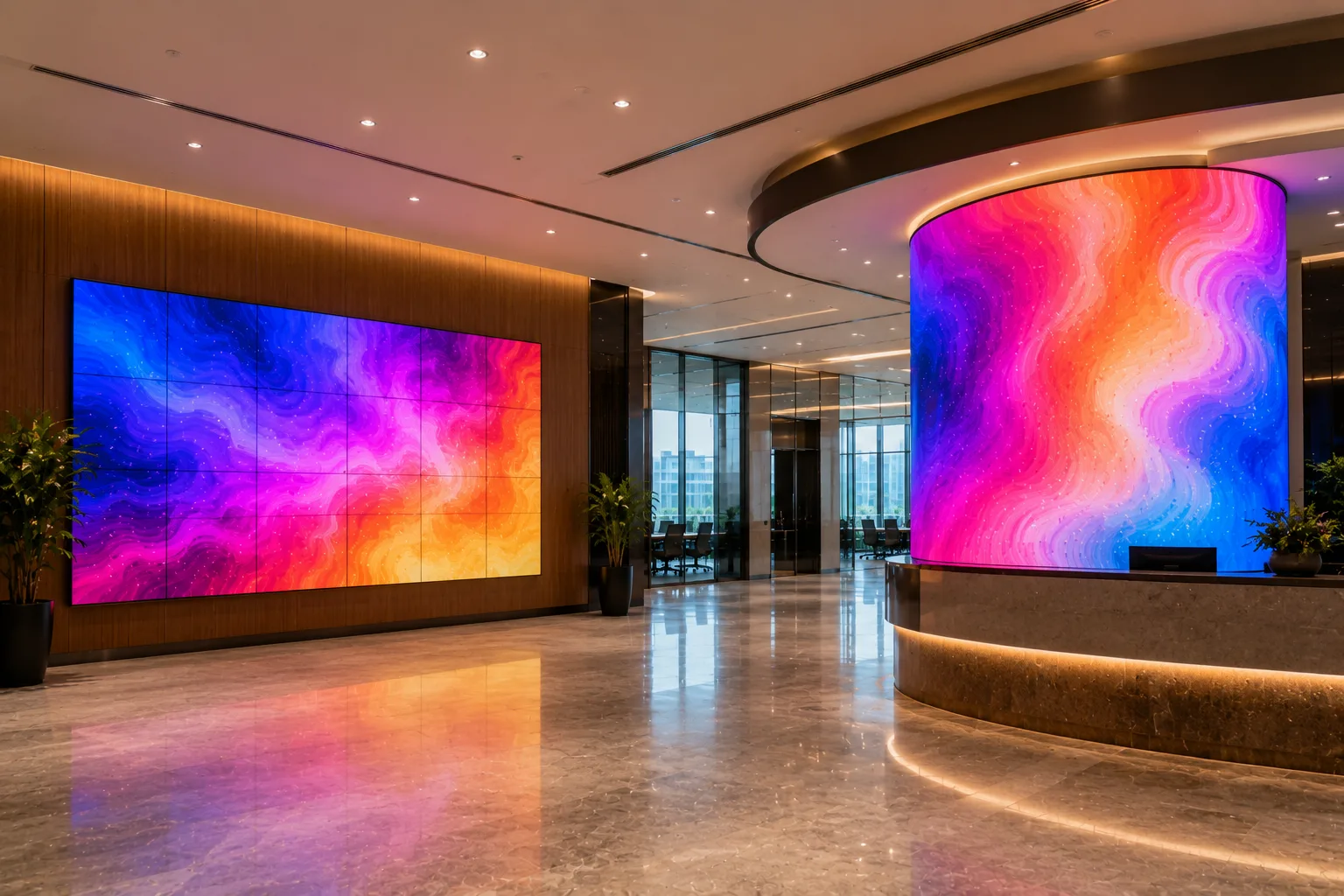
Hotels, flagship retail locations, airports, museums, and upscale corporate headquarters frequently specify LED displays that follow curved walls, wrap around pillars, or integrate into custom reception counters. Standard flat cabinets cannot achieve this accurately. Custom engineering resolves the problem by designing cabinets to the required curvature and finish.
Exact-Fit Dimensional Requirements
Some installations must match a wall recess or architectural opening precisely. Standard cabinet dimensions may leave visible seams or unusable gaps. Custom LED displays eliminate this problem by aligning cabinet sizes and aspect ratios with the physical space.
Broadcast and Studio Production
Live production environments and broadcast studios operate under technical specifications that exceed standard commercial panels. Requirements such as high refresh rates, precise colour calibration, camera-synchronised scanning, and minimal scan-line interference almost always require purpose-built display engineering.
Transparent and Sensor-Integrated Applications
Transparent LED displays designed for glass storefronts, exhibition pavilions, or showroom facades require specialised panel construction and defined transparency ratios. LED systems integrated with sensors, triggers, or building management platforms may similarly need custom hardware configuration.
Evaluation Criteria for Indian Businesses
The purchase decision should not hinge on product appearance alone. These are the factors that matter most when choosing between a custom LED display and a standard indoor LED display board.
Site and Environment Assessment
- Viewer distance and typical viewing angle
- Ambient lighting levels throughout the day
- Precise wall dimensions and available structural support
- Indoor or outdoor exposure conditions
Service Infrastructure
- Spare parts availability for the chosen product type
- Manufacturer's technical support capacity and on-site response time
- Warranty coverage terms and duration
Expansion Planning
Businesses that anticipate adding display capacity should confirm whether planned additions can integrate with the current system. Standard LED panels tend to offer better scalability for phased rollouts.
Total Cost of Ownership
The procurement price is one line in the total cost calculation. A complete assessment should include installation, maintenance, replacement components, power consumption over the operational lifespan, and the cost of future technology upgrades.
Conclusion
For most Indian businesses, a well-specified standard indoor LED display board delivers everything required — professional image quality, manageable procurement cost, straightforward maintenance, and faster deployment.
Custom LED displays serve a distinct purpose: they are appropriate when the project involves architectural integration, non-standard geometry, advanced broadcast requirements, or transparent display applications that fall outside the range of standard product lines.
Procurement teams that begin with a clear assessment of site conditions, technical requirements, and long-term ownership costs consistently make better LED display decisions — and avoid spending on customisation that the installation was never going to use.