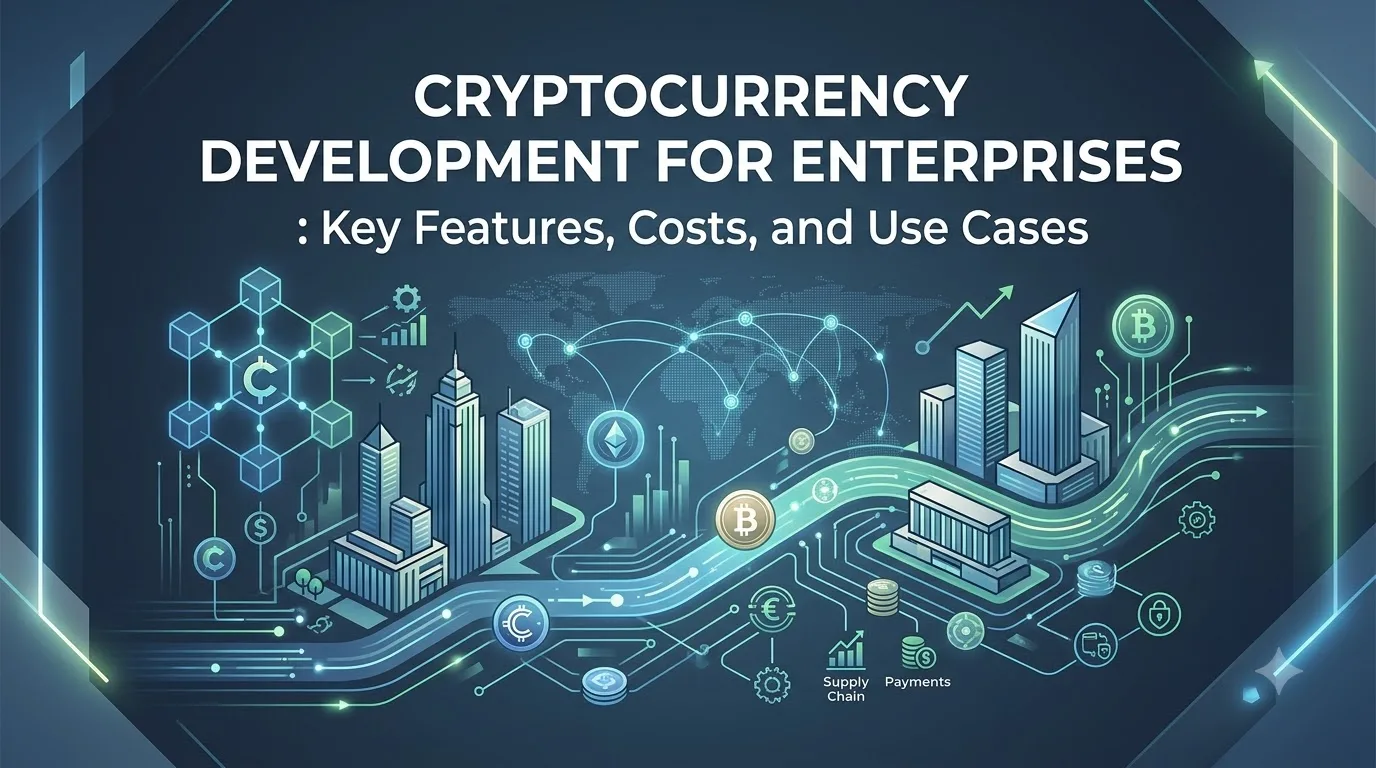
Enterprise blockchain adoption has moved beyond experimentation, with organizations across finance, healthcare, logistics, retail, and manufacturing integrating cryptocurrency solutions into their digital strategies. Blockchain now supports secure payments, smart contract automation, improved transparency, and new digital business models beyond its original role in powering cryptocurrencies.
As enterprise blockchain investment continues to grow, businesses are focusing on secure, scalable, and compliant solutions that integrate with existing systems. Success depends on strong architecture, regulatory readiness, interoperability, and governance rather than simply launching a digital asset.
Understanding Enterprise Cryptocurrency Development
Enterprise cryptocurrency development refers to designing and implementing blockchain-based digital asset ecosystems tailored for business operations rather than public speculation. These platforms can support internal financial transactions, customer rewards, supply chain verification, asset tokenization, decentralized identity management, or cross-border settlements.
Unlike consumer-focused cryptocurrencies, enterprise blockchain solutions prioritize:
- Security and regulatory compliance
- Controlled network governance
- High transaction throughput
- Integration with ERP and CRM platforms
- Privacy for sensitive business information
- Long-term operational stability
Many businesses work with a cryptocurrency development company to simplify blockchain implementation. Companies like Blockchain App Factory support enterprise blockchain solutions, token launches, and ICO projects with secure, scalable, and compliance-focused development.
As enterprise adoption continues to expand, businesses increasingly rely on specialized cryptocurrency development services to design solutions that align with industry regulations, operational workflows, and long-term growth objectives.
Essential Features of Enterprise Cryptocurrency Platforms
Scalable Blockchain Infrastructure
Scalability is one of the first considerations for enterprise blockchain systems. While many public blockchains process relatively limited transactions per second, enterprise environments often require thousands of daily transactions without network congestion.
Scalable architecture may include:
- Layer-2 scaling technologies
- Sidechains
- Parallel transaction processing
- Efficient consensus algorithms
- Cloud-native deployment
A scalable system ensures consistent performance as transaction volumes increase without significantly raising operational costs.
Advanced Security Architecture
Security remains the highest priority for enterprise cryptocurrency platforms because they frequently manage valuable digital assets, confidential business records, and customer information.
Enterprise-grade security commonly includes:
- Multi-signature authorization
- Hardware Security Module (HSM) integration
- End-to-end encryption
- Secure private key management
- Role-based access controls
- Continuous security monitoring
Smart contract audits also play a critical role in preventing vulnerabilities that attackers could exploit.
Organizations that invest in comprehensive security measures significantly reduce financial and operational risks associated with blockchain deployments.
Smart Contract Automation
Smart contracts replace manual workflows by automatically executing predefined business rules once specified conditions are satisfied.
Enterprise applications include:
- Automated supplier payments
- Escrow management
- Digital licensing
- Insurance claim processing
- Royalty distribution
- Token issuance
Automation minimizes administrative overhead while improving transaction accuracy and reducing delays caused by manual verification.
Regulatory Compliance
Compliance requirements vary across industries and jurisdictions, making regulatory readiness an essential feature rather than an optional enhancement.
Enterprise cryptocurrency platforms frequently incorporate:
- Know Your Customer (KYC)
- Anti-Money Laundering (AML)
- Transaction monitoring
- Identity verification
- Audit trails
- Tax reporting capabilities
Building compliance into the platform from the beginning simplifies future expansion into regulated markets.
Integration with Existing Business Systems
Blockchain rarely replaces an organization's existing software ecosystem. Instead, it functions alongside ERP, CRM, payment gateways, accounting platforms, inventory systems, and customer portals.
Modern APIs enable seamless communication between blockchain infrastructure and enterprise applications, allowing organizations to automate workflows without disrupting existing operations.
Governance Framework
Public blockchain governance often depends on decentralized communities. Enterprise environments require clearly defined governance structures with designated decision-makers and operational policies.
Governance frameworks typically define:
- Voting mechanisms
- Permission management
- Network upgrades
- Validator selection
- Emergency procedures
- Compliance oversight
A structured governance model supports operational consistency while maintaining accountability across stakeholders.
Enterprise Cryptocurrency Development Costs
Development costs vary considerably depending on project complexity, technical requirements, compliance obligations, and infrastructure choices. There is no universal pricing model because every enterprise solution addresses unique business challenges.
Several factors influence overall investment.
Blockchain Network Selection
Developing on Ethereum, Solana, Hyperledger Fabric, Polygon, Avalanche, or a custom blockchain affects both implementation complexity and ongoing operational expenses.
Public blockchains may require transaction fees, while private blockchain infrastructure introduces hosting and maintenance costs.
Platform Complexity
Basic token development requires significantly fewer resources than building a comprehensive enterprise ecosystem featuring:
- Smart contracts
- Wallet integration
- Payment systems
- Administrative dashboards
- Mobile applications
- Analytics platforms
- Identity verification
- Cross-chain interoperability
Every additional module increases both development effort and testing requirements.
Security Requirements
Organizations operating in regulated industries generally allocate substantial budgets for:
- Security audits
- Penetration testing
- Smart contract verification
- Infrastructure monitoring
- Disaster recovery planning
Although security investments increase upfront costs, they often prevent substantially larger financial losses resulting from cyberattacks.
Compliance Implementation
Compliance-related features frequently account for a meaningful portion of enterprise blockchain budgets.
Development may involve integrating:
- KYC providers
- AML screening
- Risk assessment engines
- Reporting systems
- Identity verification services
These integrations ensure regulatory readiness while supporting long-term scalability.
Ongoing Maintenance
Blockchain platforms require continuous maintenance after deployment.
Recurring expenses may include:
- Software updates
- Performance optimization
- Security monitoring
- Smart contract upgrades
- Infrastructure hosting
- Technical support
- Compliance updates
Organizations should budget for long-term operational maintenance rather than focusing exclusively on initial development.
Enterprise Use Cases Across Industries
Financial Services
Financial institutions represent one of the fastest-growing enterprise blockchain adopters.
Applications include:
- Cross-border payments
- Digital asset custody
- Stablecoin infrastructure
- Settlement automation
- Tokenized securities
- Trade finance
Blockchain reduces settlement times that traditionally require several business days, improving liquidity while lowering operational costs.
Supply Chain Management
Supply chain transparency remains a significant challenge for multinational organizations.
Blockchain creates immutable records documenting each stage of product movement from manufacturing through final delivery.
Benefits include:
- Product authenticity verification
- Counterfeit prevention
- Shipment tracking
- Supplier accountability
- Inventory transparency
Major retailers and logistics companies increasingly leverage blockchain to improve traceability and customer confidence.
Healthcare
Healthcare organizations manage enormous volumes of sensitive patient information while complying with strict privacy regulations.
Blockchain supports:
- Secure medical records
- Prescription verification
- Pharmaceutical supply chain tracking
- Clinical trial transparency
- Healthcare identity management
Patients gain greater control over personal medical information while providers benefit from improved data integrity.
Manufacturing
Manufacturers use blockchain to improve operational efficiency by tracking raw materials, verifying component authenticity, and automating procurement.
Smart contracts also facilitate supplier payments after delivery milestones are verified, reducing administrative processing time.
Real Estate
Property transactions involve multiple intermediaries, extensive documentation, and lengthy verification procedures.
Blockchain simplifies these processes through:
- Digital ownership records
- Tokenized real estate assets
- Automated escrow
- Smart contract settlements
- Transparent transaction histories
Tokenization additionally enables fractional ownership, expanding investment opportunities.
Retail and Loyalty Programs
Businesses increasingly replace traditional loyalty systems with blockchain-based reward ecosystems.
Customers receive digital tokens that can be redeemed, exchanged, or transferred securely while businesses gain improved transparency regarding reward distribution and customer engagement.
Many retailers are also exploring blockchain-powered payment systems that reduce processing fees and support international commerce.
Conclusion
Enterprise cryptocurrency development has evolved into a practical business strategy rather than an experimental initiative. Organizations across industries are leveraging blockchain to improve operational efficiency, automate workflows, strengthen security, enhance transparency, and create new digital business models. While implementation requires careful planning around scalability, compliance, governance, and security, the long-term benefits often outweigh the initial investment. Businesses that define clear objectives, choose the right technology stack, and partner with experienced providers of cryptocurrency development services are better positioned to build resilient blockchain ecosystems that support sustainable growth and future digital transformation.