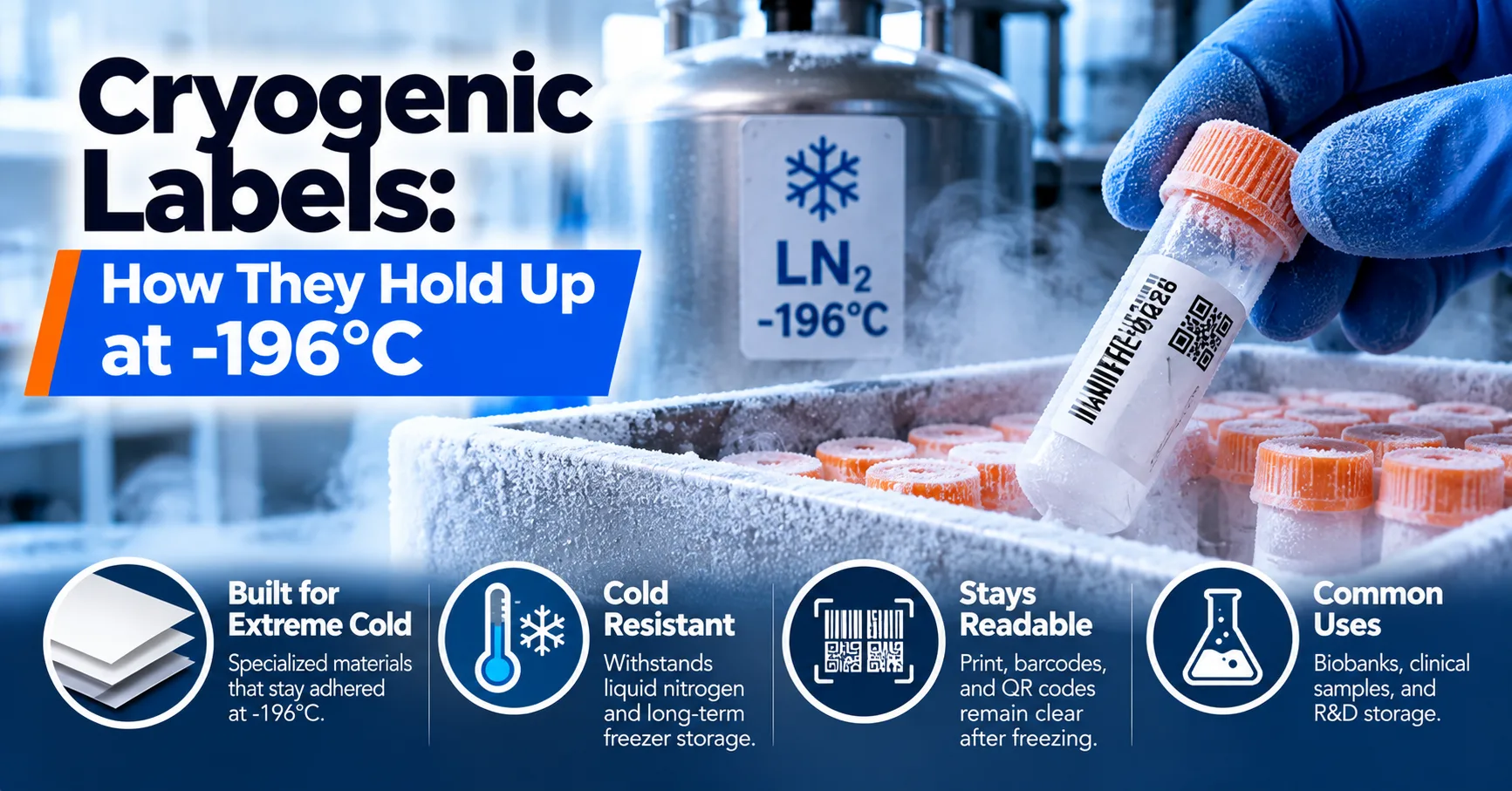
Cryogenic labels, often called cryo labels, are self-adhesive identification labels built to stay attached and readable on vials, tubes and boxes stored in liquid nitrogen, where the liquid boils at about -196°C. They hold up because every layer of the construction, from the face film to the adhesive to the printed ink, is chosen for how it behaves at that temperature rather than at room temperature. A standard paper or office label usually fails long before a sample reaches the bottom of a dewar.
For a biobank, IVF clinic, cell therapy lab or research group, a lost label means a lost sample identity, and often a sample that can no longer be used. Below is what actually happens to a label at -196°C, how cryogenic constructions are designed around those stresses, and what buyers should check before ordering. Pryntiva's own cryogenic, autoclave and solvent-resistant constructions sit within its laboratory labels range.
What Happens to a Label at -196°C
Liquid nitrogen boils at roughly 77 K, or about -196°C, according to the NIST Chemistry WebBook. In laboratory practice, "cryogenic" storage generally means temperatures at or below -150°C, the definition used by Simione and Sharp in their review of best practices for storing and shipping cryopreserved cells. Storage this cold is chosen because it sits below the glass transition temperature of pure water, around -132°C, which the ISBER addendum on liquid nitrogen storage identifies as the zone where most deterioration slows sharply (Fisher Scientific summary of the ISBER guidance).
That same deep cold works against a label in three ways.
The adhesive loses its tack
A pressure-sensitive adhesive works because it stays soft enough to flow into the surface it touches. As the temperature drops, that softness disappears. A study by a Henkel applications engineer, published through the Pressure Sensitive Tape Council, notes that adhesives lose tackiness first as temperature falls and are likely to turn brittle and detach below their minimum service temperature. The same work points out that this minimum depends on adhesive chemistry, coat weight, face stock and the application itself. That is why general-purpose freezer labels and cryo labels are not interchangeable, even when both look similar on the roll.
The face film and the container shrink differently
Every material contracts as it cools, and each contracts at its own rate. A polypropylene cryovial, a synthetic label film and the adhesive between them all move differently on the way down to -196°C. If the face film is too stiff, it can pull away at the edges, a failure usually called flagging. If it is too brittle, it can crack along the curve of a narrow tube. Cryogenic constructions use synthetic films selected to stay flexible enough to follow that movement.
Frost, condensation and the thaw cycle
When a cold vial meets room air, moisture condenses and freezes on it almost instantly. Repeated retrievals expose the label to frost, meltwater and alcohol wipes, then send it back into deep cold. Each cycle tests the bond line and the print. A label that survives one plunge into liquid nitrogen can still fail after months of handling, so long-term performance matters more than a single immersion test.
How a Cryogenic Label Is Built
A cryogenic label is a system of three layers, and each one has a specific job. The table below summarizes what buyers generally look for in each layer.
LayerIts job at -196°CWhat to ask the supplierFace stockStay flexible, resist cracking, accept printWhich film is used, and is it rated for liquid phase, vapor phase or both?AdhesiveStay bonded through contraction and frost cyclesMinimum application temperature and minimum service temperaturePrintStay legible and scannable after frost, thaw and wipingRecommended print method and ribbon, plus chemical resistancePaper face stocks are generally a poor fit because they absorb condensation. Synthetic films are the norm in cryogenic labeling, and the film, adhesive and print are best validated together rather than chosen separately.
Liquid Phase or Vapor Phase: Why the Rating Matters
Samples in a liquid nitrogen tank can sit submerged in the liquid or above it in the cold vapor. The difference matters for the sample and for the label.
Institutional safety offices generally prefer vapor-phase storage for cryovials. Yale Environmental Health and Safety advises storing cryovials in the vapor phase only and notes that most tube manufacturers warn against immersion, because liquid nitrogen can seep in through the cap and expand violently when the vial warms. Harvard's EH&S guidance describes the same rupture risk and recommends moving liquid-phase tubes into the vapor phase for 24 to 48 hours before removal, or thawing them inside a sealed, unbreakable container.
For label buyers, this means the storage phase belongs in the specification. Many cryo labels on the market are rated for vapor-phase storage at around -150°C, while others are rated for direct immersion at -196°C. A vapor-rated label may be entirely appropriate for a tank that keeps samples above the liquid, but it should not be assumed safe for submerged racks. Pryntiva applies the same thinking across its medical labels for cold-chain work: the construction is chosen for the harshest condition the item will meet, not the average one.
Application Temperature Is Not the Same as Storage Temperature
This is the point that catches the most buyers out. A label's service rating tells you how cold it can be stored. Its minimum application temperature tells you how cold the container can be when the label goes on. The two figures are often far apart.
Most cryogenic constructions are designed to be applied to a clean, dry container at room temperature and then frozen. The PSTC research cited above explains why: tack drops as temperature falls, so an adhesive that bonds well at 20°C may barely wet the surface of a vial that has just left a -80°C freezer. Frost makes it worse by placing a layer of ice between the adhesive and the plastic.
Surface preparation matters as much as the adhesive itself. A tube handled with damp gloves, or one carrying residue from a disinfectant wipe, gives the adhesive less clean plastic to grip. Labs that see edge lifting often trace it back to application habits rather than the label: touching the adhesive side, applying the label to a tube still wet from a water bath, or wrapping it loosely without firm pressure along its full length. A few seconds of careful application usually does more for long-term adhesion than switching products.
Relabeling already frozen samples is a separate use case. Specialty cryo labels for frozen vials use adhesives formulated to grip a cold surface, and suppliers of these products commonly advise wiping off visible frost with a lint-free wipe and pressing the label firmly around the full circumference. If your workflow involves relabeling inventory without thawing it, say so clearly when you request samples. Container size matters here too. Pryntiva's ampoule and vial labels are sized for wraparound fit on a few millimetres of circumference, which affects how much overlap a label can achieve on a small frozen tube.
Printing Cryogenic Barcode Labels That Still Scan
Adhesion solves only half the problem. The label also has to identify the sample, and in most modern labs that means a barcode read by a scanner, often while the vial is still cold and frosted.
Guidance from reproductive medicine shows how strict the identification requirement can be. A best-practice paper on cryogenic storage in assisted reproduction labs states that labels on cryodevices should carry at least two unique identifiers, a specimen number, a date and an accurate description of the contents. All of that has to fit on a tube that may be only a few millimetres across.
Three print decisions shape the result:
- Print method. Thermal transfer with a resin ribbon is widely used for cryogenic barcode labels because resin ink bonds well to synthetic films and resists alcohol and abrasion. Pryntiva's specimen and laboratory labels specify resin thermal transfer or specialty print rather than direct thermal, which Pryntiva notes can fade over the life of a stored sample.
- Symbology. 2D codes such as DataMatrix pack a sample ID into a small square, which suits microtubes and cryovial caps better than a long linear barcode.
- Print grade. A code that scans at the bench may fail after frost and abrasion. Ask for print verified to a readable grade on the actual face stock you will use.
Some tube manufacturers also laser-etch 2D codes into the base of the tube. Those codes complement a printed side label rather than replace it, since the side label still carries the human-readable text staff check by eye.
Rolls or Cryogenic Label Sheets?
Format follows the printer and the volume. Rolls run on thermal transfer printers and suit labs that print barcodes on demand or in large batches. Cryogenic label sheets run through office laser printers and suit smaller labs, teaching facilities or projects where a dedicated barcode printer is hard to justify.
Each format has trade-offs. Sheets make a small batch easy to print from standard software, but the laser toner must be matched to a face film that holds it at deep cold, and sheet layouts can waste labels when you only need a few. Cryo labels on rolls give tighter control over barcode quality and simplify serialized printing, but they need compatible hardware and ribbon. Buyers who want to print in-house can also start from blank stock. Pryntiva supplies blank medical labels for laser, thermal transfer and handwriting, and offers its laboratory constructions as blank material, so the face and ribbon combination can be validated on the buyer's own printer.
A Practical Checklist for Cryogenic Labeling
Before placing an order, a short checklist prevents most label failures:
- Confirm the coldest condition. Liquid-phase immersion, vapor phase, a -80°C freezer and dry ice transport each point to a different construction.
- Record the container. Note the material (polypropylene or glass), the diameter and any frosted writing area.
- Decide how labels go on. Room-temperature application before freezing, or relabeling of frozen stock.
- Choose the printer first. Thermal transfer roll printer, laser printer, or labels preprinted by the supplier.
- Check chemical exposure. Ethanol wipes, DMSO and disinfectants can attack weak print.
- Plan any hazard content. If a label also carries chemical hazard information, the layout should follow recognized elements such as the six elements of a GHS label.
- Test before you commit. Run samples through your real freeze, storage, retrieval and thaw cycle, then scan them.
No datasheet replaces the last step. A supplier's test conditions rarely match a specific lab's tanks, tubes and handling habits exactly.
Where Pryntiva Fits
Pryntiva is a label manufacturer with its production center in Shenzhen. On its laboratory labels page, the company lists a temperature range for its laboratory constructions from -196°C (liquid nitrogen) up to autoclave steam, with deep-cold permanent adhesives and formats for microtubes, cryovials, slides, bottles and plates, supplied on rolls or sheets. Pryntiva also states that performance is confirmed after validation in the buyer's own cryogenic, autoclave or solvent workflow, and it provides samples for that purpose.
In practical terms, Pryntiva supplies cryo labels either as finished labels printed with barcodes and variable data or as specialty blank stock for in-house printing, including OEM and private-label programs for lab-consumable distributors. For help matching a face stock, adhesive and print method to a specific tank and tube, you can talk to a Pryntiva engineer.
Get Samples Before You Commit
Cryogenic labeling works only when the label, the container, the printer and the storage routine are matched to each other. Send Pryntiva your storage phase, tube type, printer model and expected volume through the contact page, and request samples to test in your own tanks before placing a production order.
Frequently Asked Questions
What temperature can cryogenic labels withstand?
Cryogenic labels are rated by their manufacturers for specific storage conditions, and the most demanding ratings cover liquid nitrogen at about -196°C. Not every product carries that rating, since some are designed for vapor-phase storage around -150°C or for -80°C freezers. Check the stated service temperature and storage phase on the datasheet, then confirm the rating by testing samples in your own tanks.
Can cryo labels go straight into liquid nitrogen after application?
Some can, depending on the construction. Certain products are sold as needing no cure time before immersion, while others perform better when the adhesive has time to bond at room temperature first. Follow the supplier's application instructions and test the full workflow before relying on the label for valuable samples.
Why do ordinary labels fall off in liquid nitrogen?
Ordinary labels fall off because their adhesive loses tack and turns brittle at very low temperatures. The face material and the container also contract at different rates, which stresses the bond line. Paper faces add another problem by absorbing condensation during thaw. Cryogenic constructions use adhesives and films selected for deep-cold service.
Can you label a vial that is already frozen?
Yes, but only with labels designed for frozen-surface application. Most cryogenic labels need a dry container at or near room temperature to bond properly. Frozen-surface products use adhesives formulated to grip cold plastic, and suppliers typically recommend wiping off visible frost first. Test these labels on your own tubes before a full rollout.
Is thermal transfer or direct thermal better for cryogenic barcode labels?
Thermal transfer with a resin ribbon is the more common choice for long-term cryogenic storage. Resin ink bonds to synthetic films and tends to resist alcohol and abrasion. Direct thermal printing relies on a heat-sensitive coating that can darken or fade with heat and some chemicals. Pryntiva recommends resin thermal transfer or specialty print for its specimen labels.
Should cryovials be stored in liquid or vapor phase?
Vapor phase is the arrangement most institutional safety offices recommend for cryovials. Liquid nitrogen can leak into immersed vials and expand rapidly on warming, which can make the vial burst. Yale and Harvard safety guidance advises vapor-phase storage, or specific precautions when liquid-phase storage cannot be avoided. Label ratings should match the phase you actually use.
Are cryogenic label sheets as durable as rolls?
Cryogenic label sheets can perform well when the face film is designed for both laser printing and deep cold. Durability depends on the full combination of film, adhesive and toner rather than the sheet or roll format itself. Rolls are usually preferred for high-volume barcode printing, while sheets suit smaller batches printed on office equipment.
How do I choose a cryogenic label supplier?
Choose a supplier that asks about your storage phase, container, application temperature and printer before recommending a product. Ask for datasheets that state both minimum application and minimum service temperatures. Request samples and run them through your real storage and thaw cycle. Suppliers that offer engineering support and custom constructions make it easier to fix problems before a full order.