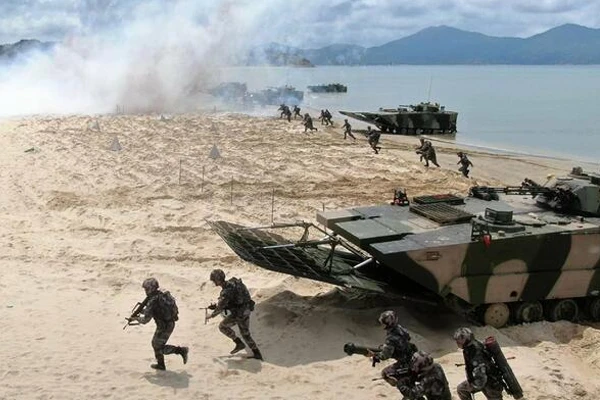
In every war game that simulates a Chinese invasion of Taiwan, the question that matters most is not "when will China strike?" but rather "how will America respond?"
This ninth installment of our series explores the strategic ambiguity, political paralysis, and potential military responses that define the U.S. dilemma over Taiwan.
THE TAIWAN RELATIONSHIP: STRATEGIC AMBIGUITY AT ITS LIMITS
Since 1979, the U.S. has adhered to a deliberately vague policy: it acknowledges One China but does not endorse it. This has allowed Washington to maintain unofficial ties with Taiwan and sell arms, while avoiding direct military commitments.
That ambiguity, however, may no longer deter Beijing. It may even invite action. China views U.S. statements on Taiwan as inconsistent, signaling resolve one day and hesitation the next. The PRC interprets this as an opportunity — a diplomatic vulnerability to exploit. For decades, this deliberate vagueness worked as a strategic deterrent. Today, it teeters on the edge of irrelevance.
The Chinese Communist Party is betting that America’s reluctance to clearly define its Taiwan policy stems from a lack of appetite for confrontation. If that bet pays off, the balance of power in Asia will change permanently.
WAR GAMED TO DEATH — BUT STILL UNPREPARED?
In classified and public simulations, U.S. and allied forces often lose the first phase of a Chinese invasion. The problem isn’t American power — it’s distance, delay, and denial.
- U.S. bases in Okinawa and Guam are vulnerable to missile barrages. China’s DF-26 and DF-17 missiles can hit U.S. positions well before reinforcements are scrambled.
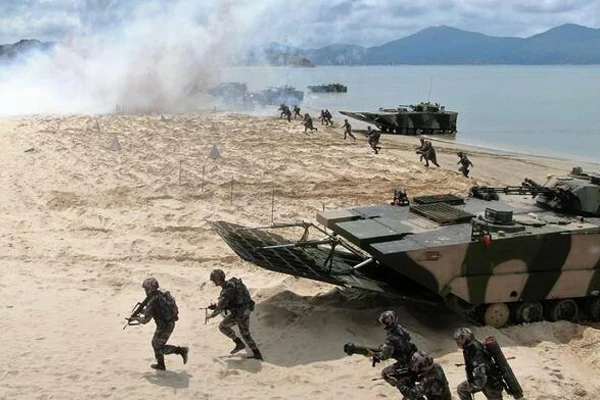
- Carrier groups take time to deploy. The closest carrier strike group might be days or weeks away. China needs only 72 hours to secure a beachhead.
- Taiwan’s defenses may collapse before help arrives. Without prepositioned U.S. troops or real-time intervention, Taipei could fall before a single American boot hits the ground.
Wargames at RAND Corporation and the Center for Strategic and International Studies have painted a grim picture: even with American intervention, Taiwan’s air force is obliterated in days, and its naval capabilities wiped out in the opening hours.
POLITICAL GRIDLOCK, STRATEGIC PARALYSIS
The American public is war-weary. Congress is divided. And a Chinese strike might come at a time of electoral distraction or internal unrest. The January 6th Capitol riot, the withdrawal from Afghanistan, and continued polarization all signal to Beijing one disturbing truth: America’s enemies do not believe it can act quickly — or cohesively.
Would Washington commit to a war that could cost thousands of lives and trillions of dollars? Would it risk nuclear escalation over an island 7,000 miles away? Maybe. But maybe not fast enough.
The decision-making structure in Washington is slow, consultative, and cautious — admirable in diplomacy, but disastrous in rapid military response. Chinese strategists are betting on that very hesitation.
OPTIONS ON THE TABLE
If America acts, it could pursue several paths:
1. Full Military Intervention
Sending carrier groups, Marines, and air wings to directly support Taiwan. This would be the most aggressive and risky option, requiring pre-positioned forces and the willingness to go toe-to-toe with China in contested waters and airspace. It would also invite retaliation on U.S. assets in Japan, Guam, or even Hawaii.
2. Aerial Blockade and No-Fly Zones
Imposing a partial blockade or establishing no-fly zones over Taiwan and the Taiwan Strait would be a middle option. Still dangerous, still escalatory, but with lower immediate costs. However, it risks mirroring the Syrian no-fly zone debate — politically symbolic, militarily limited.
3. Arming Taiwan to the Teeth
The "Ukraine model": flood the island with weapons, intelligence, and satellite data. The challenge? Taiwan isn’t land-connected to any U.S. ally. Delivering munitions during an active blockade would be nearly impossible. This strategy must start before the shooting begins.
4. Economic Retaliation
Global sanctions on Beijing, likely with Japan, the EU, and Australia. The downside? China’s economy is deeply embedded in global supply chains. Sanctions would also hurt the West. Moreover, China is already decoupling and preparing for this exact scenario.
Each option is laden with risk. Each choice will define U.S. credibility for a generation.
THE ROLE OF AMERICA’S ALLIES — AND LIMITS OF THE COALITION
If Washington hesitates, many of its allies will follow suit. Japan has promised to support Taiwan, but constitutional limitations and political calculation may mute its actual engagement. Australia is geographically positioned but militarily limited. Europe will issue statements, but likely stay hands-off.
The Philippines is vital for regional access, yet Manila’s posture toward China is inconsistent. South Korea’s calculus is shaped by North Korea, not Taiwan.
This creates a chilling truth: the only country that can move fast enough and forcefully enough to deter China is the United States. But the coalition will only follow if Washington leads.
CONCLUSION: AMERICA’S CHOICE, AND THE COST OF HESITATION
Taiwan may only have days to hold the line. Whether America acts could decide the fate of the Indo-Pacific for a generation. Deterrence works until it doesn’t. And strategic ambiguity is only a strategy until it becomes a liability.
If Washington fails to respond — or responds too slowly — the consequences won’t just be felt in Taipei. They will echo through Tokyo, Canberra, New Delhi, and every capital that depends on American leadership for stability.
China’s strategy hinges on the bet that Washington won’t act decisively, or quickly enough. And that might be the most dangerous bet of all.