
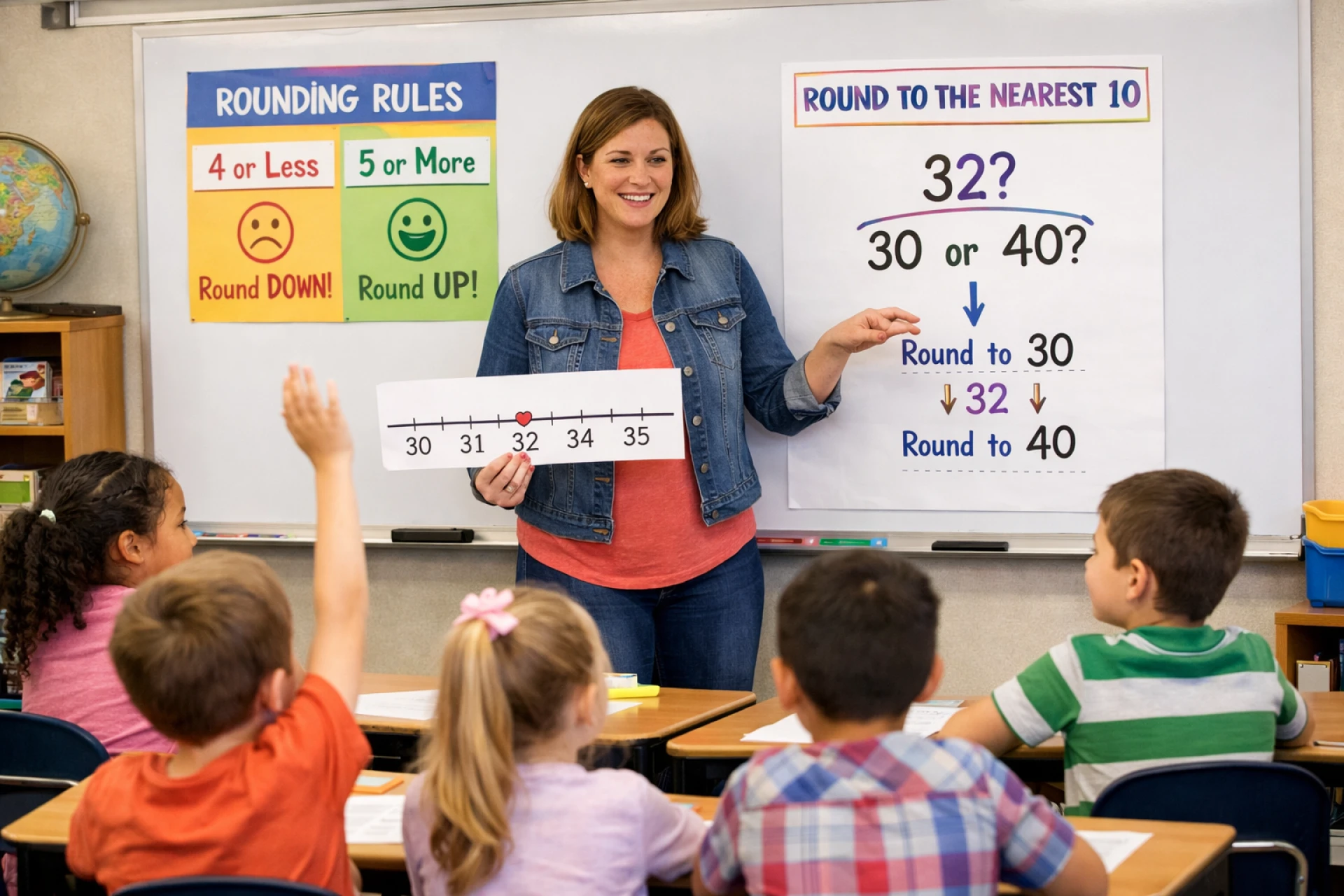
Helping third graders understand rounding can be both exciting and engaging when taught creatively. At this age, students are ready to work with larger numbers, explore number patterns, and make sense of place value in deeper ways. Rounding plays a major role in strengthening their number sense, mental math, and estimation skills, abilities they will rely on throughout their academic journey. When teachers introduce rounding through interactive, hands-on, and relatable experiences, students not only grasp the concept quickly but also develop a genuine interest in working with numbers.
This guide explores multiple creative strategies, classroom activities, and instructional approaches designed specifically for Grade 3 learners. These ideas help move beyond traditional worksheets and bring rounding concepts to life in memorable and meaningful ways.
Why Rounding Matters in Grade 3
Before diving into methods, it’s helpful to understand why rounding is such an important skill at this level.
Third graders:
- Begin working with larger numbers such as tens, hundreds, and thousands.
- Strengthen their place-value understanding.
- Improve their mental calculation skills.
- Learn how to estimate in both math problems and real-life situations.
Rounding helps simplify numbers, making them easier to work with when adding, subtracting, comparing, or estimating. When taught through imaginative approaches, students learn how rounding supports problem-solving and everyday decision-making, skills they naturally enjoy practicing.
1. Start with a Story: The Rounding Roller Coaster
Children love stories, and storytelling is one of the most effective ways to build conceptual understanding. Introduce rounding using a fun story such as:
“The Rounding Roller Coaster”
Imagine a roller coaster with a hill representing numbers. Every number wants to ride, but they can only sit at the top of the hill, either at the lower benchmark or higher benchmark (like 30 or 40 when rounding to the nearest ten). If a number is halfway or more up the hill, it rolls up to the next stop. If it’s lower on the hill, it rolls down.
Using visuals or drawing the coaster on the board makes the concept memorable. Students relate instantly to the “roll up” or “roll down” idea and understand why numbers round the way they do.
2. Use Number Lines to Build Confidence
Number lines are powerful tools for teaching rounding. They give students a clear visual of where numbers fall between two benchmarks.
How to make it fun:
- Let students build “human number lines” where they stand in a row holding number cards.
- Students physically move along the number line to decide whether a number is closer to the lower or higher rounding point.
- Use masking tape on the classroom floor to create a giant visual number line.
This physical and visual involvement helps kinesthetic learners and supports those who need extra reinforcement.
3. Transform Rounding Practice into a Game
Games turn learning into an exciting challenge and help reinforce skills without students feeling like they are doing worksheets.
a. Rounding Basketball
Set up a small bin as the “basket.”
Write numbers on sticky notes and let students pick one, determine the rounded number, and toss the note into the basket, earning points for correct answers.
b. Rounding Bingo
Create bingo cards with rounded values such as 10, 20, 30, 40. Call out numbers like 12, 26, or 38, and students mark their card according to the rounded number.
c. Rounding Race
Students work in teams. Call out a number and see which team correctly rounds it first. This encourages collaboration, speed, and accuracy.
Gamifying learning keeps students motivated and helps the concept stick.
4. Use Real-Life Contexts That Matter to Kids
Children understand rounding best when it's connected to their daily life.
Examples:
- Money: “Is $47 closer to $40 or $50?”
- Time: “If it's 8:26, is it closer to 8:30 or 8:20?”
- Distances: “If you walked 123 steps, how many steps is that?”
These real-life examples help students understand why rounding matters and how people use it all the time.
5. Introduce Rounding with Concrete Objects
Hands-on manipulatives help visual learners make sense of numerical relationships.
Try using:
- Counters
- Base-ten blocks
- Beads
- Popsicle sticks grouped in bundles of 10 or 100
Let students model numbers physically, compare quantities, and determine whether to round up or down. This approach allows them to see the difference between place values and understand the rounding process step by step.
6. Bring Technology Into the Lesson
Digital tools add an interactive layer to rounding practice. Students can explore:
- Online rounding games
- Digital number line apps
- Smartboard rounding challenges
- Virtual manipulatives
With technology, students receive instant feedback, which helps strengthen learning and boosts engagement.
Teachers can also add online practice activities from trusted learning platforms. Linking students to helpful practice sets, such as Rounding Numbers Activities,offers additional support outside the classroom.
7. Use Rounding Anchors and Classroom Tools
Anchor charts help students remember key ideas.
Create charts that show:
- Rounding rules
- Examples for rounding 2-digit and 3-digit numbers
- A rounding rhyme (e.g., “5 or more, raise the score; 4 or less, give it a rest”)
- Number line illustrations
Place these around the classroom so students can refer to them during independent work.
You can also introduce rounding sliders, where students slide a marker along a number line to identify rounding positions.
8. Let Students Create Their Own Rounding Problems
Giving ownership of learning boosts understanding. Let students:
- Write numbers on cards and exchange with classmates.
- Create rounding questions for small-group activities.
- Invent stories like “The Case of the Rounding Detective” where they solve rounding mysteries.
- Build rounding posters and explain rounding steps.
This kind of creative expression builds deeper comprehension and encourages students to think critically.
9. Practice Rounding Through Movement
Physical activities energize students and help them internalize concepts.
a. Rounding Hopscotch
Use chalk to create ten-unit intervals on the floor. Call out a number, and students hop to the nearest benchmark.
b. Rounding Corners
Label each corner of the classroom with numbers (e.g., 10, 20, 30, 40). Call out a number, and students run to the corner representing its rounded value.
These movement-based approaches make math memorable and fun.
10. Provide Purposeful Worksheets and Online Practice
After using games, stories, and hands-on activities, reinforcing skills with structured practice ensures mastery.
Teachers can combine worksheets, small-group tasks, and digital activities to build confidence.
To support independent learning, you may also include third-grade-aligned interactive practice such as Rounding Numbers Activities for 3rd Grade, which helps students strengthen skills through targeted exercises.
11. Assess Understanding in Creative Ways
Formal assessments don’t have to be dry. Try:
- Rounding exit tickets
- Rounding journals where students explain their strategy
- Rounding challenges or “quiz-quizzes”
- Peer-teaching sessions
- Small-group demonstrations
These help teachers identify which students need more support and who is ready for deeper challenges.
Final Thoughts
Teaching rounding numbers in Grade 3 doesn’t have to be limited to textbooks and worksheets. With the right mix of creativity, visual support, hands-on materials, games, storytelling, and real-life connections, students develop both confidence and enthusiasm for rounding. These engaging approaches help solidify foundational number sense and prepare students for more advanced math skills ahead.
By making rounding fun, relevant, and interactive, you create a learning environment where third graders not only understand the concept but also enjoy practicing it, setting them up for long-term success in math and beyond.