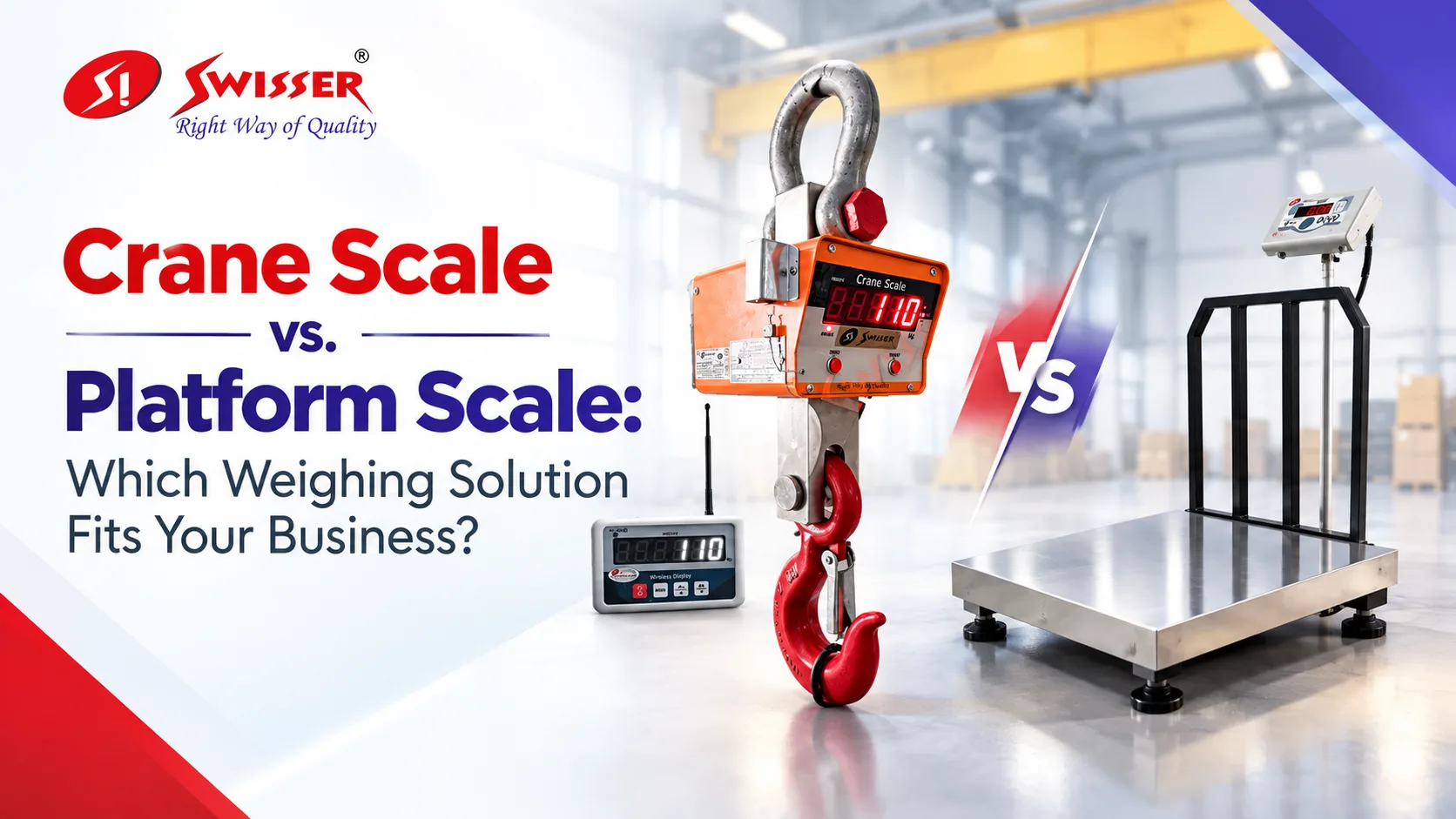
A crane scale weighs a load while it hangs from a crane hook, so it suits heavy, bulky or awkward items that lifting equipment already moves. A platform weighing scale weighs a load resting on its deck, so it suits boxes, sacks and industrial parts that travel along the floor. Choose a crane scale when lifting is part of the job. Choose a platform weighing scale when the load stays at floor level.
Buyers often compare prices first and only then ask how the load actually moves. That order causes most wrong purchases. This guide gives a step-by-step method to choose between a crane scale and a platform weighing scale, using how each product is built and where it works best.
What Is the Core Difference Between a Crane Scale and a Platform Weighing Scale?
The core difference is where the weight is measured. A crane scale measures in the air, and a platform weighing scale measures on the ground.
What is a crane scale?A crane scale serves to lift and transport heavy loads using a crane or other lifting equipment. These scales use hooks to weigh very large items, come with large displays and can weigh up to 10,000 kg. The hooks also make them easy to integrate into a variety of apparatus.
What features does a crane scale offer?
- Options such as a remote key panel, and heat protection for high-temperature work in foundries and metallurgy.
- A powder-coated metal body with gravity acceleration correction, so the scale works accurately in different locations.
- Prevention of crane overloading beyond its capacity.
Buyers can explore the full crane scale range for models and specifications.
What is a wireless crane scale?A wireless crane scale is used in industrial environments where large objects are lifted and weighed, such as building sites, manufacturing facilities, warehouses and shipping yards. Swisser Instruments also lists a wireless crane scale with a range of 1 kilometre, with a jumbo display, printer and computer interface among the options in the company's history. The wireless crane scale page shows the available models and technical data.
What is a platform weighing scale?A platform weighing scale measures the weight of objects placed on a platform or surface, and it is commonly used in industrial, commercial and retail settings. Swisser Instruments builds these scales from stainless steel for durability, with a removable bracket for mounting the indicator on a pole. For the highest loads, the heavy duty platform weighing scale is built to bear enormous weight and is used across industries to weigh hefty loads.
Quick summary: A crane scale hangs from a hook and weighs suspended loads, with a listed capacity of up to 10,000 kg. A platform weighing scale sits on the floor and weighs anything placed on its stainless steel deck. The deciding factor is whether the load is lifted or placed.
How Do a Crane Scale and a Platform Weighing Scale Compare Side by Side?
The crane scale handles hanging, heavy and oversized loads. The platform weighing scale handles floor-level loads such as boxes, sacks and parts.
FactorCrane ScalePlatform Weighing ScaleHow it weighsLoad hangs from a hookLoad rests on a deckBest load typeVery large, heavy or awkward itemsHeavy boxes, sacks and industrial partsListed capacityUp to 10,000 kgVaries by model, see product pageWhere it sitsAttached to a crane or lifting equipmentOn the floorExtra roleGuards the crane against overloadWeighs onlySpecial optionsRemote key panel, heat protectionPole-mount indicator bracket, stainless steel buildWireless optionYes, up to 1 km rangeIndicator on a poleWhich scale suits which load?A simple guide on the site puts it plainly: platform scales are the workhorses that sit on the floor and handle heavy boxes, sacks or industrial parts, while crane scales are the best choice when something must be weighed hanging in the air.
Which scale adds a safety benefit?The crane scale protects lifting equipment. It helps prevent a crane from carrying more than its rated capacity. A platform weighing scale does not play that safety role, so lifting operations gain a clear extra from the crane scale.
Quick summary: Crane scales cover hanging and heavy loads up to 10,000 kg and act as an overload check for the crane. Platform weighing scales cover floor-level loads on a stainless steel deck. Match the scale to the load type first.
How Do You Choose the Right Scale? (6-Step Method)
Follow six steps: trace the load path, check load size, review what you already own, set the accuracy need, check the environment and confirm quality credentials.
Step 1: How does your load move?Trace the load from receipt to dispatch. If a crane or hoist already lifts it, add a crane scale. If workers place it on the floor or on a pallet, use a platform weighing scale.
Step 2: How big and heavy is the load?LoadBetter ChoiceLarge, heavy or oddly shaped, up to 10,000 kgCrane scaleHeavy boxes, sacks or industrial partsPlatform weighing scaleVery heavy floor loadsHeavy duty platform weighing scaleSmall, light itemsTable top weighing scaleStep 3: What equipment do you already have?A crane scale needs a crane, hoist or other lifting equipment. A platform weighing scale needs floor space and a stable surface. Count whichever you lack before you compare prices.
Step 4: What accuracy does the job need?Read the specification tables on the product page. The industrial weighing scale page lists models by capacity, accuracy and pan size, which makes side-by-side comparison easy. Pick the capacity closest to your real working load so readings stay meaningful.
Step 5: What is the working environment?Foundries and metallurgy plants need heat protection, which the crane scale range offers. Hazardous areas need a purpose-built flameproof scale, and Swisser Instruments has supplied flameproof balances to an Indian ordnance factory. Wet or harsh floors suit stainless steel platform construction.
Step 6: Which quality credentials back the product?Swisser Instruments is ISO 9001:2015 certified. Its history also lists model approvals for crane scales, hanging scales, weighbridges and other scales. Review the certificate page before ordering.
Quick summary: Trace the load path, check size and weight, confirm your equipment, read the accuracy tables, match the environment and check certificates. A lifting workflow points to a crane scale, and a floor workflow points to a platform weighing scale.
Which Industries Use Each Scale Best?
Heavy industry and lifting operations favour crane scales. Warehousing, production floors and retail favour platform weighing scales.
Industry or SiteBest FitReasonFoundries and metallurgyCrane scale with heat protectionLoads hang from cranes in hot areasBuilding sitesCrane scale or wireless crane scaleLarge items lift constantlyShipping yardsWireless crane scaleOperators read weight from a distanceIndustrial plantsCrane scale and platform scaleHeavy lifted loads plus floor-level partsWarehousing and storagePlatform weighing scalePackages and shipments matter to operationsCommercial and retail countersPlatform or table top scaleFrequent weighing of goodsThe site's blog on the importance of industrial weighing scales in warehousing explains why the weight of packages and shipments is critical to how warehousing and public storage operate. Facilities that move loaded pallets can also review the pallet scale.
Quick summary: Foundries, building sites and shipping yards lean on crane scales. Warehouses, plants and counters lean on platform and pallet scales.
Where Does a Table Top Weighing Scale Fit In?
A table top weighing scale handles the smallest, lightest jobs, so it sits below both crane and platform scales.
What jobs suit a table top weighing scale?Tabletop scales are small, compact and well suited to weighing ingredients or small courier parcels. The table top weighing scale suits packing benches, counters and small workshops. Counting work benefits from a piece counting scale.
When should you move up to a platform scale?Move up when items no longer fit on the pan or weigh too much for a bench. Move up again to a crane scale when loads need lifting equipment.
Load and HandlingScale TierLight items handled by handTable top weighing scaleHeavy boxes, sacks or parts on the floorPlatform weighing scaleVery large or heavy suspended loadsCrane scaleCalibration needs differ across tiers. The guide on how often a table top weighing scale should be calibrated covers the light end, and how to calibrate a crane scale covers the heavy end.
Quick summary: The table top weighing scale covers small, frequent jobs. The platform weighing scale covers heavier floor loads. The crane scale covers hanging loads.
What Does Each Scale Really Cost to Own?
Total cost matters more than the quoted price. Compare purchase, space, handling time and upkeep together.
Cost ElementCrane ScalePlatform Weighing ScalePurchaseDepends on capacity and optionsDepends on deck size and capacitySpaceNo floor area neededNeeds a fixed floor areaSetupNeeds a crane or hoistNeeds a stable floorHandlingWeighing happens during the liftLoads move to the scaleUpkeepPeriodic calibrationPeriodic calibrationFloor space and handling time often outweigh a small price gap. Send your capacity, load type and environment through the contact page to get a matched quote. Swisser Instruments also offers customised crane scales built to specific requirements.
Quick summary: Crane scales save floor space and extra trips. Platform scales suit steady floor-level throughput. Compare the full cost, not only the price.
Which Mistakes Should You Avoid When Buying?
Six repeat errors cause most bad purchases.
Why is picking by price alone a mistake?A cheap scale that does not fit your workflow costs more in lost time. Decide the load path first.
Why does oversizing capacity hurt?A scale far above your normal load gives less useful readings at light weights. Choose the capacity closest to real use.
Why should the environment guide the model?Heat, moisture and hazardous atmospheres need the right build. Ask for heat protection, stainless steel or a flameproof design when the site demands it.
Why does a crane scale need proper rigging?The scale is one link in the lifting chain. Check that hooks, slings and the crane itself carry the load safely.
Why is skipped calibration risky?Readings drift over time. Schedule calibration and keep records.
Why does supplier credibility matter?Look for testing before delivery and certifications. Swisser Instruments tests its crane scales before delivery to ensure dependability.
Quick summary: Avoid price-only decisions, oversized capacity, wrong environments, weak rigging, skipped calibration and uncertified suppliers.
How Do You Keep Either Scale Accurate?
Keep a scale accurate with routine checks and scheduled calibration.
What routine checks help?- Zero the display with nothing on the scale.
- Check with a known test weight.
- Inspect hooks, shackles and the deck for damage.
- Keep the indicator clean, dry and charged.
Follow the calibration guides linked above and shorten the interval when the scale sees heavy or harsh use. Record every check with a date.
Quick summary: Zero, test and inspect routinely, and calibrate on a fixed schedule with dated records.
Do You Need Both a Crane Scale and a Platform Weighing Scale?
Many plants do, because each scale fits a different part of the process.
What does a mixed setup look like?Take a fabrication unit. A crane scale weighs incoming steel while the crane unloads it. A platform weighing scale checks finished parts on pallets before dispatch. A table top weighing scale handles small cartons at the packing bench. Each load meets the scale that suits it, and no item makes an extra trip.
Your SituationRecommendationEvery load is liftedCrane scaleEvery load is placed on the floorPlatform weighing scaleMixed loads and workflowsTwo or three scale typesPlants that weigh whole vehicles can review the weighbridge range. For broader reading, the types of weighing scales guide and the guide to choosing the right weighing scale explain the wider product family.
Quick summary: Mixed workflows justify more than one scale. A single scale works only when every load follows the same path.
Final Verdict: Which Weighing Solution Fits Your Business?
Choose a crane scale when a crane or hoist already lifts your loads, when items are large or awkward, or when overload protection matters. Choose a platform weighing scale when boxes, sacks and parts move along the floor. Add a table top weighing scale for small, frequent jobs.
Swisser Instruments has manufactured weighing equipment since 1998, and its history includes orders from organisations such as BrahMos, BEL, BHEL, ISRO, L&T and Indian Railways. Read more on the About Us page. To get a model matched to your capacity and workflow, browse the crane scale and platform weighing scale pages, or share your requirement through the contact page. The blog on what you need to know about the heavy duty platform weighing scale adds further detail.
Frequently Asked Questions (FAQs)
Which is better, a crane scale or a platform weighing scale?Neither wins in every case. A crane scale is better for hanging, heavy or awkward loads, and a platform weighing scale is better for boxes, sacks and parts on the floor. A steel fabricator lifting coils with a crane gains more from a crane scale, while a packing unit handling cartons gains more from a platform scale.
What is the maximum weight a crane scale can weigh?The Swisser Instruments guide states that crane scales can weigh up to 10,000 kg. Capacity varies by model, so check the specification table on the crane scale page. A 2-tonne casting fits comfortably within that range.
Can a platform weighing scale replace a crane scale?Only when the load fits on the deck and moves along the floor. A platform scale cannot weigh a suspended load. A foundry that lifts hot castings by crane still needs a crane scale.
Does a crane scale protect the crane from overload?Yes. It helps prevent the crane from lifting beyond its rated capacity, because the operator sees the live load before moving it. On a busy building site, this check catches an overweight load early.
Is a wireless crane scale worth it?Yes, when operators need to read the weight from a distance. The company lists wireless models with a range of up to 1 kilometre, plus options such as a large display and printer. A shipping yard supervisor can read the weight from a safe position while the crane works.
Can a crane scale work in a foundry?Yes, with the right option. Crane scales come with heat protection for high-temperature work in foundries and metallurgy. State the working temperature when you request a quote.
Which scale suits a small workshop?A table top weighing scale suits light items on a bench. Move to a platform weighing scale when items become too large or heavy for the pan. A workshop weighing brackets can start with a table top scale, while a dispatch bay with heavy sacks needs a platform scale.
Can you get a crane scale customised?Yes. Swisser Instruments offers customised crane scales built to specific requirements. Share your capacity, hook type, environment and display needs through the contact page.
How do you keep a crane scale accurate?Calibrate it on a schedule, zero it before each use and inspect the hooks and body. The calibration guide on the site explains the steps for crane scales. A plant using its crane scale daily should check it more often than a plant using it once a month.
What quality certifications does Swisser Instruments hold?The company holds ISO 9001:2015 certification and lists model approvals for crane scales, hanging scales and weighbridges. View the certificate page for the documents before you place an order.
Agar chaho toh isko Word ya Markdown file mein bana doon, ya 800 words ka landing page version bhi likh sakta hoon.