One of the first questions every student asks before enrolling is: how much does a cosmetology course cost in India?
It is a fair question. Fees vary enormously across institutes, course levels, and cities. A short certificate programme can cost as little as Rs 10,000. A one-year diploma at a premium institute can go up to Rs 5 to 6 lakh.
The range is wide because not all cosmetology courses are the same. The depth of training, duration, equipment access, faculty quality, and certification type all influence the fee. Knowing what you are actually paying for helps you make a smarter decision.
This guide breaks down cosmetology course fees in India across all course types and explains exactly what you should be comparing before you pay.
Cosmetology Course Fees in India: An Overview by Course Type
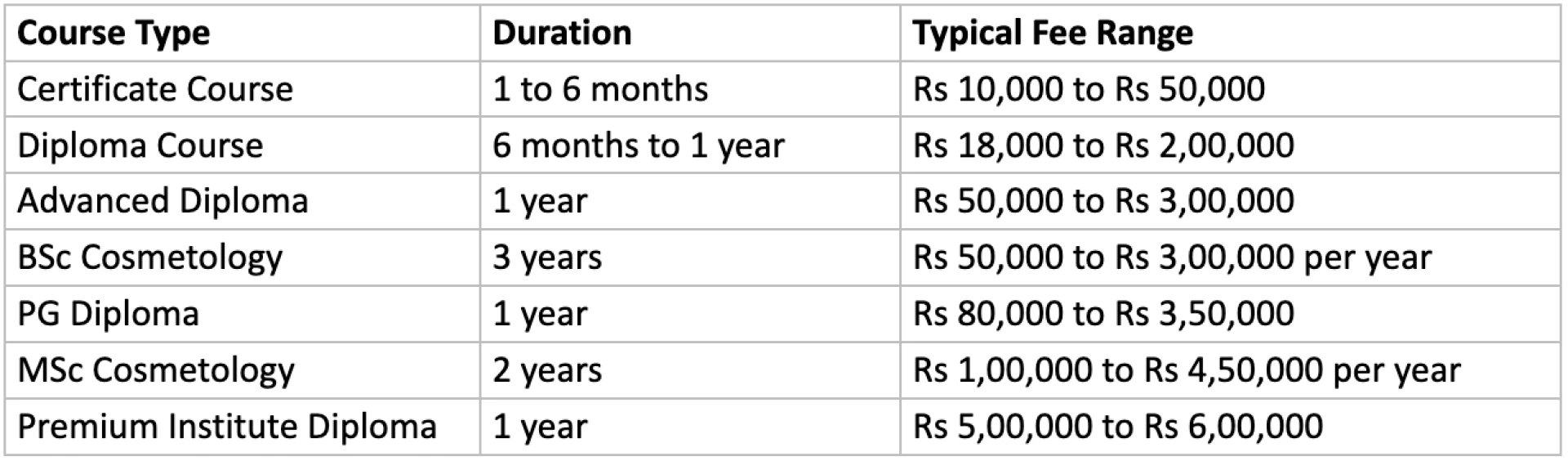
The cosmetology course cost in India depends primarily on the level of the course. Here is a realistic breakdown based on what institutes are currently offering.
What Actually Affects the Beauty Course Fees in India
Two institutes offering a one-year diploma can have fees that differ by Rs 3 to 4 lakh. That gap is not random. Here is what drives it.
1. Government Recognition and Certification
Government recognised programmes tend to cost more than unrecognised ones. The reason is simple: they are held to a higher standard in curriculum, infrastructure, and faculty.
An NSQF-aligned course certified by a Central Government approved body like Skill India or MEPSC carries legal standing that an industry-only certificate does not. That recognition has real value, and it is reflected in the fee.
2. Course Duration and Depth
A 3-month certificate covers the basics. A 1-year diploma goes much deeper into skin science, advanced treatments, clinical practice, and professional standards.
Longer programmes with richer content cost more. That is expected. The real question is whether the content and delivery justify the price, not just the duration.
3. Practical Training and Equipment
Institutes that provide hands-on training on professional-grade equipment, laser machines, skin analysis devices, and aesthetic tools have higher operating costs. Those costs are reflected in the fee.
A programme where you only observe treatments and do limited hands-on work will cost less. But you will also graduate with less clinical confidence, which has its own cost later.
4. Faculty and Clinical Expertise
Institutes that employ doctors, clinical specialists, and actively practising professionals charge more than those that rely entirely on basic beauty trainers.
For advanced aesthetic and clinical programmes, medical faculty involvement is not a luxury. It is what makes the training legitimate.
5. City and Location
The same programme at an institute in Mumbai or Delhi will cost more than the same institute's programme in a smaller city. Operational costs, rent, and market pricing all vary by location.
Some institutes now offer hybrid programmes that combine online theory with offline practical sessions. These can be more affordable while still delivering genuine clinical training.
Affordable Cosmetology Courses in India: What Is Actually Available
Affordable cosmetology courses do exist in India. But affordable does not always mean good value.
Government ITI courses and NSDC-affiliated programmes can cost as little as Rs 3,000 to Rs 15,000. These are subsidised, accessible, and government approved. They are strong starting points for students with limited budgets who want to enter the industry quickly.
Mid-range diploma programmes from reputed institutes typically fall between Rs 50,000 and Rs 2,00,000. This is the most competitive segment. The quality variation here is enormous. Two institutes charging the same fee can deliver completely different training experiences.
At this level, the factors that matter most are government recognition, practical training hours, faculty quality, and batch size. A smaller batch at a recognised institute will generally outperform a large-batch programme at a heavily marketed school, regardless of fee.
What to Compare Before Paying Any Course Fee
Never compare cosmetology course fees in isolation. Always compare what you are getting for the fee. These are the questions to ask every institute before you enrol.
- Is the course government recognised? Ask specifically which government body or awarding authority recognises the certification. Verify this independently.
- How many practical hours are included? Get an exact number. Vague answers like 'plenty of hands-on training' are not enough.
- What equipment will you train on? The machines available for student training directly determine the environments you can enter after graduating.
- Who are the faculty? Are they active professionals? Do they have clinical backgrounds? Are doctors involved in advanced module delivery?
- What is the batch size? Smaller batches mean more individual attention and more hands-on time per student.
- What does the syllabus cover? Ask to see the full syllabus. A strong programme includes skin science, clinical procedures, advanced aesthetics, and business fundamentals, not just basic beauty techniques.
The Real Cost Is Not Just the Fee
The cheapest cosmetology course in India might save you money today and cost you much more in the long run.
A certificate that is not government recognised may not get you into premium clinics. A programme with limited practical training will leave you without the confidence to handle real clients. A course from an unaccredited institute might need to be repeated at a recognised institute before you can access certain career paths.
The better question is not which course is cheapest. It is which course gives you the best return on the fee you pay, measured in career readiness, certification credibility, and practical skill.
What a Government Recognised Programme Looks Like in Practice
To see what genuine government recognition and quality training looks like, IICTN is a useful reference point.
The Indian Institute of Cosmetology, Trichology and Nutrition has been training professionals since 2005. Its programmes are NSQF aligned and certified by Central Government approved bodies including Skill India and MEPSC. The faculty includes doctors and clinical specialists. Practical training is on professional-grade equipment. Batches are small.
Their professional cosmetology course is a 1-year NSQF Level 4 diploma available across 8 cities with both hybrid and offline training options. It covers advanced skin treatments, laser, anti-aging procedures, and clinical practice under qualified supervision.
For students comparing cosmetology course fees in India, this is the kind of programme where the fee reflects genuine value: government recognition, clinical depth, qualified faculty, and a certification that carries real professional weight.
Know What You Are Paying For
India's cosmetology education market is large and uneven. The fee range is wide because the quality range is equally wide.
A student who spends Rs 80,000 at a properly recognised institute with strong practical training will be better placed than one who spends Rs 5 lakh at a heavily branded school that delivers weak hands-on experience.
The fee is just one number. What it buys is what matters. Ask the right questions, compare the right things, and choose the programme that will actually prepare you for the career you want.