

There’s a moment most content teams know too well. It’s late. Someone’s staring at an empty document. The publishing calendar says something needs to go live tomorrow. Again. And the question quietly hangs there: how are we supposed to keep this pace without burning out or lowering quality? That’s usually where content automation enters the conversation. Sometimes with excitement. Sometimes with suspicion. Sometimes both at once.
Because automation sounds efficient. But content is human, right? Messy. Opinionated. Full of half-formed thoughts and sudden clarity at odd hours. Can automation really help without flattening everything into bland sameness?
Short answer: yes. Long answer… well, that’s what this is about.
What Content Automation Actually Looks Like in Real Life
Let’s clear something up first. Content automation isn’t a robot writing your blog while you sip coffee and do nothing. Anyone who tells you that is selling something. Probably expensive.
In practice, content automation is about systems. Quiet systems. The kind you don’t notice until they’re gone.
It shows up as:
- Scheduled publishing that doesn’t require manual reminders
- Automated content workflows that move drafts from idea to review to publish
- Tools that repurpose one solid piece of content into multiple formats
- Consistency checks that catch small issues humans miss when tired
It’s less about replacing people and more about giving them breathing room.
Why Consistency Is the Hardest Part of Publishing
Most teams can produce good content. Once. Maybe twice.
Consistency is the real problem.
Weekly blogs turn into monthly ones. Social posts lose rhythm. Email newsletters get skipped because “we’ll do it next week.” And next week turns into next quarter.
This is where content automation for publishing starts to matter. Not because people are lazy. Because people are human.
Automation handles the repeatable parts. The boring parts. The parts that don’t need creativity, just reliability.
High-Quality Content Doesn’t Mean Manual Everything
There’s a weird belief floating around that quality and automation can’t coexist. That if a process is automated, the output must be generic.
That hasn’t been true for a while.
High-quality publishing depends on:
- Clear guidelines
- Strong editorial standards
- Consistent formatting and structure
- Reliable review processes
All of those can be supported by automated content systems without touching the voice or ideas themselves.
Automation doesn’t write opinions. It protects them.

The Quiet Power of Automated Content Workflows
This part doesn’t get enough attention.
An automated content workflow can move content through stages without constant checking-in. Draft ready? It goes to review. Approved? It gets scheduled. Scheduled? It publishes. No one has to chase updates across emails and messages.
That alone saves hours. And mental energy.
We’ve seen teams produce better work simply because they weren’t exhausted by coordination chaos.
Content Automation Tools: What They’re Actually Used For
People often imagine content automation tools as writing machines. In reality, they’re more like assistants who never forget.
They help with:
- Content scheduling across platforms
- Version control and updates
- Automated content distribution
- SEO checks and formatting consistency
- Analytics reporting without manual data pulling
None of that removes creativity. It removes friction.
Scaling Content Without Losing the Plot
Growth creates pressure. More pages. More channels. More formats. Video. Blogs. Short posts. Long posts. Updates. Rewrites.
Trying to scale all that manually usually ends one way. Quality slips. Or people burn out. Or both.
Content automation for scaling allows teams to grow output without stretching humans thin. Repurposing content becomes easier. Updates happen faster. Publishing doesn’t depend on one person remembering everything.
And yes, mistakes still happen. Just fewer of them.
SEO and Content Automation: An Uneasy Friendship That Works
Search optimisation has rules. Humans forget rules. Especially when deadlines loom.
This is where content automation and SEO quietly work well together.
Automated systems can:
- Ensure metadata isn’t skipped
- Check keyword placement without stuffing
- Flag missing headings or links
- Maintain internal linking patterns
The content still sounds human. The structure just stops breaking.
That balance matters more than people admit.
The Human Touch Still Matters (More Than Ever)
Here’s the uncomfortable truth. Automated content without human input feels empty. Readers notice. Even if they can’t explain why.
Automation should never decide:
- What opinions matter
- How a topic feels
- When something needs nuance
Humans do that. Automation supports them.
Think of it like this: automation sets the stage. People perform on it.
Content Automation for Different Content Types
Not all content benefits equally from automation. Some areas see immediate gains.
Blogs and Articles
Scheduling, formatting, internal linking, updates. Huge win.
Social Media Publishing
Automation handles timing and distribution. Humans handle tone and context. That mix works.
Email Content
Automation ensures consistency and segmentation. Writing still needs empathy. No system can fake that well.
Evergreen Content Updates
Automated reminders to refresh older posts prevent content decay. Easy to forget manually. Easy to fix with systems.
Quality Control Without Micromanagement
One of the underrated benefits of content automation is quality protection.
Automated checks catch:
- Broken links
- Formatting errors
- Missing sections
- Publishing inconsistencies
Not because humans are careless. Because humans get tired.
Automation doesn’t judge. It just checks. Quietly.
The Myth That Automation Makes Content Cold
Cold content usually comes from unclear intent, not automation.
If the original idea is thoughtful, automation won’t erase that. If the idea is shallow, no amount of manual effort saves it either.
Automation amplifies what’s already there. That’s the part people overlook.
Content Automation and Team Collaboration
This one hits close to home for many teams.
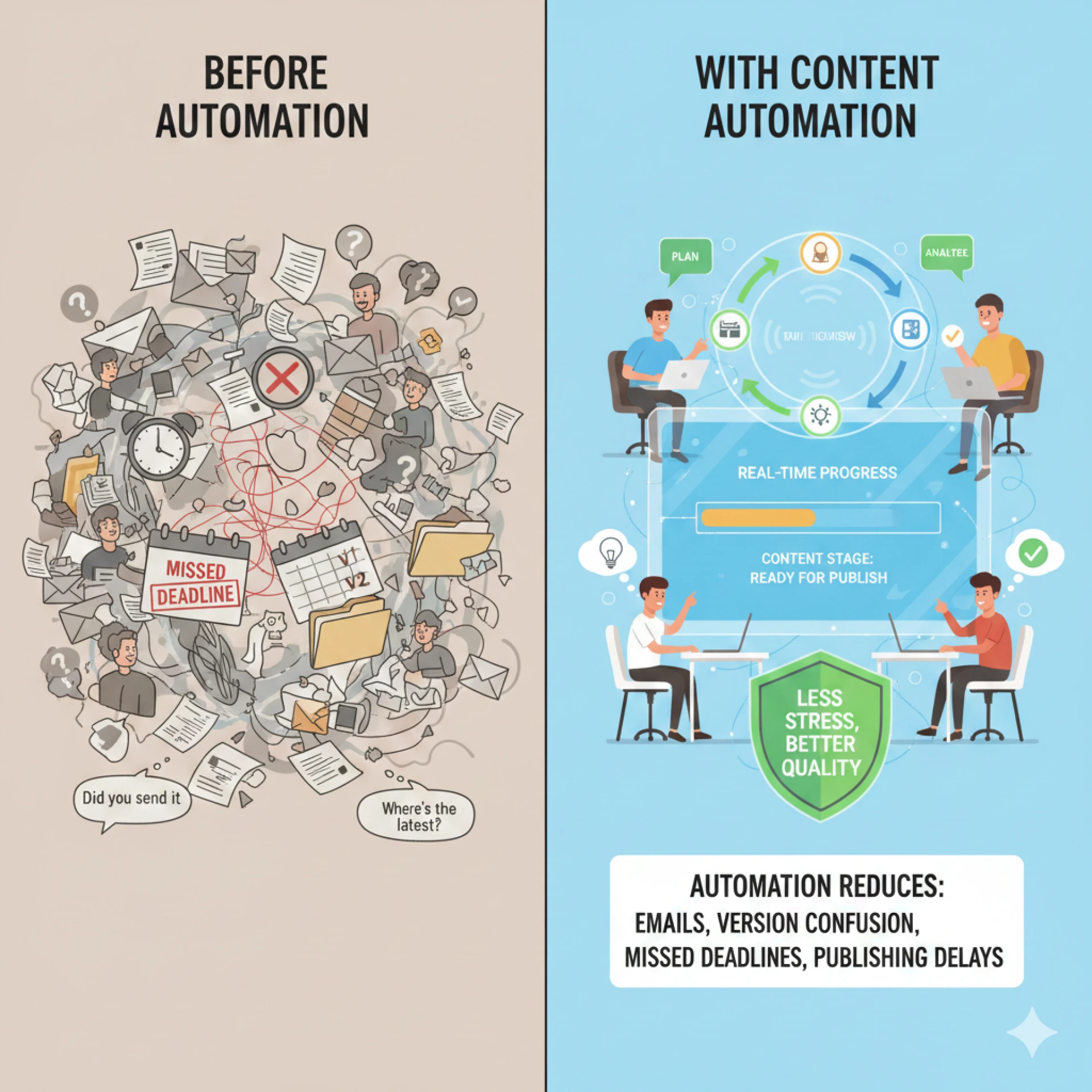
Automation reduces:
- Back-and-forth emails
- Confusion over versions
- Missed deadlines
- Publishing delays
Everyone sees where content is. No guessing. No awkward follow-ups.
That clarity alone improves output quality. Less stress. Better thinking.
When Content Automation Goes Wrong
It does happen.
Too much automation leads to:
- Over-publishing without purpose
- Repetitive formats
- Content that feels rushed
This usually isn’t a tool problem. It’s a strategy problem.
Automation should support a clear content plan, not replace it.
Finding the Right Balance (This Takes Time)
There’s no perfect setup on day one. Teams tweak. Adjust. Remove things that don’t work. Add things they didn’t expect to need.
That’s normal.
The goal isn’t full automation. It’s useful automation.
The kind that fades into the background and lets people focus on thinking, writing, editing, and questioning ideas. The good stuff.
Why Content Automation Is Becoming Non-Negotiable
Publishing expectations keep rising. Faster. More frequent. More channels. Better quality. Somehow all at once.
Without content automation, maintaining that pace becomes unrealistic. Something gives. Usually quality. Sometimes morale.
Automation isn’t a shortcut. It’s infrastructure.
And infrastructure doesn’t get applause. But everything relies on it.
A Few Honest Thoughts Before You Scroll On
Content automation won’t fix bad ideas. It won’t replace curiosity. It won’t suddenly make content meaningful.
But it will protect good work from chaos. It will make consistency achievable. It will give creative people room to think instead of constantly rushing.
And honestly, that’s probably why it works so well. It doesn’t try to be human. It lets humans do their job better.