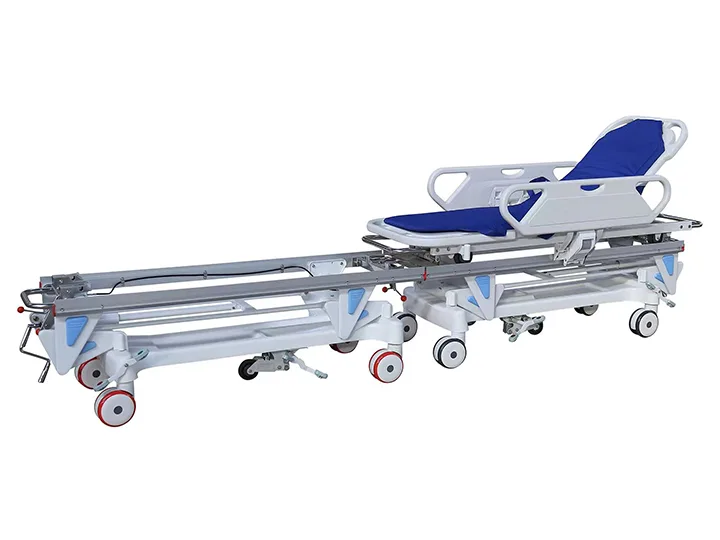
As a core medical auxiliary device in hospital emergency rooms, the emergency stretcher is specifically designed to enhance emergency response efficiency and patient safety. It skillfully integrates the dual functions of a transfer cart and a treatment bed, aiming to optimize rescue procedures and provide medical staff with a stable and reliable work platform. Its structure typically features a sturdy rectangular steel tube frame, a bed surface that is easy to clean and disinfect, and an integrated caster braking system, enabling seamless switching between rapid movement and immediate fixation. The bed surface often has extension and tilting functions to facilitate various emergency operations. Additionally, common auxiliary configurations such as IV poles, oxygen supply interfaces, and protective side rails further enhance its collaborative support capabilities in complex rescue scenarios.
Core Functions and Design Advantages
The core value of emergency stretchers is reflected in the following key aspects:
1. Efficient and Safe Patient Transfer: The device is equipped with a flexible caster system with brake locks, allowing for smooth and rapid transfer of patients between the emergency department, ambulance, and operating room. Reliable braking devices can instantly lock the bed in place upon arrival, effectively preventing accidental sliding and ensuring transfer safety.
2. Flexible Multi-Position Adjustment: Whether electrically or manually controlled, modern emergency stretchers can typically adjust back elevation, leg extension, and overall height. This flexibility is crucial for operations requiring specific positional support, such as supine positioning for cardiopulmonary resuscitation, exposure during trauma management, or the supine leg-elevated position needed for shock patients.
3. Comprehensive Safety Protection Design: To prevent patient falls, standard emergency stretchers are equipped with elevating side rails, three-point safety belts, and anti-rollover structures. This is particularly important for unconscious or restless patients, providing vital passive protection during transfer and treatment.
4. Powerful Functional Expandability: Many models have preset expansion interfaces such as oxygen cylinder holders, monitoring equipment platforms, or infusion pump slots. This integrated design reduces the complexity of connecting external devices during rescues, improves the efficiency of collaborative work among multiple life support devices, and saves critical time in emergency situations.
Operational Specifications and Maintenance Points
Proper use and maintenance are fundamental to maximizing the effectiveness of emergency stretchers and ensuring patient safety.
Pre-Use Inspection: Before each use, always confirm the power connection (if electric), the effectiveness of caster brakes, emergency braking devices, and that all position adjustment functions are in normal working condition.
Patient Fixation and Transfer: Before moving the patient, shoulder, waist, and knee safety belts must be correctly used for multi-point fixation to prevent slipping or displacement during transfer.
Regular Maintenance and Disinfection: A regular inspection system should be established to test the functionality of key components such as the bed adjustment mechanism, wheel locks, and rail locking devices. After each use, the bed surface and accessories should be thoroughly disinfected according to regulations to eliminate the risk of cross-infection.
How to Choose an Emergency Stretcher Based on Scenarios?
Different application environments have different priorities for emergency stretchers:
Hospital Emergency Departments and ICUs: Priority should be given to electric emergency stretchers with overall rapid lifting, one-button position memory, strong braking, and excellent load-bearing performance to meet high-intensity and variable emergency needs.
Home Long-Term Care: Focus can be placed on easy-to-operate, low-noise, nursing-type beds with separate back and leg adjustment functions, emphasizing comfort and care convenience.
Special Patient Groups: For obese or heavy patients, specially designed high-load-bearing models with widened and reinforced steel frames, anti-rollover auxiliary wheels, and enhanced drive systems must be selected to ensure stability and safety.
Choosing the right emergency stretcher is essentially selecting a key basic module for the life support system. Understanding its core functions, strictly adhering to operational specifications, and making informed choices based on actual scenarios will directly contribute to improving the success rate of treatment.