A practical breakdown of the machines and tools you actually need to run a profitable momo business
Walk through any Indian city today, and you will spot momo stalls on almost every corner. What was once a Tibetan street food has become one of India's most loved snacks. The demand keeps growing, and smart entrepreneurs are cashing in.
If you have been thinking about how to start a momo business in India, the first thing you need to figure out is your equipment. Get this right, and you are set up for smooth operations. Get it wrong, and you will waste money on repairs, replacements, and lost customers.
India's momo market is now worth around ₹25,000 crores per year. Street vendors dominate about 90% of this market, but organized momo shops are catching up fast. Whether you want a simple stall or a proper restaurant setup, this equipment guide for momo shop in India covers everything you need to know.
Why Your Equipment Choices Matter
Before we get into the list, let me explain why equipment selection deserves your attention. The machines you buy will affect:-
- Product consistency – Every momo tastes the same, batch after batch
- Speed – You can handle rush hours without making customers wait
- Labour costs – Machines do the repetitive work, so you need fewer staff
- Hygiene – Stainless steel equipment is easier to clean and passes health inspections
- Running costs – Good machines use less electricity and last longer
I have seen too many new shop owners buy cheap equipment to save money upfront. Within six months, they end up spending double on repairs or buying new machines altogether. Investing in High Quality Commercial Kitchen Equipment from day one saves you headaches down the road.
Equipment You Need to Start a Momo Shop
When figuring out how to start a momo shop, expect to spend anywhere from ₹50,000 for a basic cart setup to ₹5-8 lakhs for a full commercial kitchen. Here is what you will need:-
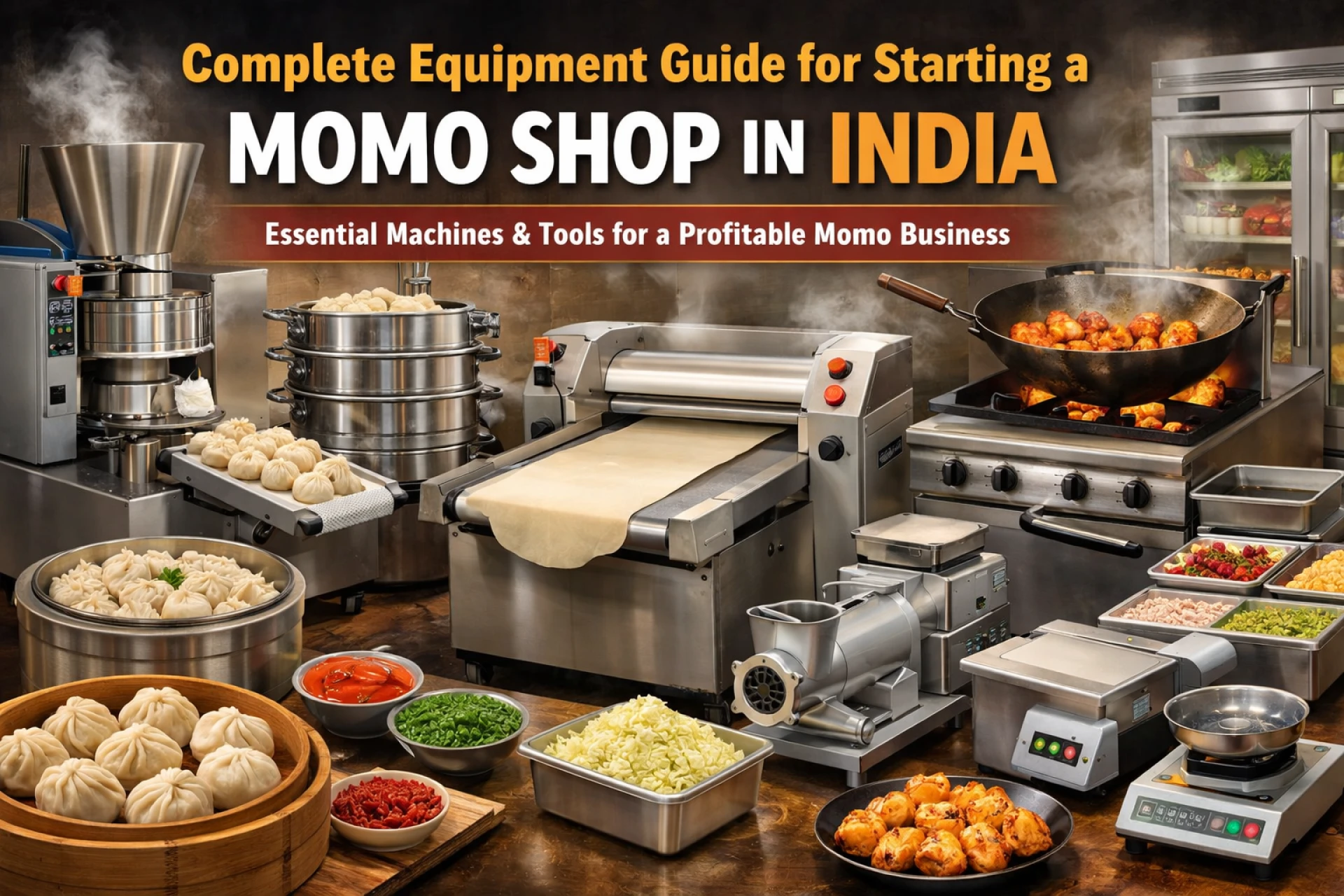
1. Momo Making Machine
This is your main production workhorse. A momo making machine fills and shapes momos automatically, which means you can make hundreds of pieces per hour instead of doing it by hand.
Two main types:-
- Semi-Automatic: Good for small shops, makes 500-2,000 pieces per hour. Costs ₹70,000-₹1,50,000
- Fully Automatic: For high-volume operations, makes 2,500-4,000 pieces per hour. Costs ₹1,80,000-₹3,50,000
What to check before buying:
- Can you adjust the momo size?
- Is it made of stainless steel?
- Are the parts easy to remove and clean?
- Does it fill each momo with the same amount?
- How loud is it when running?
2. Momo Sheeter Machine (Dough Sheeter)
A dough sheeter rolls out your dough into thin, even sheets for momo wrappers. Rolling by hand is slow and gives you uneven thickness. A machine does this job in seconds and keeps every wrapper identical.
Things to look for:
- Adjustable thickness (usually 0.5mm to 3mm)
- Roller width that matches your production needs
- Motor power between 0.5 to 1.5 kW
- Stainless steel rollers
Cost: ₹35,000-₹80,000 depending on size and brand
3. Commercial Momo Steamer
Steaming gives momos their soft, pillowy texture. You cannot compromise on your steamer – it directly affects how your momos taste and look.
Options available:
- Aluminium Steamers: Budget option for small stalls (₹2,000-₹10,000)
- Stainless Steel Multi-Tier Steamers: Lasts longer and stays cleaner (₹8,000-₹25,000)
- Electric Steamers: Steady temperature, faster cooking (₹21,000-₹45,000)
- Commercial Gas Steamers: Best for high volume (₹15,000-₹40,000)
How to calculate capacity: A 3-tier steamer cooks about 30-45 momos at once, taking 12-15 minutes per batch. Work backwards from your expected daily orders to figure out what size you need.
4. Dough Mixing Machine
Mixing dough by hand is tiring and gives inconsistent results. A commercial mixer ensures your dough has the same texture every single time.
Specs to consider:
- Capacity: 5-20 kg based on your daily production
- Spiral or planetary mixing action
- Speed control options
- Stainless steel bowl
Cost: ₹25,000-₹80,000
5. Refrigeration Equipment
You cannot run a food business without proper cold storage. Here is what you need:
- Deep Freezer: Stores prepared momos and frozen ingredients (₹15,000-₹45,000)
- Refrigerator: Keeps vegetables, meat, and fillings fresh (₹20,000-₹60,000)
- Display Chiller: If you want to sell frozen momos to take home (₹25,000-₹70,000)
6. Preparation Tools
Beyond the big machines, you will need these daily-use items:-
- Vegetable Chopper: For cutting cabbage, onions, and other filling ingredients (₹5,000-₹25,000)
- Meat Mincer: If you serve chicken or mutton momos (₹8,000-₹35,000)
- Work Tables: Stainless steel surfaces for prep work (₹5,000-₹15,000 each)
- Weighing Scales: For portion control (₹1,000-₹5,000)
7. Equipment for Fried Momos
Fried momos and tandoori momos are huge sellers. If they are on your menu, you will need:
- Deep Fryer: Single or double tank based on volume (₹8,000-₹35,000)
- Frying Pans/Kadhai: For pan-fried and tandoori styles (₹2,000-₹8,000)
- Gas Range: Multi-burner setup for cooking flexibility (₹15,000-₹50,000)
Setting Up in Phases: A Practical Approach
Not everyone has ₹5 lakhs to spend on day one. Here is how you can start small and grow:
Phase 1: Street Cart or Small Kiosk (₹50,000-₹1,50,000)
Start with the basics:
- Manual or semi-automatic dough sheeter
- Multi-tier aluminium steamer
- Small refrigerator
- Basic utensils and prep tools
This setup works well for testing your recipes and building a customer base before spending more.
Phase 2: Small Shop or Food Court (₹2,00,000-₹4,00,000)
Once you have steady customers:
- Semi-automatic momo making machine
- Commercial dough sheeter
- Electric steamer
- Deep freezer and refrigerator
- Gas range
- Stainless steel work tables
Phase 3: Restaurant or Cloud Kitchen (₹5,00,000-₹8,00,000)
For serious operators:
- Fully automatic momo making machine
- High-capacity dough sheeter
- Multiple commercial steamers
- Full refrigeration setup
- Exhaust and ventilation system
- Display counters
Keeping Your Equipment in Good Shape
Your machines will last years longer if you take care of them. Here is a simple maintenance routine:-
- Every day: Wipe all surfaces and remove food bits after closing
- Every week: Take apart removable components and clean them properly
- Every month: Check for loose screws, worn parts, or strange noises
- Every quarter: Get a technician to service complex machines
- Always: Cover equipment when not in use to keep dust out
Licenses You Need
Before buying equipment, sort out your paperwork:
- FSSAI License: Required for all food businesses (₹2,000-₹5,000 per year)
- GST Registration: Needed if your turnover crosses ₹40 lakhs
- Municipal Health License: From your local corporation
- Fire Safety Certificate: Especially if using gas equipment
- Shop and Establishment License: For physical stores
Picking the Right Supplier
Where you buy matters as much as what you buy. Look for suppliers who offer:
- Warranty and after-sales service
- Help with installation and training
- Spare parts availability
- Good reviews from other buyers
- Clear pricing with no hidden charges
- EMI options if you need them
Final Thoughts
The momo business offers real potential for anyone willing to put in the work. But your equipment is the foundation – skimp here, and you will pay for it later through breakdowns, inconsistent products, and unhappy customers.
Take time to research your options. Visit suppliers, ask questions, and talk to other momo shop owners if you can. The right equipment setup, matched to your budget and growth plans, will serve you well for years.
With solid machines backing you up and a commitment to quality, there is no reason your momo shop cannot become the go-to spot in your area.
Looking to set up your momo shop? Check out our range of momo making machines, steamers, and kitchen equipment to get started.