A hidden internal void inside a heavy steel valve body rarely shows up on the foundry floor—it shows up during final CNC machining or, worse, under operating pressure in the field. For industrial buyers and project engineers, a single rejected batch can derail production schedules and inflate project budgets overnight.
While steel casting offers unmatched design freedom for complex, high-strength components, pouring molten steel above 1,500°C is an unforgiving process. Understanding the root causes behind the most frequent casting defects—and the exact engineering controls modern foundries use to eliminate them—is the best way to protect your supply chain.
1. Gas Porosity (Blowholes and Pinholes)
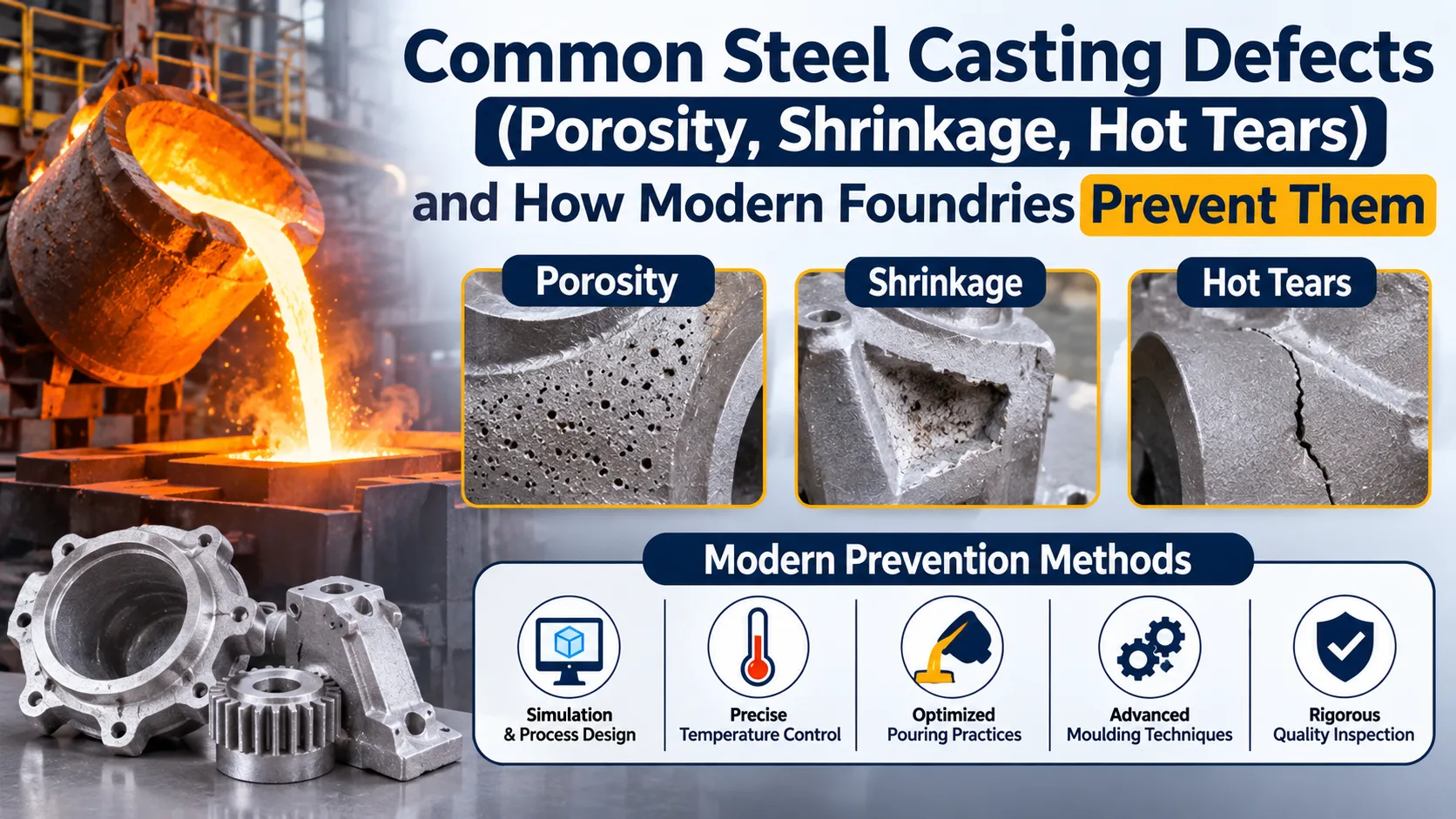
What it is: Gas porosity appears as small, rounded cavities either on the surface (open holes/pinholes) or trapped beneath the skin of the casting (blowholes). These voids reduce structural density and can cause pressure-retaining components like pump housings and valves to fail leak tests.
Common causes:
- Excess moisture in moulding sand or improperly dried mould coatings
- Poor mould permeability or inadequate venting that traps escaping gases
- Dissolved hydrogen or nitrogen in the molten steel
- Turbulent pouring that pulls air into the metal stream
How modern foundries prevent it:
- Strict sand and moisture control: Using resin-bonded (no-bake) or properly baked moulds with controlled sand permeability.
- Melt degassing: Performing proper deoxidation and degassing treatments in induction furnaces before pouring.
- Laminar gating design: Engineering smooth runner and gating systems that fill the mould cavity steadily without turbulence, paired with well-placed vents.
2. Shrinkage Defects (Cavities and Micro-Shrinkage)
What it is: Unlike smooth, round gas pores, shrinkage defects appear as jagged internal cavities or surface depressions. As molten steel transitions from liquid to solid, it naturally contracts in volume. If isolated "hot spots"—usually in thick wall sections—freeze last without a fresh supply of liquid metal, a void forms.
Common causes:
- Undersized or poorly positioned risers (feeders)
- Abrupt transitions between thick and thin wall sections
- Uneven cooling rates that block directional solidification
How modern foundries prevent it:
- Directional solidification: Designing patterns and gating so the thinnest sections freeze first and solidification progresses steadily toward the risers.
- Chills and exothermic sleeves: Placing metal chills in heavy sections to speed up local cooling, while using insulated riser sleeves to keep feeder metal liquid longer.
- Solidification modeling: Reviewing part drawings during the Design-for-Manufacturability (DFM) stage to eliminate isolated hot spots before cutting the pattern.
3. Hot Tears (Solidification Cracks)
What it is: Hot tears are irregular, branched cracks that form while the casting is still semi-solid and weak. As the metal cools and tries to contract, rigid mould walls or internal cores hold it back, creating tensile stress that literally tears the hot steel apart.
Common causes:
- Sharp internal corners or sudden changes in cross-sectional thickness that concentrate thermal stress
- Overly rigid sand moulds or cores that resist natural metal contraction
- Excessive sulfur or phosphorus levels in the steel chemistry, which weaken grain boundaries at high temperatures
How modern foundries prevent it:
- Generous fillets and smooth transitions: Modifying sharp corners in the pattern design to distribute cooling stress evenly.
- Controlled mould collapsibility: Formulating sand binders so the mould holds its shape during pouring but yields slightly as the solidifying steel contracts.
- Spectrometer verification: Checking molten alloy chemistry before every pour to keep sulfur and phosphorus strictly within specification.
4. Non-Metallic Inclusions (Slag and Sand)
What it is: Inclusions occur when foreign particles—such as furnace slag, refractory fragments, oxides, or loose moulding sand—get swept into the cavity and trapped inside the solidifying steel. Inclusions severely damage fatigue life and can chip expensive CNC cutting tools during finish machining.
How modern foundries prevent it:
- Installing ceramic foam filters in the gating system to trap slag and oxides before metal enters the part cavity.
- Maintaining clean ladles, disciplined skimming practices, and well-maintained furnace linings.
- Applying durable refractory mould washes to prevent molten steel from eroding the sand walls.
5. Cold Shuts and Misruns
What it is: A misrun happens when molten steel freezes before completely filling the mould cavity, leaving missing edges or incomplete features. A cold shut occurs when two separate streams of molten metal meet inside the mould but are too cool to fuse properly, leaving a weak seam.
How modern foundries prevent it:
- Monitoring pouring temperatures closely with calibrated immersion pyrometers.
- Shortening metal travel distances through optimized gating layouts so the cavity fills rapidly and uniformly.
Verification: Catching Defects Before Delivery
Even with tight process control, high-reliability industries—such as oil and gas, power generation, mining, and heavy machinery—require proof of internal soundness. Leading foundries back up their process controls with systematic inspection:
- Visual & Dimensional Inspection: Checking surface finish and tolerances against CAD drawings.
- Magnetic Particle Inspection (MPI) & Dye Penetrant Testing (DPT): Detecting fine surface and near-surface cracks.
- Ultrasonic Testing (UT) & Radiography (RT): Verifying internal soundness in thick, pressure-critical sections.
Partnering for Zero-Defect Steel Castings
Preventing casting defects starts long before molten metal is poured—it begins with disciplined pattern engineering, verified metallurgy, controlled moulding, and in-house inspection. When your foundry controls every stage from CNC pattern development and induction melting to heat treatment and finish machining, rejection rates drop and project timelines stay intact.
To learn how integrated process controls and certified metallurgical testing protect your industrial components, review our steel casting manufacfturing capabilities.