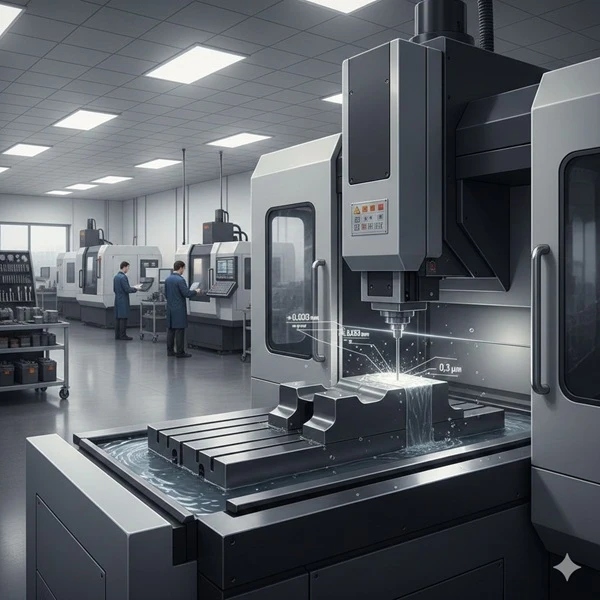
Precision manufacturing isn’t just a buzzword — it’s a non-negotiable requirement in industries like aerospace, automotive, medical devices, and high-end tooling. But many tool rooms struggle to consistently hit micron-level tolerances, leading to scrap, rework, delays, and ballooning costs.
If you’re wrestling with accuracy issues in your shop, you’re not alone. The challenge isn’t always just “better machines” — it’s often systemic. Let’s break down the real reasons most tool rooms fall short of micron-level precision and what you can do about it.
Common Reasons Tool Rooms Struggle with Micron-Level Accuracy
1. Conventional Machines Hit a Physical Limit
Traditional CNC milling, turning, and grinding machines rely on mechanical contact — meaning cutters physically touch the material. This introduces:
- Tool deflection
- Vibration
- Heat buildup
These factors create dimensional errors far larger than a few microns, especially when machining harder materials like hardened steel or titanium. The more rigid the cut, the greater the disturbance — and accuracy suffers.
Even with high-end machines, you’re fighting physics.
2. Tool Wear Alters Cutting Geometry
Every cutting tool dulls over time. Even the best carbide tools develop wear patterns that change the effective tool shape. The result?
- Unpredictable dimensional drift
- Inconsistent surface finish
- Frequent need for recalibration
In high-precision work, even the smallest wear can push parts out of tolerance — so tool wear isn’t a minor annoyance, it’s a major process bottleneck.
3. Heat is the Invisible Enemy
Heat buildup may be invisible, but its impact is measurable:
- Materials expand with temperature
- Spindle and feed mechanics shift
- Hydraulic and coolant systems fluctuate
Your machine might be capable on paper, but accuracy degrades when the workpiece, tool, and machine components are expanding at different rates. Without rigorous thermal management or environmental control, microns slip away.
4. Surface Finish Isn’t Just Cosmetic
When your finish isn’t controlled, you’re not controlling accuracy. Surface texture affects:
- Fit of mating parts
- Wear patterns
- Functional performance under stress
Grinding or polishing after cutting adds time and cost — and can also remove material unevenly, destabilising tolerances.
5. Complex Geometries Amplify Errors
Straight cuts are one thing — complex curves, tight radii, and sharp internal corners are another. Traditional machining tools struggle to maintain steady engagement with the material in these areas. The result? Deviations that are tiny but unacceptable in precision parts.
This is where non-traditional methods become necessary.
6. Human Variability and Setup Errors
Even in automated shops, operator skill matters. Poor fixturing, misalignment, or inconsistent setup practices can instantly introduce errors. Micron-level accuracy demands repeatability — and humans are variable.
7. Machine Calibration and Maintenance Gaps
Regular calibration isn’t optional if you want true precision. Over time, linear guides, ballscrews, and encoders lose their factory alignment, which leads to:
- Drift in axis positioning
- Cumulative errors across features
- Lost productivity
A neglected machine is a precision machine that will never be precise.
8. Material Properties and Variability
Some materials are literally harder to control:
- Hard alloys
- Anisotropic metals
- Materials with inconsistent grain structures
These materials resist traditional cutting and create unpredictable tool loads, which reduce accuracy.
Turning the Tide: A Better Approach
If you’re battling these challenges and need consistent micron-level accuracy, it’s time to expand beyond traditional machining.
One solution gaining traction across precision industries is Wire Cut Electrical Discharge Machining (EDM). Unlike conventional tools, Wire EDM uses electrical discharges to erode material — non-contact, thermally controlled, and capable of extremely tight tolerances.
If your shop is tired of fighting physical limits and wants to level up precision, a CNC Wire Cut EDM machine could be the upgrade your tool room needs. Take a look at the capabilities and options available here:
CNC Wire Cut EDM Machine – Premium Servo Series from Berlin Machineries.
Conclusion
Achieving micron-level accuracy isn’t about just buying a “better” mill or grinder. It’s about identifying where conventional processes are breaking down — heat, tool wear, vibration, materials, setup, and geometry — and choosing solutions that work within those constraints.
If your tool room is tired of inconsistent results, high rework rates, and quality headaches, it’s time to rethink the process — not just the machine.