
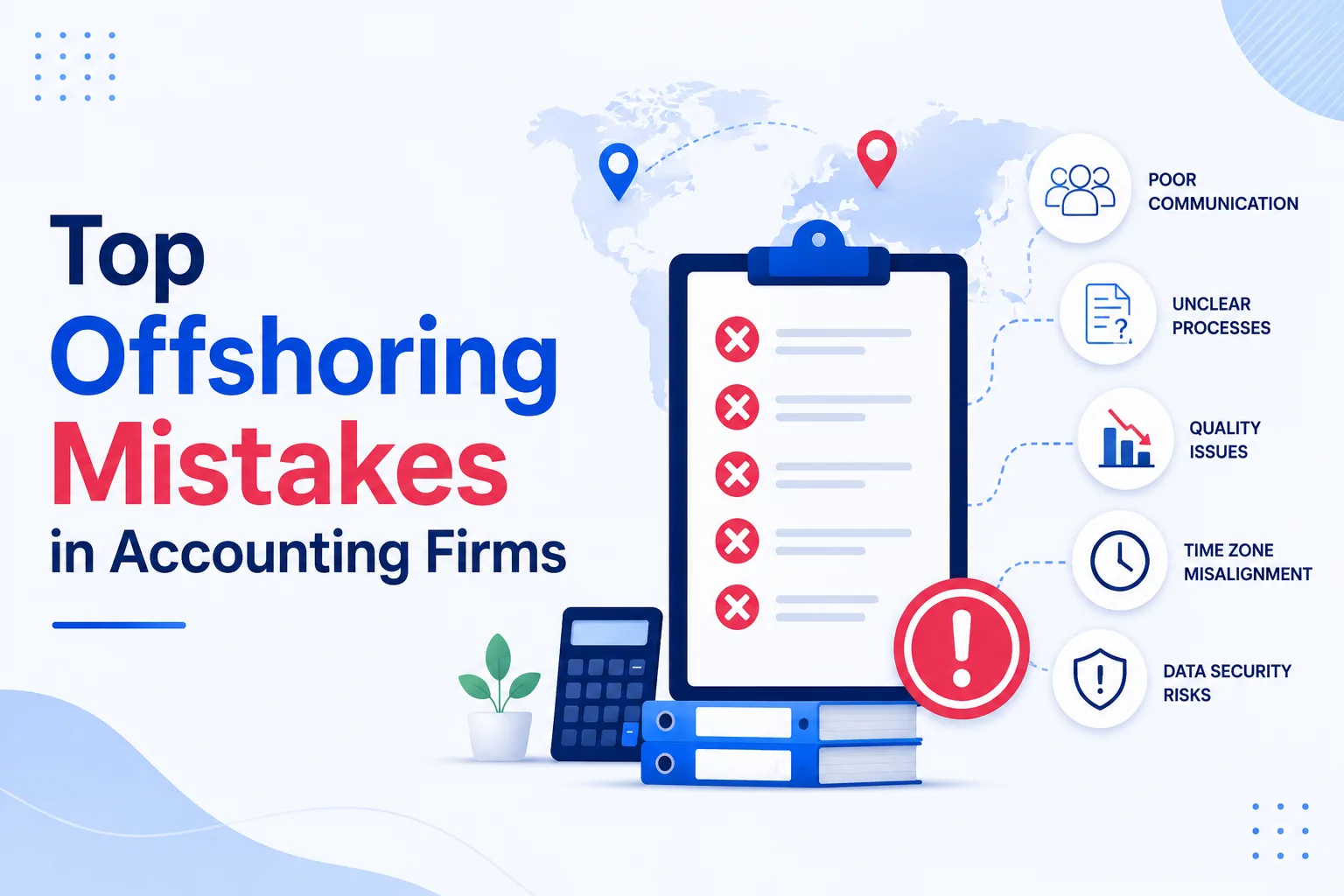
Accounting offshoring has moved from a niche cost play to a mainstream operating model. Firms of every size now route bookkeeping, tax preparation, audit support, and client accounting services to offshore teams to manage capacity, talent gaps, and seasonal pressure. Yet many firms see disappointing results, and the cause is rarely the offshore model itself. It is how the model is set up and managed.
The most common offshoring mistakes accounting firms make are treating offshoring purely as a cost cut, transitioning work before processes are documented, overlooking data security and IRS compliance, hiring on price instead of skill, skipping training and knowledge transfer, isolating offshore staff from firm culture, managing communication poorly, and expecting instant results. Each of these is avoidable with the right structure.
Key Takeaways
- Offshoring fails on execution, not on the model itself.
- Document your workflows before you transfer any client work.
- Treat data security and IRS Section 7216 compliance as non-negotiable.
- Hire for accounting skill and software fluency, not just hourly cost.
- Plan a realistic ramp-up of three to six months before judging performance.
- Integrated, well-trained offshore teams outperform isolated ones every time.
Why Accounting Firms Are Increasingly Turning to Offshoring
The pipeline of new accounting talent in the United States has tightened sharply. Fewer graduates are sitting for the CPA exam, experienced staff are retiring, and firms are competing for the same shrinking pool of candidates. At the same time, compensation expectations keep climbing, which makes domestic hiring slower and more expensive.
Offshoring helps firms respond to several pressures at once:
- Talent shortages that leave roles unfilled for months.
- Rising domestic labor costs that compress margins.
- Seasonal workload spikes during tax season and year-end close.
- Scalability needs as firms grow without overextending local hiring.
- Access to specialized accounting talent trained on US tax and GAAP workflows.
Used well, an offshore accounting team frees senior staff to focus on advisory work and client relationships. Used poorly, it creates rework, compliance exposure, and frustration on both sides.
What Are the Most Common Offshoring Mistakes Accounting Firms Make?
Before the detail, here is the short list. Most firms that struggle with offshoring are tripping over one or more of these eight issues:
- Treating offshoring solely as a cost-cutting strategy.
- Failing to define processes before transitioning work.
- Ignoring data security and compliance requirements.
- Hiring based on cost instead of skill alignment.
- Skipping structured training and knowledge transfer.
- Excluding offshore teams from firm culture.
- Managing communication and workflow poorly.
- Expecting immediate results.
Mistake #1: Treating Offshoring Solely as a Cost-Cutting Strategy
When the only metric is hourly savings, quality becomes an afterthought. Firms chase the lowest rate, accept thinner vetting, and end up with work that needs heavy review. The hidden costs surface quickly: partner time spent correcting returns, missed deadlines, and clients who notice the slip.
Cost matters, but it should sit alongside accuracy, turnaround, and capacity gains. A bookkeeping engagement that costs less but arrives with reconciliation errors is not a saving. The practical solution is to measure offshoring on total value, including review time saved and the senior capacity it unlocks, not on rate alone.
Mistake #2: Failing to Define Processes Before Transitioning Work
Offshore teams cannot read the unwritten rules that live in a partner's head. When firms hand over work without documented standard operating procedures, the result is workflow confusion, inconsistent output, and constant back-and-forth.
Consider a tax preparation handoff. If the offshore preparer does not know your firm's conventions for documenting client-provided figures, your software defaults, or your review checklist, every return becomes a guessing exercise. The same applies to monthly bookkeeping, where chart-of-accounts mapping and accrual treatments must be explicit. Document the workflow, record a few sample engagements, and build a shared knowledge base before the first file moves.
Mistake #3: Ignoring Data Security and Compliance Requirements
Accounting firms handle Social Security numbers, financial statements, and tax data. Offshoring that work without strict controls is a serious risk. IRS Section 7216 governs how preparers use and disclose taxpayer information, and consent requirements can apply when returns are handled offshore. Client engagement letters and confidentiality obligations add another layer.
Before any client data leaves the building, confirm the essentials:
- Role-based access controls so staff see only what they need.
- Secure, encrypted infrastructure and a no-local-storage policy.
- Documented compliance with IRS 7216 and applicable state rules.
- Signed confidentiality and data-handling agreements.
- Audit trails that show who accessed each file and when.
Mistake #4: Hiring Based on Cost Instead of Skill Alignment
A low rate means little if the person cannot prepare a clean 1040 or reconcile a complex ledger. Skill alignment is what separates a productive offshore hire from an expensive learning curve. Look for genuine technical accounting knowledge, familiarity with US standards, and hands-on experience with the platforms your firm runs.
Assess candidates on the things that actually drive output:
- Technical accounting knowledge across the engagement types you offshore.
- Industry experience relevant to your client base.
- Fluency in your tax and accounting software, from UltraTax or Lacerte to QuickBooks and Xero.
- Clear written and verbal communication for review notes and client-facing context.
Mistake #5: Lack of Training and Knowledge Transfer
Even strong hires need to learn your firm. Skipping structured onboarding is one of the fastest ways to undermine an offshore engagement. New team members should receive process documentation, shadow live work, and have a clear path for questions during their first engagements.
Knowledge transfer is not a one-time event. Tax law changes, client circumstances shift, and software updates roll out every year. This matters most ahead of tax season, when capacity is tightest and onboarding gaps are exposed under deadline pressure. Firms exploring offshore tax preparation support often pair it with seasonal refreshers, so that preparers stay current on filing rules and firm conventions. Building continuous learning into the relationship keeps offshore teams sharp and steadily reduces review burden over time.
Mistake #6: Excluding Offshore Teams From Firm Culture
Offshore staff who feel like outsiders disengage, and disengagement shows up as turnover and inconsistent quality. Treating an offshore preparer as an anonymous resource rather than a team member is a costly mistake, because retention and accuracy both depend on engagement.
Practical integration is straightforward:
- Introduce offshore staff to the onshore team and name their points of contact.
- Include them in relevant team meetings and firm updates.
- Give recognition for strong work, the same as you would onshore.
- Share context on the clients they support so the work has meaning.
Mistake #7: Poor Communication and Workflow Management
Time-zone gaps and unclear ownership can stall even skilled teams. Without defined channels and expectations, simple questions sit unanswered for a full day and deadlines slip. The fix is operational discipline rather than more meetings.
Set clear response-time expectations, use a shared project management system so status is visible to everyone, define who owns each step of an engagement, and hold consistent check-ins that respect both time zones. Accountability works best when every task has a named owner and a due date that both sides can see.
Mistake #8: Expecting Immediate Results
Offshoring is an investment that compounds, not a switch that flips. Firms that expect peak productivity in week one are usually disappointed, then conclude the model does not work. In reality, a new offshore team needs a ramp-up period to learn firm-specific processes, software conventions, and client nuances.
Plan for a learning curve of roughly three to six months, set performance benchmarks for accuracy and turnaround, and review progress against those benchmarks rather than against an unrealistic day-one standard. The firms that stay patient through ramp-up are the ones that see the largest long-term gains.
Common Mistake Potential Impact Recommended Best Practice Chasing the lowest rate Rework, errors, partner review time Measure total value, not hourly cost No documented processes Inconsistent output, constant rework Build SOPs and a knowledge base first Weak data security IRS 7216 exposure, breach risk Use role-based access and encryption Hiring on price alone Skill gaps, slow output Vet for technical and software skill No structured training Long learning curve, high review load Onboard, document, and train continuously Isolating offshore staff Disengagement and turnover Integrate offshore teams into the firm Unclear communication Missed deadlines, stalled work Define channels, owners, and SLAs Expecting instant results Premature cancellation of the model Plan a three to six month ramp-up
How Successful Accounting Firms Build High-Performing Offshore Teams
The firms that get durable value from offshoring share a pattern. They plan strategically, deciding which functions to offshore and why, rather than reacting to a busy season. They standardize processes so work is repeatable and reviewable, and they put security controls in place before any data moves. Firms researching how to structure this often look at managed offshore accounting services to understand how staffing models, process standardization, and team integration fit together when scaling accounting operations. The same firms integrate offshore staff as genuine members of the team, then track performance against clear benchmarks and adjust as the relationship matures.
This is also where structured providers add value. MYCPE ONE is one example of how firms address these operational challenges through managed offshore staffing models, built-in training and continuing education for offshore staff, and workflow alignment that fits how accounting firms actually operate. The point is not the provider itself but the structure it represents: clear processes, ongoing skill development, and security baked into the model rather than added later.
Key Takeaways for CPA and Accounting Firms
- Offshoring problems are almost always execution problems, not model problems.
- Document processes and standardize workflows before transferring work.
- Treat data security and IRS 7216 compliance as prerequisites, not extras.
- Hire for accounting skill and software fluency over the lowest rate.
- Invest in onboarding, knowledge transfer, and continuous training.
- Integrate offshore staff into firm culture to protect quality and retention.
- Allow a realistic ramp-up before measuring success.
Conclusion
Successful accounting offshoring is not simply about reducing costs. Firms that invest in process clarity, compliance, communication, training, and team integration are far more likely to achieve sustainable growth and operational efficiency from their offshore accounting strategy.
The model rewards firms that build structure around it, and it punishes those that treat it as a shortcut. Approach offshoring as a long-term operating capability, and it becomes one of the most reliable ways to expand capacity and protect margins.
Frequently Asked Questions
Is accounting offshoring safe for CPA firms?
Yes, when handled correctly. Safety depends on encryption, role-based access controls, signed confidentiality agreements, and compliance with IRS Section 7216. Firms that vet their provider's security infrastructure and document data-handling procedures can offshore sensitive work without compromising client confidentiality or regulatory standing.
What tasks can be offshored in an accounting firm?
Firms commonly offshore bookkeeping, tax preparation, audit support, payroll processing, and client accounting services. Routine, process-driven work transfers most easily, while final review, sign-off, and client advisory typically stay onshore. The right mix depends on each firm's structure and risk tolerance.
How do firms maintain quality with offshore teams?
Quality comes from documented processes, structured onboarding, defined review steps, and clear performance benchmarks. Firms that build standard operating procedures, train offshore staff continuously, and use a shared review checklist see consistent output and a steadily declining error rate as the team matures.
What security measures should offshore accounting providers follow?
Look for encrypted infrastructure, role-based access, a no-local-storage policy, audit trails, signed confidentiality agreements, and documented IRS 7216 compliance. These controls protect taxpayer data and client confidentiality, and they should be verified before any client information is shared with the offshore team.
How long does offshore team onboarding take?
Most firms see a ramp-up period of three to six months before an offshore team reaches full productivity. The timeline depends on the complexity of the work, the quality of process documentation, and the depth of training. Clear SOPs shorten the curve considerably.
What is the biggest mistake firms make when offshoring?
The single biggest mistake is treating offshoring purely as a cost cut. When price is the only metric, quality, security, and training get neglected, which leads to rework and lost capacity. Successful firms weigh accuracy, turnaround, and integration alongside cost.
How can accounting firms improve offshore team performance?
Improve performance by documenting workflows, investing in continuous training, setting clear communication standards, integrating offshore staff into the team, and tracking results against benchmarks. Consistent feedback and recognition also raise engagement, which directly supports accuracy and retention over time.