For many Malaysian businesses, modernizing operations is no longer optional. Growing customer expectations, increasing operational complexity, tighter financial controls, and the need for real-time business information are encouraging companies to move away from spreadsheets and disconnected software.
However, despite the growing adoption of ERP software in Malaysia, many businesses still hesitate to implement an ERP system because of common misconceptions. Some business owners believe ERP is only suitable for large corporations, while others assume that implementation is too expensive, complicated, or disruptive.
These assumptions can prevent Malaysian companies from adopting technology that could improve productivity, financial visibility, inventory management, procurement, sales, and overall business performance.
In this article, we will discuss the most common ERP myths in Malaysia, explain what is actually true, and show why businesses should take a more practical approach when evaluating ERP solutions in Malaysia.
What Is an ERP System?
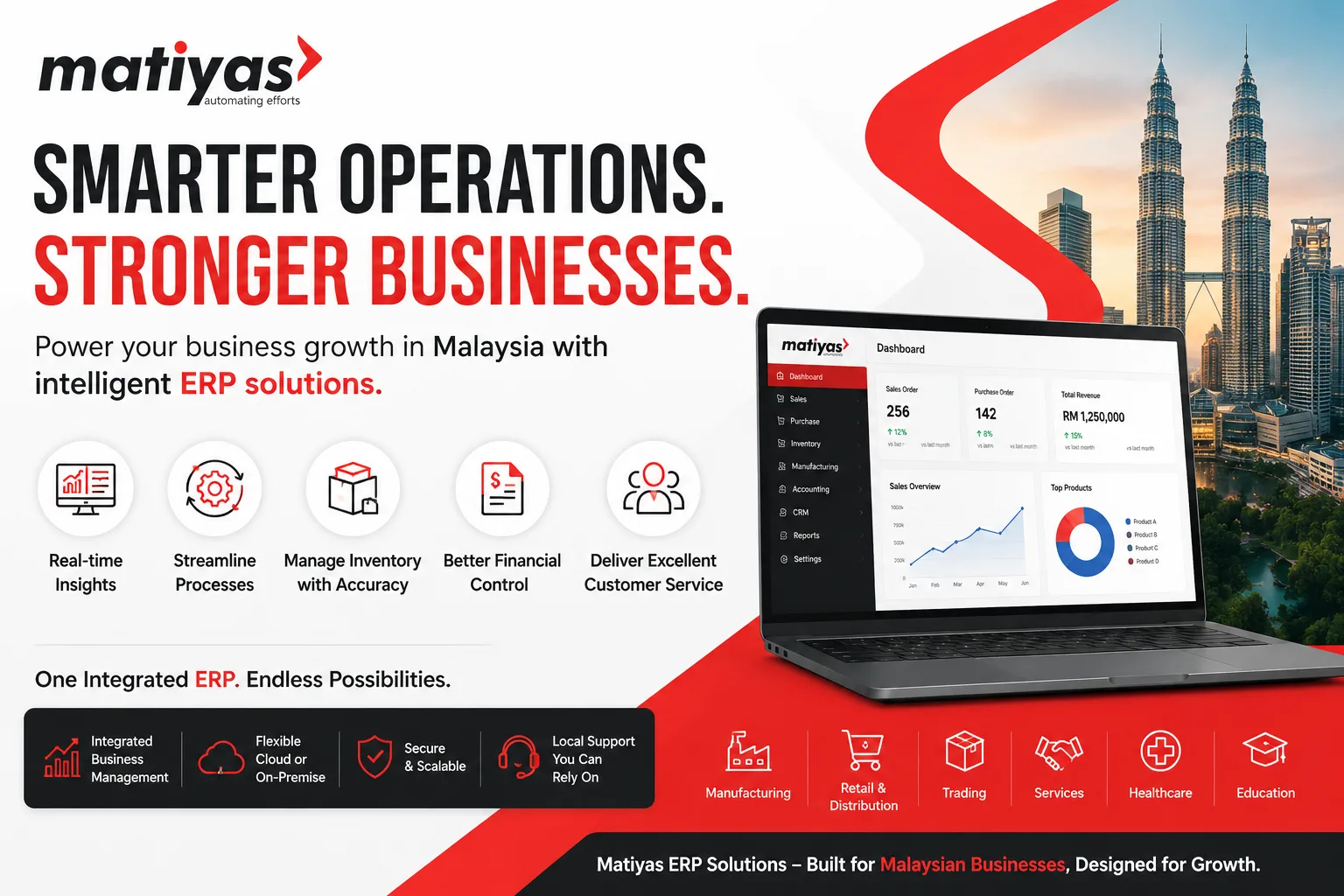
An Enterprise Resource Planning (ERP) system is business management software that connects different functions within an organization through a centralized platform. Depending on the business requirements, an ERP system can manage accounting, sales, purchasing, inventory, manufacturing, customer relationships, human resources, projects, and other operational processes.
Instead of maintaining separate systems for different departments, businesses can use an integrated ERP system in Malaysia to manage and share information across the organization.
Modern ERP platforms are available in different deployment models, including cloud-based and on-premise solutions. This gives Malaysian businesses more flexibility when selecting software based on their size, budget, industry, and operational requirements.
Myth 1: ERP Software Is Only for Large Companies
One of the biggest misconceptions is that ERP software is designed only for large enterprises with hundreds or thousands of employees.
This is no longer true.
Today, ERP software in Malaysia is available for businesses of different sizes. Small and medium-sized enterprises can implement ERP solutions based on their specific requirements and gradually expand their systems as the business grows.
For example, a growing Malaysian trading company may initially need accounting, inventory, purchasing, and sales management. As the company expands, it may add CRM, warehouse management, manufacturing, or additional financial capabilities.
The key is not choosing the biggest ERP system. It is choosing an ERP solution that matches the current business requirements and can support future growth.
Myth 2: ERP Implementation Is Always Too Expensive
Cost is another major concern when Malaysian businesses consider implementing an ERP system.
While ERP implementation requires investment, saying that every ERP project is extremely expensive is misleading. The total cost depends on factors such as the number of users, required modules, customization, integrations, implementation services, training, and deployment model.
Cloud ERP can also provide a more accessible approach because businesses may avoid some of the infrastructure and maintenance costs associated with traditional systems.
Instead of focusing only on the initial price, businesses should evaluate the total value of the ERP implementation. Reducing manual work, minimizing data errors, improving inventory control, accelerating financial reporting, and increasing operational visibility can create long-term business value.
The right question is not simply "How much does ERP cost?" but "What business problems will the ERP system solve?"
Myth 3: ERP Systems Are Too Complicated for SMEs
Some Malaysian business owners believe that ERP systems are complicated and require specialized technical knowledge to operate.
Modern ERP platforms are designed to provide user-friendly interfaces, role-based access, dashboards, workflows, reports, and automation tools. Employees can access the features relevant to their responsibilities instead of dealing with unnecessary system complexity.
For example, an accounts employee can focus on financial transactions and reports, while an inventory employee can work with stock movements, warehouses, and inventory records.
Proper implementation and employee training are still important. However, complexity is not an unavoidable characteristic of ERP software. A well-configured ERP system in Malaysia should simplify business processes rather than make them harder.
Myth 4: ERP Means Replacing Everything at Once
Another common misconception is that implementing ERP requires a business to replace every existing system immediately.
In reality, ERP implementation can be planned in phases.
A Malaysian company can begin with its most important business functions and gradually introduce additional modules. For example, a business could initially implement accounting, purchasing, sales, and inventory before expanding into manufacturing, HR, CRM, or advanced reporting.
This phased approach can reduce operational disruption and allow employees to become familiar with the system before additional functionality is introduced.
Businesses should work with ERP software companies in Malaysia to develop an implementation roadmap based on their operational priorities.
Myth 5: ERP Is Only Useful for Accounting
Because accounting is one of the most commonly implemented ERP functions, some businesses assume that ERP is essentially advanced accounting software.
ERP is much broader than financial management.
A comprehensive ERP platform can connect accounting with sales, purchasing, inventory, manufacturing, CRM, HR, projects, and other business functions.
For example, when a sales order is created, the relevant inventory information can be updated. Purchasing teams can monitor stock requirements, while the finance department can access financial information related to transactions.
This integration helps businesses create a connected flow of information instead of maintaining isolated departmental records.
Myth 6: ERP Implementation Will Disrupt Business Operations
Business owners often worry that implementing a new ERP system will interrupt daily operations for weeks or months.
Poor planning can certainly create disruption, but ERP implementation does not have to stop normal business operations.
A structured implementation approach can include requirement analysis, data preparation, configuration, testing, user training, migration, and controlled deployment.
Businesses can also implement modules in stages and schedule critical activities around operational requirements.
The goal of an ERP implementation is to improve business processes while managing the transition carefully.
Myth 7: Cloud ERP Is Not Secure
Security concerns are often raised when businesses consider cloud ERP in Malaysia. Some companies believe keeping software and data on local infrastructure automatically makes it more secure.
Security depends on how systems are designed, configured, maintained, and monitored. Modern cloud platforms can use security controls such as access management, encryption, backups, monitoring, authentication, and controlled permissions.
Cloud ERP can also reduce the burden on internal teams to maintain physical infrastructure and perform certain system maintenance tasks.
However, businesses should still carefully evaluate the security practices, data management policies, backup procedures, access controls, and compliance requirements of any ERP provider before making a decision.
Myth 8: ERP Requires Extensive Customization
Another common ERP myth is that businesses need to heavily customize the software before employees can use it.
Excessive customization can increase implementation complexity, costs, and maintenance requirements. A better approach is to first understand the standard capabilities of the ERP platform and identify which processes genuinely require changes.
Many businesses can adapt certain internal workflows to established ERP processes instead of modifying the software for every existing habit.
The objective should be to achieve the right balance between business requirements and standard ERP functionality.
Myth 9: Switching to ERP Means Losing Existing Business Data
Businesses that have accumulated years of information in spreadsheets, accounting applications, or legacy systems may worry that implementing a new ERP will result in lost data.
Data migration is a standard part of many ERP implementations.
Historical and operational information can be assessed, cleaned, mapped, and transferred into the new system according to the migration strategy. Businesses can determine which information needs to be migrated and which outdated or duplicate records can be removed.
Proper data preparation is important because inaccurate or duplicate information can create problems in the new ERP environment.
Myth 10: ERP Does Not Provide Enough Value for Growing Malaysian Businesses
Some businesses continue using spreadsheets and disconnected applications because they believe their current processes are "good enough."
This can become a problem as the organization grows.
More customers, products, suppliers, employees, warehouses, transactions, and locations create greater operational complexity. Manual processes that worked for a small business may become inefficient as transaction volumes increase.
An ERP system in Malaysia can provide centralized information, process automation, better reporting, and improved coordination between departments.
The value of ERP becomes particularly clear when businesses need better control over operations and want to make decisions using accurate, up-to-date information.
How Malaysian Businesses Can Evaluate ERP Solutions
Instead of making an ERP decision based on assumptions, Malaysian businesses should evaluate their actual operational requirements.
Start by identifying the processes that currently consume the most time or create the most errors. These could include manual data entry, inventory tracking, purchase management, financial reporting, order processing, or communication between departments.
Next, identify the ERP modules required to address those problems. Businesses should also consider scalability, integration capabilities, user experience, customization requirements, implementation support, security, reporting, and long-term costs.
Comparing multiple ERP companies in Malaysia can help businesses understand which solutions are suitable for their industry and operational model.
A successful ERP project is not necessarily the one with the most features. It is the one that solves important business problems and provides measurable operational value.
Why Malaysian Businesses Should Look Beyond ERP Myths
ERP technology has evolved significantly. Modern ERP platforms can support small businesses, SMEs, and larger organizations with flexible deployment options and modular functionality.
The biggest obstacle is often not the technology itself but the assumptions surrounding it.
Believing that ERP is only for large companies, always expensive, too complicated, insecure, or disruptive can prevent businesses from exploring suitable solutions.
For Malaysian companies looking to improve operational efficiency, the better approach is to assess their current processes, identify business challenges, define measurable goals, and compare ERP solutions in Malaysia based on actual requirements.
Conclusion
The common myths surrounding ERP can prevent Malaysian businesses from taking the next step toward digital transformation. ERP software is no longer limited to large enterprises, and businesses can choose solutions based on their size, industry, budget, and growth plans.
From accounting and inventory to purchasing, sales, manufacturing, CRM, and reporting, an integrated ERP system can help businesses connect their operations and gain better visibility into day-to-day performance.
For Malaysian businesses considering modernization, the most important step is to move beyond assumptions and evaluate what an ERP system can actually deliver. With the right planning, implementation strategy, and ERP company in Malaysia, businesses can build a more connected, efficient, and scalable operating environment.