Introduction
The television industry is changing as broadcasters, media companies, and independent content creators move toward internet-based distribution. Traditional broadcasting often requires specialized equipment, physical infrastructure, and dedicated technical teams. Cloud technology offers another approach, allowing many broadcasting operations to be managed through online platforms.
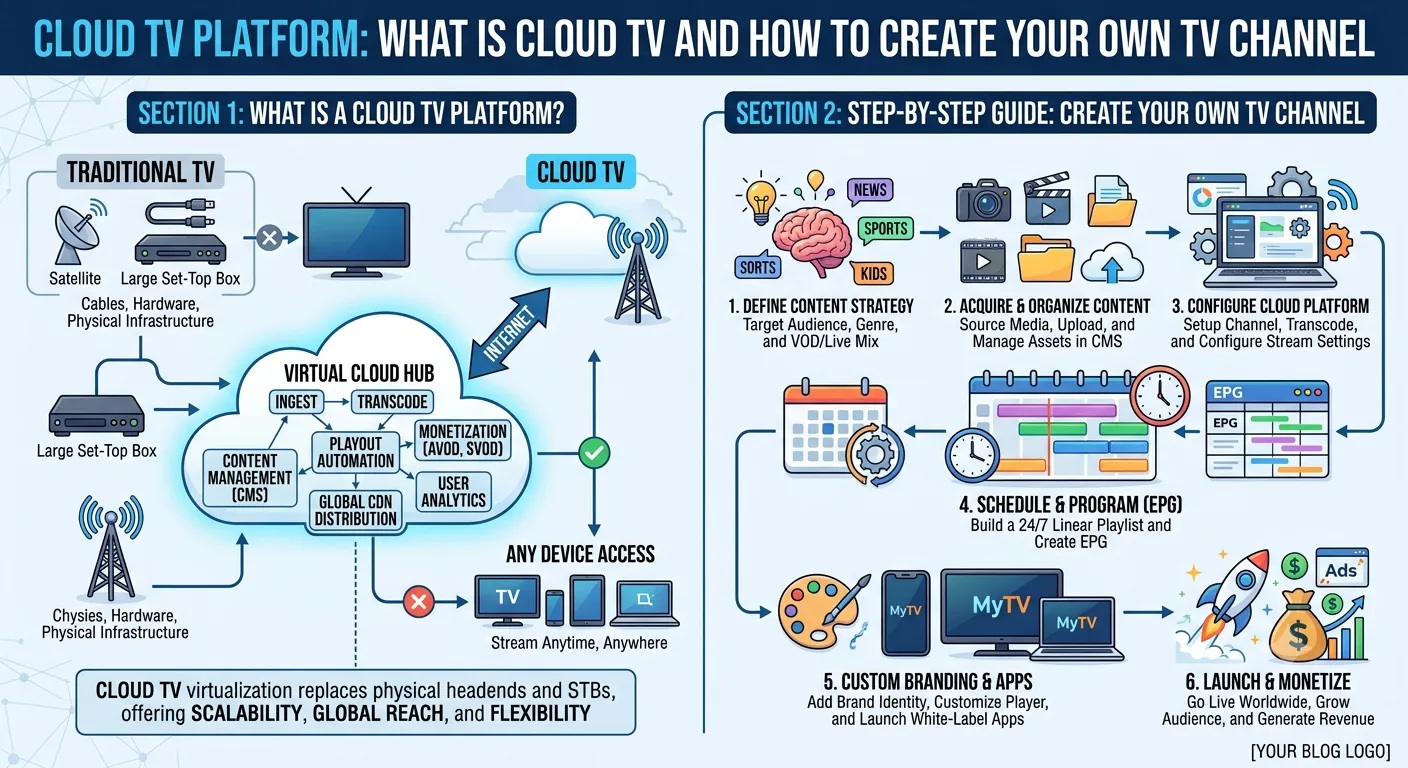
For businesses exploring modern streaming solutions, understanding what is cloud Tv is an important first step. Cloud TV uses cloud-based infrastructure and services to support television-related activities such as video storage, content management, playout automation, and streaming distribution. Depending on the platform, it can help broadcasters manage channels without maintaining every component of their broadcasting system on-site.
A cloud-based broadcasting solution can also make it easier to create your own tv channel and distribute content to viewers across websites, mobile devices, and connected televisions. However, the benefits depend on selecting the right platform, preparing quality content, and designing a reliable distribution workflow.
This guide explains how a Cloud Tv platform works, its major features, its business advantages, and the steps involved in launching an online television channel.
What Is Cloud TV?
When asking what is cloud Tv, it helps to begin with the role of cloud computing. Cloud computing allows software, storage, processing resources, and other technology services to be accessed through remote infrastructure rather than relying entirely on equipment located at a user's premises.
In television broadcasting, cloud services can support different stages of the video workflow. Content may be uploaded to remote storage, organized through a content management system, scheduled using playout automation, and delivered through internet streaming infrastructure.
The exact capabilities depend on the provider. Some platforms specialize in cloud playout, while others combine channel management, live streaming, video-on-demand delivery, analytics, and application integrations.
For example, a regional broadcaster could upload prerecorded programs to a cloud platform, arrange them into a daily schedule, and distribute the resulting channel online. Staff may be able to manage the schedule remotely without operating a traditional broadcasting facility for every task.
Cloud TV does not automatically mean that every component is hosted in the cloud. Some organizations use hybrid workflows that combine cloud services with local production equipment, encoding systems, or existing broadcast infrastructure.
What Is a Cloud TV Platform?
A Cloud Tv platform is a technology solution that provides tools and infrastructure for managing television content and delivering it through internet-based distribution systems.
Rather than building every component independently, broadcasters can use a platform that brings together selected functions within a centralized environment. This can reduce operational complexity and help teams coordinate their broadcasting activities.
Depending on the service, a platform may provide the following capabilities.
Cloud content management
Content management tools help broadcasters upload, categorize, describe, and organize their media assets. A well-structured library makes it easier to locate programs, prepare playlists, and update schedules.
Automated playout
Cloud playout systems play video content according to predefined schedules. They can support continuous programming, recurring playlists, and transitions between media assets. Some solutions also offer live input integration and graphics overlays.
Live streaming support
Certain platforms can receive live video from cameras, production software, remote studios, or external feeds. The stream can then be processed and delivered to supported destinations.
Video-on-demand management
A cloud platform may also provide tools for building an on-demand library. Viewers can select individual programs instead of watching only a continuous scheduled channel.
Distribution and delivery
Depending on the service, distribution capabilities may include website playback, mobile applications, connected-TV applications, or integration with external streaming services. Some platforms provide delivery infrastructure directly, while others connect to third-party services.
Analytics and monitoring
Monitoring tools help operators review playback status, identify streaming problems, and evaluate audience activity. These insights can support both technical improvements and content planning.
Benefits of Using a Cloud TV Platform
Cloud broadcasting can offer several advantages, particularly for organizations that want to launch or expand a digital television service.
Reduced infrastructure requirements
Traditional broadcasting environments may require significant investment in servers, specialized equipment, and ongoing maintenance. A cloud-based service can reduce the amount of infrastructure that a business needs to purchase and manage directly.
This does not eliminate all costs. Subscription fees, bandwidth usage, storage, application development, and other services may still contribute to the overall budget.
Remote channel management
Cloud platforms often allow authorized team members to manage content and schedules through an online interface. This can be useful for broadcasters with distributed production teams or operations across multiple locations.
Flexible scalability
A growing broadcaster may need additional storage, processing capacity, or channels as its content library and audience expand. Cloud services can offer flexible resource options, although the actual scalability and associated costs depend on the provider.
Faster operational changes
Updating playlists, changing program schedules, or preparing a new channel may be simpler when the relevant tools are available through a centralized platform. This can help media teams respond more quickly to programming requirements.
Support for multiple distribution channels
A cloud workflow can help broadcasters prepare content for several online destinations. For example, the same organization might distribute a scheduled stream through its website while also maintaining an on-demand library for viewers who prefer to choose their own programs.
How to Create Your Own TV Channel Using Cloud Technology
If your goal is to create your own tv channel, begin with a clear concept and a practical implementation plan. Cloud technology can simplify many technical tasks, but the channel still needs a defined audience, suitable programming, and an effective distribution strategy.
Step 1: Define your channel's purpose
Choose the subject and audience for your channel. You might focus on entertainment, education, news, sports, music, business, lifestyle, or regional culture.
A specific focus helps you make better decisions about programming, branding, promotion, and monetization.
Step 2: Select your content format
Decide whether you want to operate a live channel, a continuously scheduled linear channel, a video-on-demand service, or a combination of these formats.
A linear channel is useful for viewers who prefer a traditional television experience. On-demand programming offers greater flexibility, while live streaming supports events and real-time coverage.
Step 3: Choose a suitable Cloud Tv platform
Compare providers according to their available features, reliability, supported streaming formats, channel limits, and pricing.
Check whether the platform includes media storage, playout automation, live stream ingestion, distribution, and analytics. If some components require separate services, account for those requirements before committing.
Step 4: Upload and organize your media
Prepare your video files and add descriptive titles, categories, thumbnails, and other relevant metadata. Test each file to ensure that the picture and sound are acceptable and that the media is compatible with your chosen workflow.
Also, confirm that you have permission to distribute the content, including any music, films, or third-party material.
Step 5: Create a programming schedule
Organize your content into playlists and assign appropriate broadcast times. Consider how programs should transition, when promotional messages should appear, and what should happen if a scheduled asset becomes unavailable.
If your channel operates continuously, establish a plan for handling playback failures and unexpected interruptions.
Step 6: Configure streaming and distribution
Connect the channel's playback output to the required streaming destination. Depending on your platform, this may involve configuring a supported streaming protocol, a player, a website, or an application.
Test the stream on different devices and internet connections before making the channel publicly available.
Step 7: Launch and monitor performance
Begin with a controlled launch if possible. Ask a small group of viewers to test playback and navigation, then resolve any technical problems before promoting the channel more widely.
After launch, monitor stream health and audience analytics. Use the results to improve scheduling, refine your content strategy, and identify opportunities for expansion.
Important Factors to Consider Before Choosing a Platform
Not every cloud broadcasting solution provides the same functionality. Some are designed for professional broadcast workflows, while others focus on making online streaming accessible to smaller organizations.
Consider these factors before making your choice:
- Reliability: Review uptime commitments, monitoring features, support availability, and recovery procedures.
- Compatibility: Check supported media formats, streaming protocols, player technologies, and destination platforms.
- Security: Examine account permissions, access controls, data protection, and backup arrangements.
- Scalability: Confirm how the platform handles additional channels, viewers, storage, and processing requirements.
- Total cost: Consider subscriptions, bandwidth, storage, technical support, and third-party integrations.
- Portability: Understand how you can export your media, schedules, and other data if you eventually change providers.
These considerations help prevent unexpected limitations as the channel develops.
Monetization Opportunities for Cloud-Based TV Channels
A cloud-based channel can support different business models, depending on the audience, content, and distribution strategy.
Advertising is one option for channels that attract a consistent audience. Brands may be interested in sponsoring programs or reaching viewers through relevant commercial placements.
Subscription-based access can work well for exclusive educational content, premium entertainment, specialist programming, and membership communities. Pay-per-view may be suitable for individual events, while sponsorships can help fund content production.
Some channels combine free programming with paid services or premium content. The appropriate model depends on what viewers value and how much they are willing to pay.
Before implementing a revenue strategy, verify that your chosen platform supports the necessary advertising or payment integrations. Also consider applicable broadcasting regulations, consumer protection requirements, and privacy obligations.
The Future of Cloud TV Broadcasting
Cloud technology is contributing to a more flexible broadcasting environment. Media businesses can experiment with new channel formats, distribute content across more destinations, and adapt their workflows as audience expectations change.
Automation can reduce repetitive tasks, while analytics can help broadcasters understand viewing patterns and improve programming decisions. Integration with connected-TV applications and on-demand services can also give viewers more ways to access content.
Nevertheless, technology alone does not guarantee a successful channel. Quality programming, reliable delivery, effective promotion, and a clear understanding of the audience remain essential.
Broadcasters should therefore evaluate cloud services not only by the number of features they offer but also by how well those features support their real operational needs.
Conclusion
Understanding what is cloud Tv helps explain why cloud-based services are becoming an important part of modern television distribution. A Cloud Tv platform can bring together content management, automated playout, streaming workflows, and monitoring tools, reducing the need to manage every broadcasting component independently.
For businesses and creators who want to create your own tv channel, cloud technology provides a practical starting point. By defining a clear channel concept, choosing suitable infrastructure, preparing quality content, and monitoring performance, you can establish a digital broadcasting service designed to grow over time.
The most effective solution is not necessarily the platform with the most features. It is the one that matches your programming requirements, audience expectations, technical capabilities, and budget while providing a reliable foundation for future development.