

IT operations are undergoing a move towards cloud-native technologies, and DevOps is at the heart of this change. The IT practice of the past, where structures and teams are rigid and siloed, cannot keep pace with the modern business that demands rapidity and scalability. Cloud-native DevOps has become a potent model in this new era to consolidate both development, operations, and automation by using cloud infrastructure.
Using cloud-native DevOps, businesses can scale and innovate more quickly, as well as more effectively manage IT resources, with the agility of DevOps practices and the scalability of cloud platforms. This model has allowed organizations to provide software at scale, to incorporate security into their design, and to adopt modern trends, including containerization and microservices. Simply put, it is not only a technological development, it is the future of IT workings.
The Convergence of DevOps and Cloud Adoption
DevOps was created to bridge the gap between operations and development, and facilitate continuous delivery and faster deployment. Instead, cloud adoption brought about elastic infrastructure, self-service provisioning, and pay-as-you-go scalability. They are a natural fit together: DevOps speeds up delivery, and the cloud offers a platform to scale those efforts without any issues.
When these two are combined by companies, the outcomes are revolutionary. To meet changing demand, teams are able to spin up new environments on demand, roll out updates more often, and automatically scale workloads as demand fluctuates. This synergy removes the old bottlenecks where IT departments had to wait weeks to get resources or approvals. In cloud-native DevOps, the software is as agile as the infrastructure itself.
Containerization and Microservices as Enablers
The emergence of containerization and microservices is one of the best arguments proving that cloud-native DevOps is flourishing today. Applications and dependencies are packaged into lightweight and movable units that are compatible across environments. This portability means that the applications that have been developed on the laptop of a developer are the same when tested and in production.
Microservices also complement this model by dividing monolithic applications into smaller, autonomous services that can be developed, deployed, and scaled separately. Combined, containers and microservices will enable DevOps teams to develop features more quickly, isolate problems, and implement a more resilient architecture. The cloud-native DevOps movement would not have the same impact as it does today without these enablers.
Key Benefits of Cloud-Native DevOps
The advantages of combining cloud-native practices with DevOps are undeniable. Here are some of the most compelling benefits:
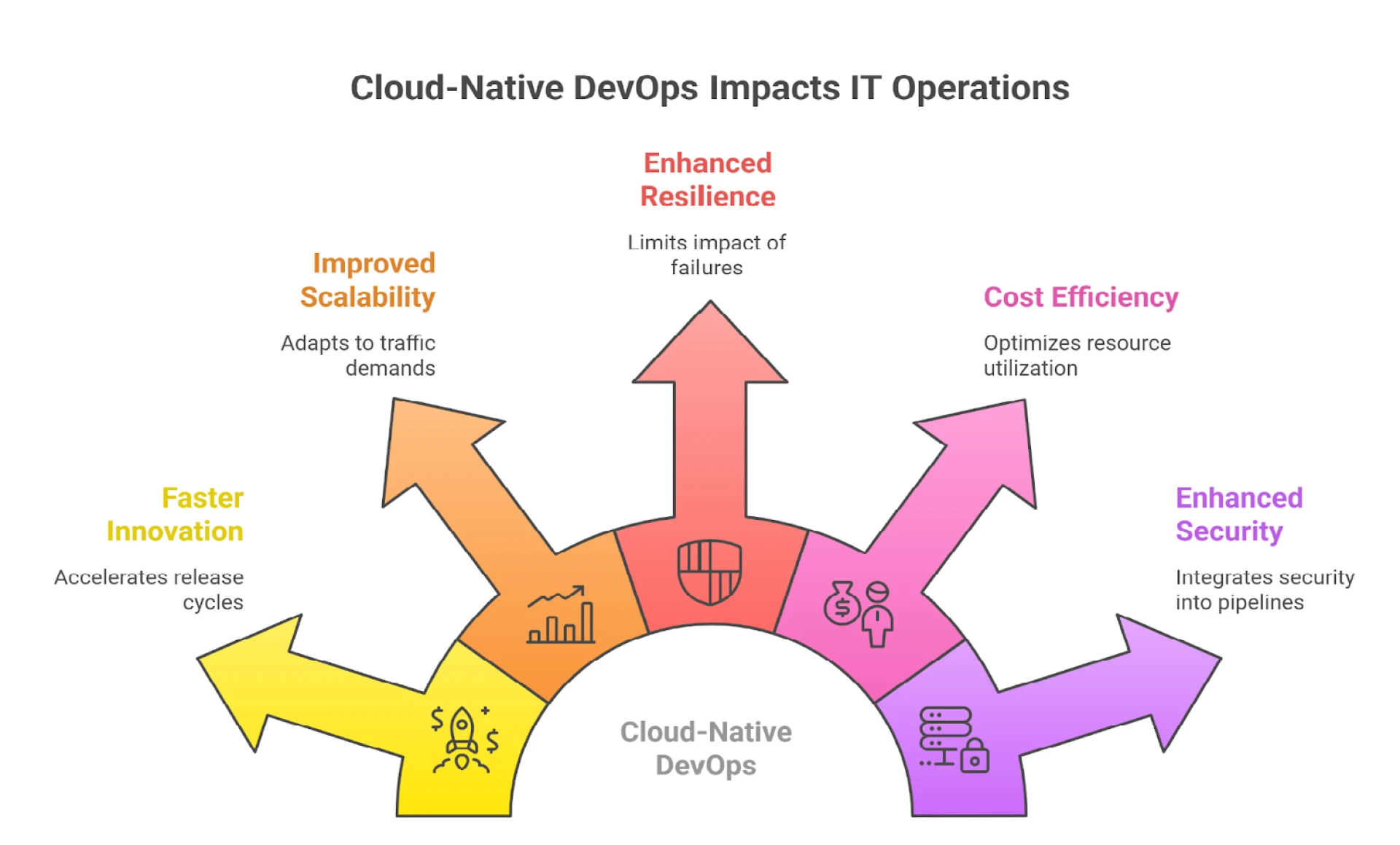
- Faster time-to-market: Automated pipelines and elastic infrastructure accelerate release cycles.
- Improved scalability: Applications adapt to traffic demands without manual intervention.
- Resilience: Microservices and containers limit the impact of system failures.
- Cost efficiency: Cloud’s pay-per-use model ensures optimized resource utilization.
- Enhanced security: DevSecOps integrates compliance and security checks into pipelines.
These benefits highlight why cloud-native DevOps isn’t just a trend—it’s becoming the default way modern IT operations are run. For businesses competing in fast-moving industries, these advantages can be the difference between leading the market and falling behind.
Expand your knowledge: Top DevOps Consulting Companies in 2025
Building a Cloud-Native DevOps Culture
Technology is the base, but culture is what binds cloud-native DevOps together. The focus of this culture is on cooperation, collective responsibility, and automation throughout the software lifecycle. The development and operations teams are no longer operating as individual teams but as one squad that is aligned to the business goals.
The cultural turn is also a turn toward failure as an educational experience. Cloud-native environments are built to be experimentable, allowing teams to experiment rapidly, roll back failures, and learn without significant interruption. Companies that promote this attitude develop a strong workforce that is willing to embrace continuous change and innovation.
Automation: The Heart of Cloud-Native DevOps
It is automation that makes the promise of cloud-native DevOps a reality. Infrastructure provisioning to ongoing integration and delivery (CI/CD) pipelines, automation provides consistency, repeatability, and scalability of processes. This minimizes human error, accelerates deployment, and enables teams to work on higher-value tasks instead of standard maintenance.
In the case of IT operations, automation also applies to monitoring and incident response. Cloud-native platforms also provide tools that automatically identify anomalies, send notifications, and in certain instances, self-heal. The further the workflows are automated, the closer organizations can get to the notion of continuous delivery and continuous improvement.
Overcoming Challenges in Cloud-Native DevOps
Cloud-native DevOps also has its drawbacks despite the benefits. The complexity of distributed systems is one of the biggest challenges. Visibility and monitoring have never been as important as they are with microservices, containers, and various cloud platforms at stake. Troubleshooting can easily get out of control without observability.
The other issue is security in a dynamic environment. Conventional security methods tend to decelerate DevOps, but in cloud-native systems, security has to be part of the process. This has led to DevSecOps, whereby security practices are automated and integrated into all development and operations. These challenges can only be overcome by a balance between governance and agility.
Cloud-Native DevOps and the Future of IT Skills
The skills demanded in the IT operations are also changing as businesses embrace this model. Experts must now be skilled in cloud systems, containerization software such as Kubernetes, and automation systems. They also need to be well-informed of CI/CD practices and monitoring tools so that operations run seamlessly.
This demand change is the reason why most organizations are seeking to hire DevOps Developers with cloud knowledge who can work across teams and introduce automation-based thinking to IT processes. This hiring is often accompanied by the necessity to hire mobile app developer talent, as cloud-native architectures tend to support mobile-first applications. Both product development and operational excellence are expedited when these skill sets are combined in proximity.
Pitfalls to Avoid in Cloud-Native DevOps
Adopting cloud-native DevOps is not without its risks. Businesses often fall into common traps that undermine the effectiveness of their initiatives. Some of the most notable pitfalls include:
- Relying on legacy processes that slow down agile workflows
- Overcomplicating architectures with unnecessary tools or frameworks
- Ignoring cost governance leads to overspending on cloud resources
- Treating security as an afterthought instead of integrating it into pipelines
- Failing to invest in training and cultural alignment across teams
Avoiding these mistakes requires planning, disciplined execution, and a willingness to evolve practices as the organization grows.
Cloud-Native DevOps and Business Agility
Agility in business is one of the greatest results of cloud-native DevOps. Companies do not need to take months to develop features or to address customer needs. Instead, they can deploy updates continuously, experiment with ideas fast, and scale systems as market dynamics change in real time. This agility is not merely technical--but is also reflected in the overall way the business functions.
Agility is a matter of survival when it comes to businesses operating in competitive markets. The customers demand ongoing innovations and trusted digital experiences. Cloud-native DevOps offers the platform to fulfill these expectations without making operations unstable and cost-effective. Agility is, in most respects, the final ROI of this model.
Cloud-Native DevOps and Digital Transformation
Digital transformation has become a buzzword, and the essence of it is using technology to provide customers with greater value. One of the most powerful drivers of this change is cloud-native DevOps. With IT operations and business strategy aligned, organizations are able to innovate at all times, create customer-focused products, and stay competitive in a digital-first world.
More to the point, this method enables companies to future-proof their business. Cloud-native DevOps makes sure that not only are systems scalable now, but also able to adapt to new technologies tomorrow. It can be the integration of AI-driven analytics, IoT workloads, or edge computing, but organizations that have adopted cloud-native DevOps are in a better position to look at the next thing.
The Road Ahead for Cloud-Native DevOps
Flexibility, automation, and speed will become the defining characteristics of IT operations in the future, and cloud-native DevOps reflects all three of them. With faster adoption, we will have more monitoring tools powered by AI, more security by design, and more containers and serverless architecture. Those that wait to adopt run the risk of getting outrun by other organizations that can be faster and more reliable.
Cloud-native DevOps is not merely a practice--a tactical benefit. The companies that invest in this model today are laying the foundation of innovation, agility, and resilience tomorrow. Cloud-native is already the future of IT operations.
Final Thoughts
Cloud-native DevOps is a radical change in the way IT operations are designed and implemented. It allows businesses to innovate more quickly, save money, and become more resilient by integrating the concepts of DevOps and the scalability of the cloud. This trend has been further accelerated by the adoption of containerization and microservices, and cloud-native is the new gold standard of modern IT.
In the digital age, organizations that want to stay competitive are no longer free to adopt cloud-native DevOps but must embrace it. Companies can future-proof their business and remain ahead of the competition in a constantly evolving market with the right culture, tools, and talented professionals. It is high time to do it, as the future of IT operations is undoubtedly cloud-native.