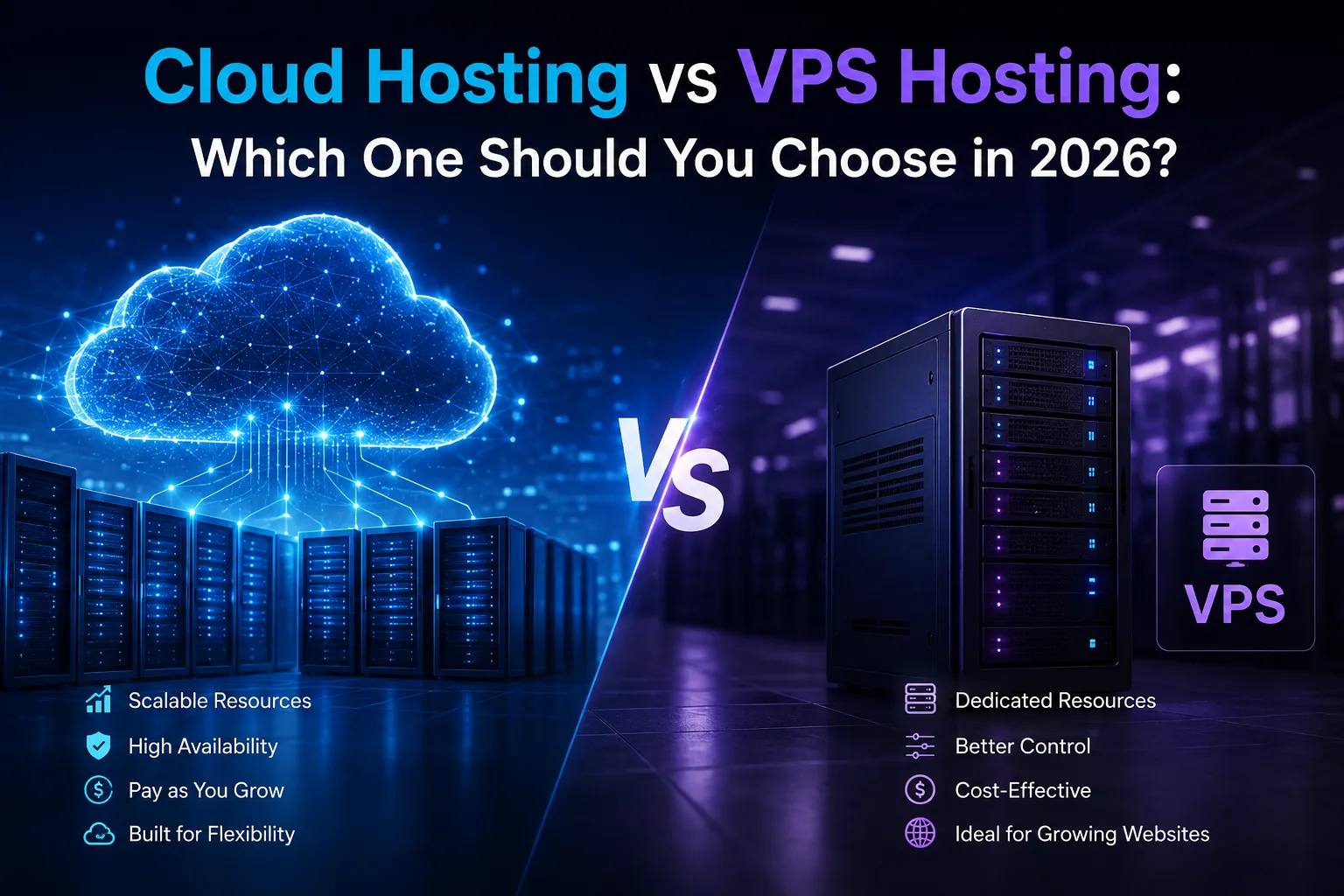
Two of the most commonly compared infrastructure options. Two very different value propositions. And a choice that most businesses make based on price alone — which is usually the wrong starting point.
Cloud hosting vs VPS hosting isn't a question of which is better in the abstract. It's a question of which fits your workload, your growth trajectory, and your technical team's capacity to manage what's underneath your application. Get it right and your infrastructure becomes invisible. Get it wrong and it becomes the thing your team talks about every Monday morning.
Here's a clear-headed breakdown of cloud hosting vs VPS hosting in 2026 — what each actually delivers, where each falls short, and how to decide without second-guessing yourself six months later.
What Is VPS Hosting?
A virtual private server sits between shared hosting and dedicated hardware. A physical server is generally divided into isolated virtual machines, each of them with fully guaranteed CPU, RAM, and storage allocations. Apart from shared hosting, your assets aren't pooled with all other users — what you're allocated is yours, consistently.
VPS hosting appeals to businesses that need more control and performance than shared hosting provides, without the cost of a full dedicated server. A good VPS provider gives you root access, your choice of operating system, and the ability to configure your environment exactly as your application requires.
The constraint is that a virtual private server is still tied to one physical machine. If that machine experiences hardware failure, your VPS goes with it. Growing beyond your allocated resources needs an upgrade of your current plan or migrating to a bigger instance — neither of which happens automatically.
What Is Cloud Hosting?
Cloud web hosting services distribute your workload across a network of interconnected servers rather than a single physical machine. Resources are virtualised across the infrastructure, which means redundancy is architectural rather than optional.
The defining characteristic of cloud hosting is elasticity. Resources scale up or down based on demand — automatically, in most cases — without requiring migration to a new instance or a support ticket to your VPS provider. Traffic spikes that would overwhelm a fixed virtual private server are absorbed by the cloud's distributed capacity.
Private cloud hosting adds an isolation layer for businesses that need the flexibility of cloud infrastructure without the multi-tenancy of public cloud — a middle ground that's increasingly popular with compliance-sensitive industries.
Cloud hosting services from providers like Infinitive Host are built around this elasticity model — infrastructure that grows with your business rather than requiring you to anticipate your needs six months in advance.
Cloud Hosting vs VPS Hosting: The Core Differences
Scalability is where cloud hosting vs VPS hosting separates most clearly. A virtual private server has fixed resource limits. Hitting those limits means manual intervention—upgrading plans, migrating data, potential downtime. Cloud hosting scales horizontally without those friction points.
Reliability tilts toward the cloud. A single-node virtual private server has a single point of failure. Cloud infrastructure allocates heavy workloads across different nodes, so hardware failure at the physical layer doesn't easily translate to downtime at the application layer.
Cloud server pricing is usage-based in most of the models—you pay for what you use in real-life. VPS hosting generally goes for flat-rate monthly pricing regardless of usage. For highly predictable tasks, VPS flat-rate pricing can be more budget-friendly. When it comes to workload scalability, the usage-based pricing structure of the cloud eliminates the risk of paying for unused capacity.
The ability to have control is the top consideration where the use of VPS hosting is concerned, and it presents an immense advantage to certain organizations. When developers gain root access to the VPS, it means they have full control over all the layers of the stack.
When VPS Hosting Is the Right Choice
Go for a virtual private server when your workload is fully stable and predictable, your traffic doesn't grow dramatically, and your team values direct control over the environment.
Managed VPS options from a quality VPS provider close the gap on operational overhead — handling OS updates, security patches, and monitoring while preserving the control and cost predictability that makes VPS attractive in the first place.
For small to mid-size businesses running applications with consistent traffic patterns — a CRM, an internal tool, a medium-traffic website—managed VPS is often the most cost-efficient and operationally simple choice. You're not paying for scalability infrastructure you don't use, and your bill is predictable month to month.
When Cloud Hosting Is the Right Choice
Choose cloud when your traffic is variable or growing, when redundancy is non-negotiable, or when your team wants infrastructure that manages itself rather than infrastructure that needs managing.
Cloud hosting providers are the natural fit for e-commerce businesses with seasonal peaks, SaaS platforms with growing user bases, and any application where downtime has a direct revenue cost. The elastic scaling and built-in redundancy that define cloud infrastructure are worth the premium when your workload actually needs them.
Private cloud hosting is increasingly the choice for businesses that want cloud flexibility without sharing physical infrastructure — financial services companies, healthcare platforms, and any business where data residency and isolation requirements go beyond what standard public cloud guarantees.
Cloud web hosting services through Infinitive Host cover both standard and private cloud configurations, with cloud server pricing that's transparent rather than buried in usage calculators that require a spreadsheet to interpret.
The Cost Reality in 2026
Cloud server pricing has come down significantly as the market has matured and competition among cloud hosting providers has intensified. The gap between cloud and VPS costs is narrower than it was three years ago — particularly at the managed level, where managed VPS and managed cloud configurations often sit within 20–30% of each other for equivalent capabilities.
The honest cost comparison requires looking at total cost—compute, storage, bandwidth, support, and the engineering time required to manage what the provider doesn't. A cheaper virtual private server that requires more internal management isn't always cheaper when you account for the hours.
Infinitive Host positions both options honestly—managed VPS for teams that want cost predictability and control, cloud configurations for teams that need elasticity and redundancy — with pricing that reflects the actual infrastructure rather than marketing positioning.
Conclusion
Cloud hosting vs VPS hosting in 2026 is a workload question, not a prestige question. Neither is inherently better—each is better for different things.
A virtual private server wins on cost predictability and direct control for stable, predictable workloads. Cloud hosting wins on scalability, redundancy, and operational simplicity for variable or growing workloads. Managed VPS and managed cloud close the gap on operational burden on both sides.
Start with your workload. If your traffic is consistent and your team wants control—explore managed VPS from a quality VPS provider like Infinitive Host. If your traffic varies, growth is the priority, or uptime is non-negotiable—look at their cloud hosting services and run the numbers against your actual usage profile.
Cloud hosting vs VPS hosting is a decision you should be able to revisit as your business grows. The right cloud hosting providers and VPS providers make that transition straightforward—not a reason to stay somewhere that no longer fits.