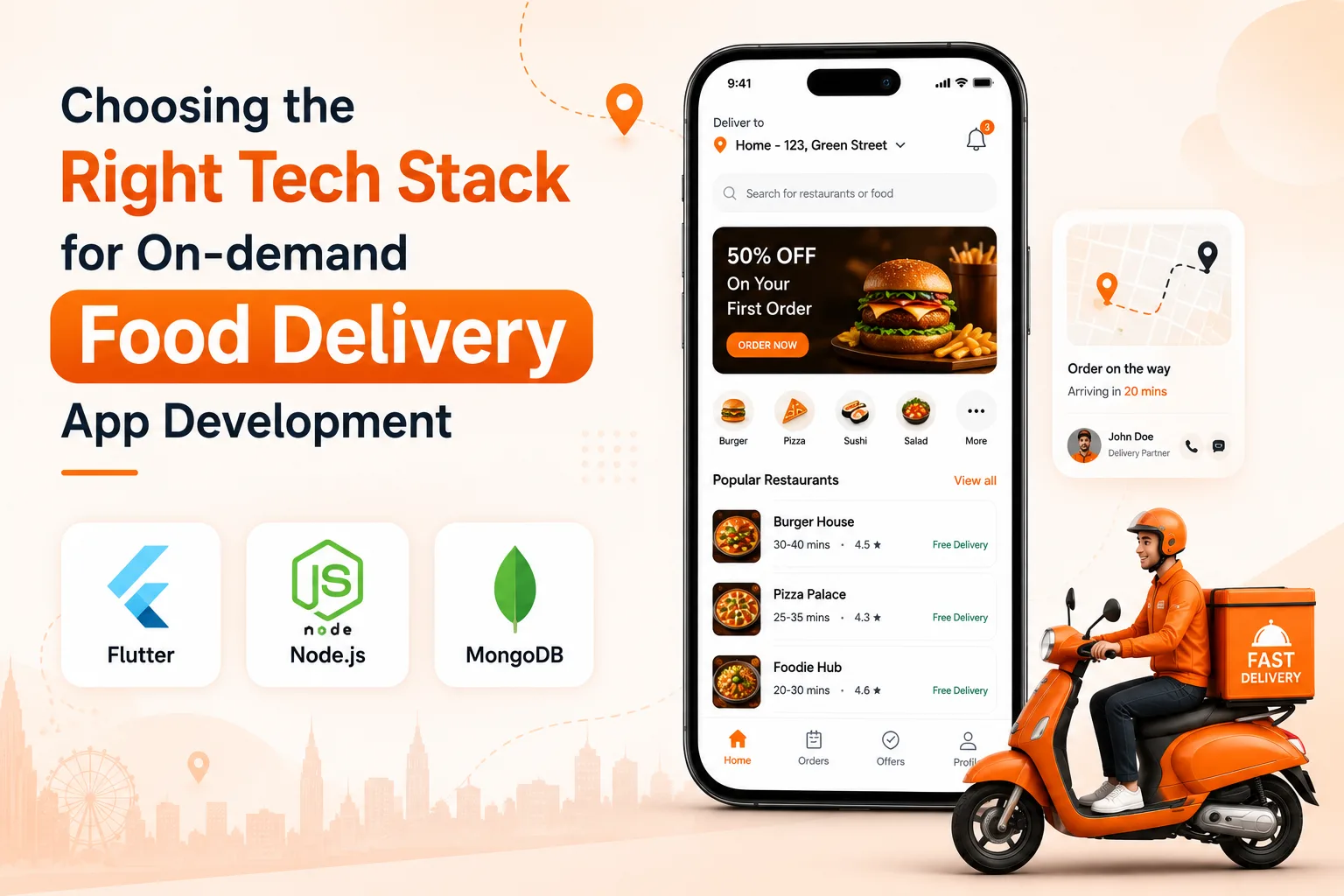
The on-demand food delivery industry has grown into one of the most competitive digital markets in the world. Every day, millions of people rely on their phones to order meals, track deliveries in real time, and get food at their doorstep within minutes. Behind every smooth, glitch-free ordering experience is a carefully chosen tech stack — the combination of programming languages, frameworks, databases, and tools that power the entire app.
For businesses planning to build a food delivery platform, choosing the right tech stack isn't just a technical decision. It directly affects how fast the app performs, how well it scales as your user base grows, how secure customer data remains, and how much it costs to maintain in the long run. Get it wrong, and you end up with an app that crashes during peak hours, takes forever to load, or costs a fortune to update. Get it right, and you have a foundation that can support your business for years.
In this article, we'll break down everything you need to know about picking the right technology stack for on-demand food delivery app development, covering each core component of the system.
Why the Tech Stack Matters So Much in Food Delivery Apps
A food delivery app isn't just one app — it's actually three interconnected platforms working together:
- The customer app, where users browse restaurants, place orders, and track delivery status.
- The delivery partner app, used by riders to accept orders and navigate to delivery locations.
- The restaurant/admin panel, where restaurant owners manage menus, orders, and inventory.
Each of these components needs to communicate with the others in real time. That means your tech stack has to support live order tracking, instant notifications, seamless payment processing, and high concurrency, especially during lunch and dinner rush hours when thousands of orders may hit the system simultaneously. Choosing technologies that can't handle this kind of load is one of the most common reasons on-demand apps fail after launch.
Key Factors to Consider Before Choosing a Tech Stack
Before jumping into specific technologies, it helps to think through a few practical factors:
- Scalability: Can the stack handle a growing number of users, orders, and restaurants without major rework?
- Real-time capability: Does it support live GPS tracking, instant order updates, and push notifications smoothly?
- Development speed: Will it let your team build and launch an MVP quickly, then iterate based on user feedback?
- Cost of development and maintenance: Some stacks are cheaper to build with initially but expensive to maintain, and vice versa.
- Talent availability: Popular, well-supported technologies make it easier to hire developers later.
With these factors in mind, let's look at the specific layers of the tech stack.
Front-End Development: Building the Customer-Facing App
The front end is what users actually interact with, so performance and user experience are critical here.
For mobile apps, two of the most popular choices are:
- React Native: A cross-platform framework that lets you build for both iOS and Android using a single codebase. It's widely used in food delivery apps because it cuts development time and cost significantly while still delivering near-native performance.
- Flutter: Google's UI toolkit is another strong cross-platform option, known for its smooth animations and consistent design across devices. Many newer food delivery startups prefer Flutter for its fast rendering engine and growing developer community.
If budget allows and performance is an absolute priority, some businesses still choose native development — Swift for iOS and Kotlin for Android — since native apps generally offer the best performance and access to device-specific features. However, this comes at the cost of maintaining two separate codebases.
For the web dashboard (used by admins and restaurant partners), frameworks like React.js or Vue.js are commonly used, offering fast, responsive interfaces that are easy to maintain and update.
Back-End Development: The Engine Behind the App
The back end handles everything users don't see — order processing, user authentication, restaurant data management, and communication between the customer app, delivery app, and admin panel.
Popular back-end technologies for food delivery apps include:
- Node.js: Extremely popular for real-time applications because of its non-blocking, event-driven architecture, which is ideal for handling multiple simultaneous connections, like live order tracking and chat features.
- Python (Django/Flask): Known for clean, readable code and a rich ecosystem of libraries, making it a solid choice for apps that also plan to integrate data analytics or machine learning features like personalized restaurant recommendations.
- Ruby on Rails: A framework that allows rapid development, often chosen by startups that want to launch an MVP quickly and iterate based on early user feedback.
The right choice here often depends on your team's existing expertise and how quickly you need to get to market.
Database Management: Storing and Organizing Data
Food delivery apps deal with huge volumes of structured and semi-structured data — user profiles, order histories, restaurant menus, real-time location data, and more. Choosing the right database (or combination of databases) is essential.
- PostgreSQL or MySQL: Reliable relational databases well-suited for structured data like user accounts, orders, and transactions.
- MongoDB: A NoSQL database often used alongside relational databases to handle flexible, fast-changing data like restaurant menus or delivery tracking logs.
- Redis: An in-memory data store commonly used for caching frequently accessed data, session management, and powering real-time features like live order status updates.
Many successful food delivery platforms use a hybrid approach, combining relational and NoSQL databases depending on the specific data needs of each feature.
Real-Time Tracking and Location Services
Live tracking is one of the defining features of any on-demand delivery app, and it requires a specific set of tools:
- Google Maps API or Mapbox for real-time location tracking, route optimization, and estimated delivery time calculations.
- WebSockets or tools like Socket.IO to enable real-time, two-way communication between the app and the server, so users see live updates without refreshing the app.
- Firebase Cloud Messaging (FCM) for sending push notifications about order confirmations, delivery updates, and promotional offers.
Payment Gateway Integration
A smooth, secure checkout process can make or break user trust in a food delivery app. Depending on your target market, popular payment gateway options include:
- Stripe and PayPal for global reach and ease of integration.
- Razorpay for businesses operating in India.
- Region-specific gateways for markets like the UAE or GCC region, where local payment preferences and compliance requirements matter.
Security is non-negotiable here — make sure whichever gateway you choose is PCI-DSS compliant to protect customer payment data.
Cloud Infrastructure and Hosting
Reliable hosting infrastructure ensures your app stays up and running, even during high-traffic periods. The most widely used cloud platforms include:
- Amazon Web Services (AWS) – Offers extensive scalability options and a wide range of services for storage, computing, and real-time data processing.
- Google Cloud Platform (GCP) – Known for strong data analytics and machine learning tools, useful if you plan to add personalized recommendations later.
- Microsoft Azure – A solid choice for businesses already using other Microsoft enterprise tools.
Using containerization tools like Docker and orchestration platforms like Kubernetes can also help manage deployment and scaling more efficiently as your app grows.
Analytics and Third-Party Integrations
Beyond the core stack, most food delivery apps also integrate with third-party tools for:
- Analytics (Google Analytics, Mixpanel) to track user behavior and improve app performance over time.
- SMS and email services (Twilio, SendGrid) for order confirmations and customer communication.
- Customer support tools (Zendesk, Intercom) to handle user queries efficiently.
Common Mistakes to Avoid When Choosing a Tech Stack
- Choosing technology based on trends rather than actual project needs. Just because a framework is popular doesn't mean it's the right fit for your specific app requirements.
- Ignoring scalability early on. Many startups build for their current user base without planning for growth, leading to costly rebuilds later.
- Overlooking security requirements. Payment data, user information, and location tracking all require strict security measures from day one.
- Underestimating maintenance costs. Some technologies are cheap to build with but expensive to maintain long-term — factor this into your decision.
Final Thoughts
There's no single "perfect" tech stack that works for every food delivery app. The right choice depends on your budget, timeline, target market, and long-term business goals. A startup looking to launch an MVP quickly might prioritize speed and cost-efficiency with tools like React Native and Node.js, while an established business planning for rapid scale might invest more heavily in native development and robust cloud infrastructure from the start.
Working with an experienced on-demand food delivery app development company can make this decision much easier. A team that has built similar platforms before will already understand which combinations of technologies work well together, what pitfalls to avoid, and how to build an app that's ready to scale as your business grows.
Ultimately, the goal is to build a stack that supports a fast, reliable, and secure experience for your customers, delivery partners, and restaurant owners alike — because in the food delivery business, performance and reliability are what keep users coming back.