
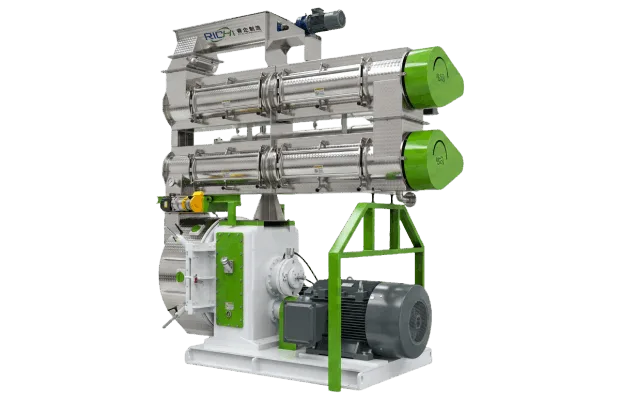
Turning forage into pellets can help livestock feed producers simplify material handling and create a more uniform product. However, forage materials vary considerably in fiber length, moisture, and compression behavior. Choosing equipment without considering these differences can lead to unstable feeding, low output, or pellets that break easily.
A silage pellet machine should therefore be selected according to the raw materials, required production capacity, pellet specifications, and intended use of the finished product.
1. Identify Your Main Raw Materials
The first step is to identify the materials that will enter the production line. Depending on the formulation, these may include grass silage, alfalfa, chopped corn stalks, and other suitable forage ingredients.
Different materials require different preparation methods. Long fibers may need chopping before grinding, while mixtures containing several ingredients may benefit from controlled mixing. Material consistency helps the pelletizer receive a more uniform feed.
Producers should also inspect the incoming materials for mold, contamination, and unusual odors. Proper storage and raw material management are essential because pelletizing cannot correct spoilage or make unsuitable forage safe for feeding.
If the formulation changes seasonally, the production process may need to change as well. A configuration that performs well with one mixture may not achieve the same output with another.
2. Decide Whether You Need a Standalone Machine or a Complete Line
A standalone pelletizer may suit a small operation that already has suitable prepared material. In this situation, the main requirements may be controlled feeding, pellet formation, and appropriate handling after production.
Larger projects often require a more integrated system. Depending on the incoming materials, a production line may include:
- A chopper for reducing long forage fibers
- A grinder for adjusting particle size
- A mixer for combining ingredients
- A pelletizer for forming compact pellets
- A cooler and conveying system for downstream handling
Not every plant needs every machine. For example, preprocessed materials may not require an additional grinding stage. Reviewing the entire process before purchasing helps avoid unnecessary equipment and reduces the risk of bottlenecks.
3. Match Capacity to Actual Production Requirements
Machine capacity should be evaluated against the quantity of finished product required per hour or per day. Buyers should also account for operating hours, expected maintenance downtime, and possible changes in demand.
Rated capacity alone is not enough to make a reliable comparison. Actual throughput depends on material moisture, particle size, formulation, pellet diameter, and operating conditions.
Ask the supplier to explain the conditions behind the proposed capacity. If possible, test the actual raw material using the intended pellet specifications. This gives you a more useful basis for planning production than relying only on a general catalogue figure.
It is also important to check the capacity of upstream and downstream equipment. A grinder that cannot supply material quickly enough may limit the pelletizer, while insufficient cooling or conveying capacity can interrupt finished-product handling.
4. Consider Pellet Size and Durability
Pellet diameter should match the intended feeding method and livestock requirements. The die determines the basic diameter, while the cutter affects pellet length.
Forage composition and fiber structure influence how well the material binds under pressure. If the finished pellets break easily, the problem may involve particle size, moisture, formulation, die condition, or operating settings rather than the machine alone.
Producers should establish practical quality checks for pellet shape, consistency, and resistance to handling. Sample testing during production can help identify issues before a large batch is completed.
Cooling and storage should also be included in the plan. Depending on the process, freshly produced pellets may require cooling before packaging. Finished products should be stored in a clean, dry environment to reduce moisture-related deterioration.
5. Evaluate the Equipment's Operating Costs
The purchase price is only one part of the investment. Electricity consumption, labor, replacement parts, maintenance, and production downtime can all affect operating costs.
Before purchasing, ask about die and roller service life, lubrication requirements, access to the pelletizing chamber, and the availability of replacement components. A machine that is easy to inspect and maintain can simplify routine work.
For operations processing different forage formulations, a 5T/H grass pellet machine may also be relevant to the equipment comparison. However, different materials can behave differently during compression. Confirm that the proposed machine and die configuration are suitable for the actual formulation instead of assuming that all forage materials will produce identical results.
6. Prepare for Installation and Daily Operation
Available floor space, electrical supply, material flow, and maintenance access should be checked before installation. A well-planned layout can reduce unnecessary conveying and make it easier for operators to inspect the equipment.
Ask the supplier what installation support, operating instructions, training, and spare parts are included. Clear documentation helps operators understand startup procedures, routine inspection, and safe shutdown practices.
For a complete project, Richi Machinery can be consulted about machine selection and production-line configuration. Providing the raw material type, target capacity, pellet diameter, and site conditions will help the supplier evaluate the requirements more accurately.
Before committing to a purchase, compare proposals based on the same production conditions. To review available equipment options and processing arrangements, read more about forage pellet production and prepare your specifications for a detailed quotation.