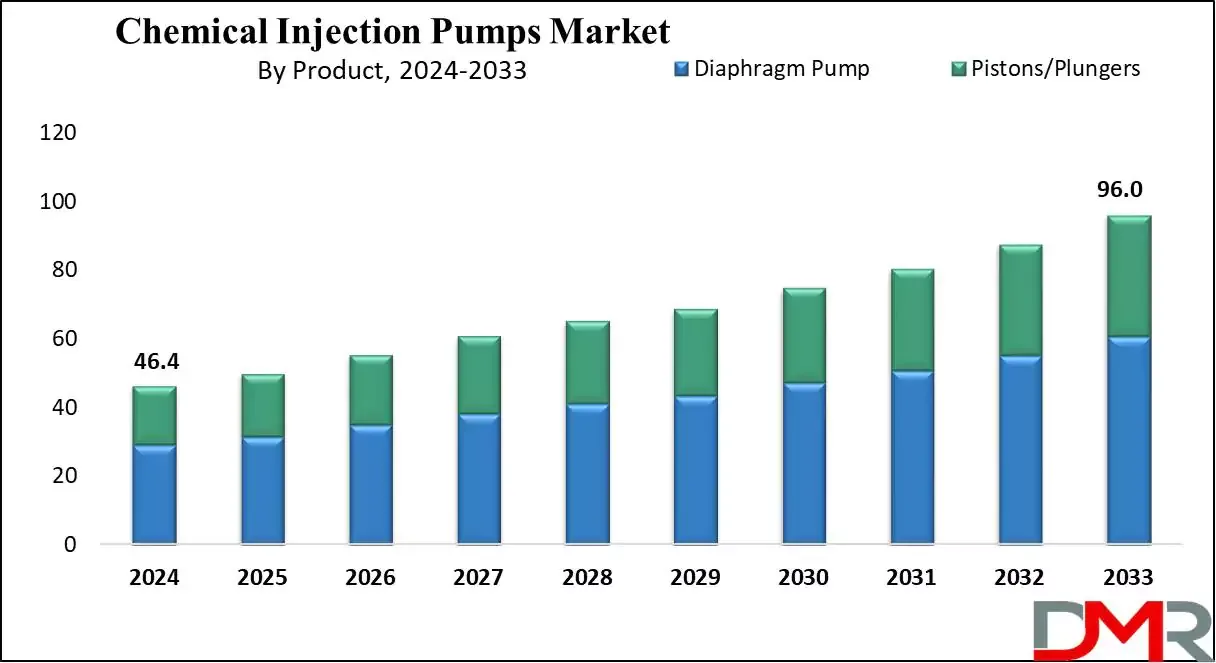
According to Dimension Market Research, the Chemical Injection Pumps Market is gaining momentum as industrial companies seek more accurate chemical dosing, improved process control, and reduced operational waste. The market is estimated at USD 46.4 billion in 2024 and is forecast to reach USD 96.0 billion by 2033, expanding at an 8.4% CAGR.
Chemical injection pumps are designed to introduce controlled amounts of chemicals into a process, pipeline, treatment system, or production environment. Their applications range from injecting corrosion inhibitors into oil wells to dosing disinfectants in water treatment plants.
Increasing industrial automation is changing the way these pumps are operated. Instead of relying exclusively on manual adjustments, industrial facilities are increasingly using sensors, control systems, and data analytics to optimize chemical delivery.
Major Trends Shaping the Market
Smart Chemical Dosing
One of the most important trends is the integration of smart technologies with chemical injection systems. Sensors can monitor pressure, flow rates, chemical levels, and equipment conditions.
Data collected from connected systems can help operators identify abnormalities and optimize dosing rates. This can contribute to better process control and potentially reduce unnecessary chemical consumption.
Predictive Maintenance
Unexpected pump failures can interrupt production and affect chemical dosing accuracy. Predictive maintenance systems can analyze equipment data to identify signs of wear before a major failure occurs.
This approach can help industrial users reduce downtime and improve equipment utilization.
Sustainable Chemical Management
Sustainability is becoming increasingly important across industrial operations. Precise chemical dosing can reduce overuse, minimize waste, and support compliance with environmental requirements.
As industries focus on responsible chemical management, efficient injection pumps are becoming an important part of process optimization.
Oil & Gas Remains a Key Application
Oil and gas operations require chemical injection at multiple stages of production. Corrosion inhibitors, scale inhibitors, demulsifiers, and other specialty chemicals may be injected into production systems to protect equipment and maintain operational efficiency.
Dimension Market Research estimates that oil & gas accounted for approximately 41.2% of the Chemical Injection Pumps Market in 2024.
The continued need for infrastructure protection and efficient chemical management provides manufacturers with opportunities to develop high-pressure and application-specific pump systems.
Water Treatment Creates Long-Term Demand
Water treatment is another critical application area. Chemical injection pumps are used to deliver disinfectants, coagulants, pH-control substances, and other treatment chemicals.
Increasing water scarcity and stricter water quality requirements are encouraging investment in treatment facilities. Desalination projects also create demand for reliable dosing systems, particularly in water-stressed regions.
Diaphragm Pumps Lead the Type Segment
The market is divided into Diaphragm Pumps and Pistons/Plungers. Diaphragm pumps held around 58% market share in 2024 and are expected to maintain a leading position during the forecast period.
Their precision, safety characteristics, and ability to support demanding chemical handling requirements make them attractive across pharmaceutical, water treatment, chemical, and industrial applications.
Piston and plunger pumps also remain important where high-pressure chemical injection and robust operating performance are required.
Industry-Wise Opportunities
Chemical injection pumps have applications across several industries:
Water Treatment: Accurate dosing of disinfectants and treatment chemicals.
Oil & Gas: Corrosion protection, scale control, and production optimization.
Agriculture: Fertilizer and pesticide injection through irrigation systems.
Chemical Processing: Controlled addition of acids, alkalis, and specialty chemicals.
Pharmaceuticals: Precise chemical dosing during manufacturing and processing.
Pulp & Paper: Chemical treatment and process control.
The diversification of applications reduces dependence on any single industry and creates opportunities for manufacturers with flexible product portfolios.
Regional Market Outlook
North America is currently the largest regional market, holding 36.4% revenue share in 2024. Strong industrial activity, advanced manufacturing capabilities, and stringent water treatment requirements support the region's position.
Asia-Pacific is projected to be the fastest-growing region. Rapid industrial development and increasing investments in water and wastewater treatment are supporting demand across China, India, and other economies.
Europe is also an established market, supported by industrial automation and environmental standards. Meanwhile, Middle Eastern countries can offer opportunities through oil and gas production and desalination projects.
Download Sample PDF of the Report: https://dimensionmarketresearch.com/request-sample/chemical-injection-pumps-market/
Key Market Challenges
Despite favorable growth prospects, manufacturers face several challenges. Different industries require pumps with specific dosage rates, flow rates, pressure levels, chemical compatibility, and material specifications.
Pump failure is another concern. Incorrect chemical dosing can create safety, compliance, and environmental problems, while equipment downtime can interrupt production.
Manufacturers therefore need to focus on reliability, customization, preventive maintenance, and technical support.
Competitive Landscape
The Chemical Injection Pumps Market includes several established and specialized companies. Key players include ITC Dosing Pumps, Milton Roy, Cameron, Idex Corp, Lewa GmbH, Seko SpA, SPX FLOW, Hunting PLC, Proserv, and Graco Inc.
Companies are competing through technological innovation, product customization, digital monitoring, engineering capabilities, and expansion into high-growth industrial applications.
Outlook Through 2033
The market's growth trajectory reflects the increasing importance of accurate chemical management. Industrial users are looking for pumps that deliver precision while reducing waste, maintenance requirements, and operating risks.
The combination of water treatment expansion, oil and gas demand, industrial automation, and smart pump technologies is expected to create attractive opportunities through 2033.