Customer expectations are changing as businesses introduce artificial intelligence into their communication channels. Customers want quick answers, convenient interactions, and support that understands their requirements. Chatbots and voicebots help meet these expectations by automating conversations through text and speech. However, their interaction methods, technical requirements, and ideal applications differ.
A 2026 Gartner survey of 3,566 customers found that 87% consider access to a human agent essential when companies use generative AI for customer service. This finding highlights why businesses must design automated support around customer needs rather than focusing only on reducing human involvement. Source: Gartner, 2026.
What Is a Chatbot?
A chatbot is an AI-powered software application that communicates with users through text messages. It can be integrated into websites, mobile applications, social media platforms, and messaging services to answer questions and guide customers.
Traditional chatbots often follow predefined rules and decision trees. Modern AI chatbots use natural language processing (NLP), machine learning, and large language models to understand complex questions and generate contextual responses.
For example, an online shopping chatbot can help customers find products, compare specifications, check delivery updates, and understand refund policies. It can also connect with customer relationship management (CRM) systems to provide more relevant assistance.
What Is a Voicebot?
A voicebot is a conversational AI system that interacts with users through spoken language. Instead of typing questions, customers speak naturally and receive audio responses.
Voicebots combine automatic speech recognition (ASR), natural language processing, and text-to-speech (TTS) technologies. ASR converts spoken words into text, NLP interprets the request, and TTS generates a spoken response.
For instance, an airline can use a voicebot to help passengers check flight schedules, understand baggage policies, and receive booking updates through telephone conversations.
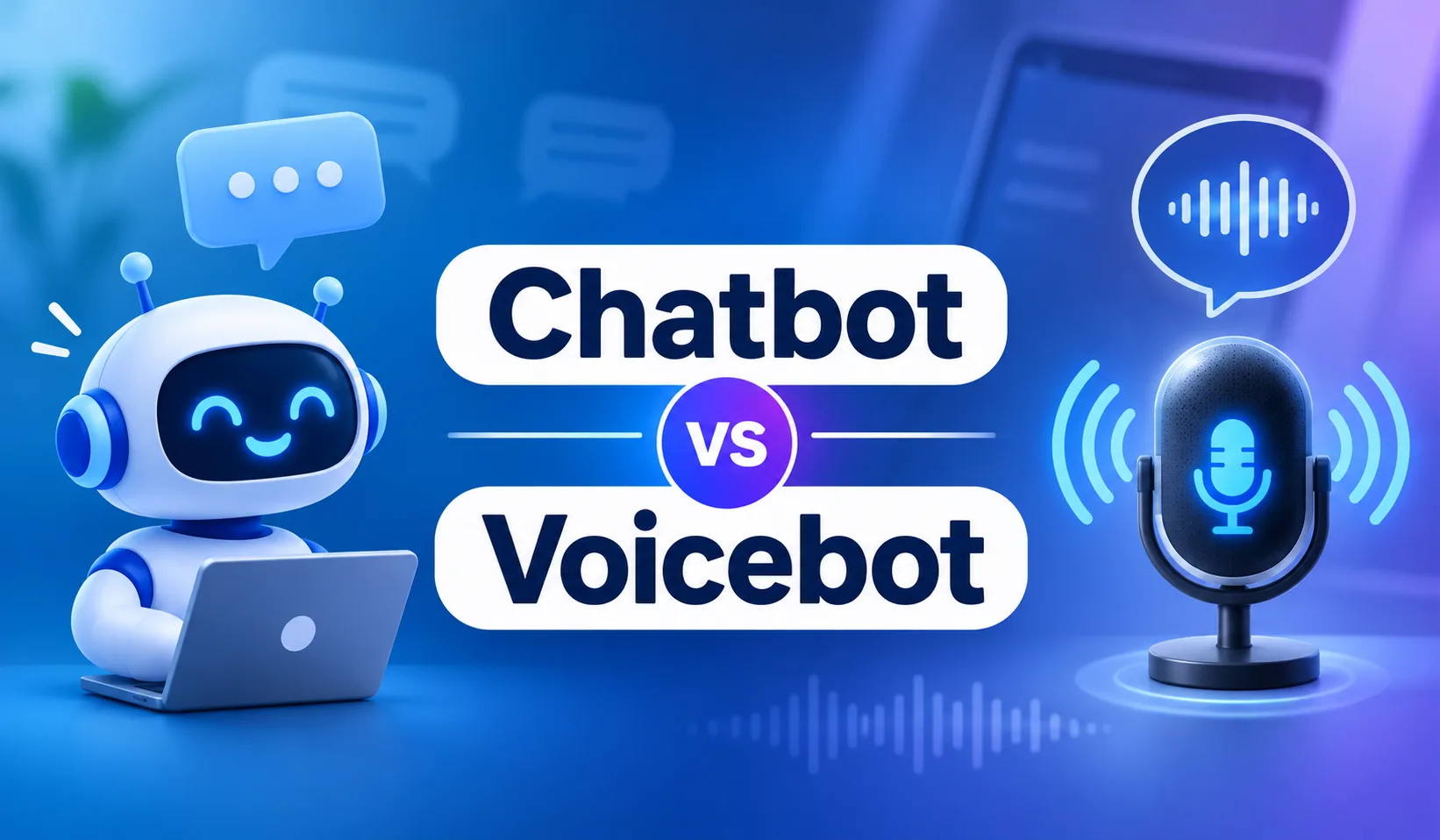
Chatbot vs Voicebot: How Do They Differ?
Both technologies automate conversations, but their capabilities vary across several areas.
1. Input and Output
Chatbots primarily process written messages and respond with text. They can also share images, documents, links, and interactive options.
Voicebots accept spoken commands and respond through generated speech. Some advanced systems support additional inputs, but voice remains their primary communication channel.
2. Conversation Flow
Chatbots allow users to send multiple messages, review previous responses, and continue conversations at their convenience. This makes them useful for queries that require step-by-step instructions.
Voicebots support real-time spoken conversations. Users can explain their requirements without typing, although interruptions, unclear pronunciation, and background noise may affect the interaction.
3. Integration Requirements
Chatbots commonly connect with websites, messaging applications, databases, CRM platforms, and e-commerce systems.
Voicebots require additional integrations with telephony platforms, speech recognition services, contact center software, and voice processing systems. These integrations help businesses automate incoming and outgoing calls.
4. Customer Accessibility
Chatbots are useful when customers prefer written communication or need information they can revisit later. They are also suitable for environments where speaking is inconvenient.
Voicebots benefit customers who prefer speaking, need hands-free assistance, or want to complete tasks without navigating multiple screens. However, voice interactions may not be appropriate in noisy or public environments.
5. Development and Maintenance
Chatbot development generally involves designing conversation flows, connecting data sources, configuring AI models, and testing text responses.
Voicebot development includes these activities along with speech recognition, voice selection, audio quality testing, and telephony integration. Consequently, implementation complexity depends on the required features and business environment.
Benefits of Chatbots and Voicebots
Each technology offers different operational advantages.
Benefits of Chatbots
- Continuous availability: Respond to customer questions outside business hours.
- Scalable communication: Handle multiple conversations simultaneously.
- Consistent information: Deliver standardized responses to common questions.
- Conversation history: Allow customers and support teams to review previous messages.
- Easy information sharing: Provide links, product details, documents, and instructions.
Benefits of Voicebots
- Natural interaction: Let customers communicate through spoken language.
- Call automation: Handle repetitive inquiries without requiring an agent for every interaction.
- Hands-free convenience: Support users who cannot easily type or navigate an application.
- Call routing: Direct customers toward relevant departments or services.
- Real-time assistance: Respond to spoken questions during telephone interactions.
Business Applications of Chatbots and Voicebots
The choice between these solutions depends on customer behavior and the tasks a business wants to automate.
Industries Using Chatbots
- E-commerce: Product discovery, order tracking, and return assistance.
- Education: Admission information, course inquiries, and student support.
- Healthcare: Appointment booking, general information, and patient assistance.
- Banking: Service inquiries, account guidance, and transaction-related FAQs.
- Travel: Reservation support, travel information, and itinerary updates.
Industries Using Voicebots
- Telecommunications: Billing inquiries, plan information, and technical support calls.
- Healthcare: Appointment reminders, scheduling, and routine patient communication.
- Insurance: Policy inquiries, claim status updates, and customer assistance.
- Banking: Basic account inquiries and telephone service navigation.
- Hospitality: Reservation assistance, booking confirmations, and guest inquiries.
How to Choose Between a Chatbot and a Voicebot?
Start by identifying how customers prefer to communicate with your business. If most interactions happen through websites, applications, or messaging platforms, a chatbot may be the more practical option.
If your business handles a high volume of telephone inquiries, a voicebot can automate routine calls and improve call handling. Consider implementation costs, integration requirements, data security, and the complexity of customer requests before making a decision.
For businesses serving customers across multiple channels, combining both technologies can provide greater flexibility. A chatbot can manage written inquiries while a voicebot handles telephone conversations. Both should also support escalation to human agents when requests become complex.
Why Choose Moon Technolabs for Chatbot and Voicebot Development?
Building conversational AI requires suitable technology, reliable integrations, and an understanding of customer workflows. Moon Technolabs provides AI development and consultancy services to help businesses create customized chatbot and voicebot solutions.
Its services include conversational interface development, AI integration, mobile and web application development, and workflow automation. Businesses can work with its team to build solutions that streamline communication, manage repetitive inquiries, and support evolving customer service requirements.
Conclusion
The chatbot vs voicebot comparison shows that neither technology is universally better. Chatbots are effective for written interactions and information sharing, whereas voicebots are valuable for spoken communication and telephone automation. Businesses should evaluate customer preferences, operational requirements, and integration needs before selecting a solution. Combining both technologies can also create a more flexible customer support experience.