
The era of publishing bland financial reports is now behind us. The stakeholders of today, the investors, the employees, the customers, and even the regulators want more. They want organizations to tell not only how much they have made, but how they have made it, and the effect of their activities in the world. It is here that the integrated annual report comes in.
But while the idea is simple—combine financial data with environmental, social, and governance (ESG) metrics into one powerful document—the execution is anything but easy. Most companies find it hard to develop reports that are not only compliant but meaningful. It is not uncommon that the process is full of fragmented information, lack of teamwork, and lack of clarity.
So, why is it so difficult for companies to get integrated reporting right? Are there any possible ways to overcome these situations? Let’s explore!
Common Challenges in Crafting an Integrated Annual Report—and How to Solve Them
Not to get bogged down in the theory, let us find out what the real-life problems companies face on preparing an integrated annual report are. And how they can avoid them to produce a document that actually represents their vision, their performance, and their plans.
These are the proper solutions to your queries or the problems you are facing in your business:
1. Disjointed Departmental Data
One of the most common (and frustrating) challenges in preparing an integrated annual report is data fragmentation. The financial data may be in one system, sustainability data in another, HR data in spreadsheets, and risk data in still another tool. The language, process, and reporting cycle differ among the departments.
This integration is a problem that makes it hard to integrate everything into one. It also adds to the chances of mistakes, discrepancies, and deadlines being missed.
Solution:
Invest in a central reporting system or enterprise data warehouse that collects financial and non-financial information. Have one common taxonomy for each department, and develop frequent data collection templates. Preliminary liaison and data-sharing arrangements between departments help significantly in making the reporting process simple.
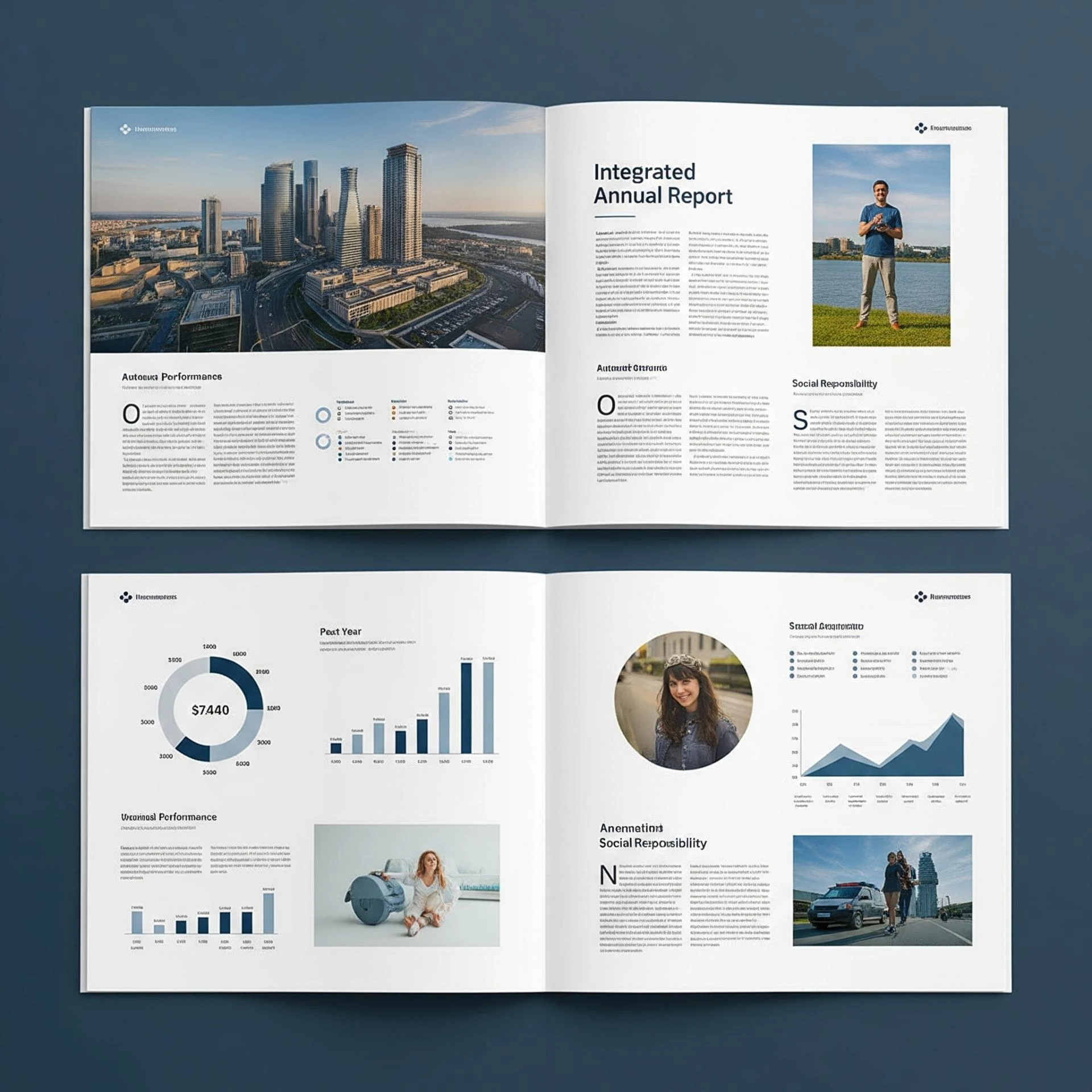
2. Misalignment of Financial and ESG Measures
The standards that govern financial reporting are clear and globally accepted like IFRS and GAAP. However, the ESG data is much less standardized. That is why aligning financial and non-financial metrics becomes a daunting task.
This can be illustrated by the example of a firm that could easily measure the growth of the revenue but might not be able to measure social impact or environmental improvement in the same manner using similar KPIs. The result? An episodic storyline that is counterproductive to the point of an integrated annual report.
Solution:
Use established ESG and integrated reporting frameworks such as the International <IR> Framework, GRI (Global Reporting Initiative), or SASB. These models provide guidelines for how the financial and non-financial information should be arranged and related in a meaningful way. The companies are also encouraged to come up with their own internal ESG KPIs which are in line with their business strategy as well as the expectations of their stakeholders.
3. No Certainty of the Reporting Process Ownership
What is in the focus of the integrated annual report? Finance? Sustainability? Investor Relations? The thing is that most organizations consider reporting as a secondary activity, which is given only at the last stage and is poorly coordinated. As a result, it causes miscommunication, redundancy in work, and finally, a report that is not cohesive.
Solution:
Establish a cross-functional reporting department as the fiscal year begins. Therefore, appoint a project manager, or another lead, to oversee the entire process. They will ensure that every department recognizes its responsibilities, timeline, and deliverables. Regular check-ins and project management tools (like Asana or Trello) can help keep the team aligned.
4. Lack of Data Quality and Accuracy
There may be data but it may be dubious. Errors can be made due to manual data entry, old systems, or variable definitions of metrics. The inaccurate data does not only spoil credibility but may also put companies under legal risks and reputational risks.
Solution:
You can implement data governance procedures such as frequent audits and automated data gathering along with concise definitions of metrics. Promote the use of real-time data systems by the departments where feasible. The data that you have used to construct your integrated annual report should be checked and revised.
5. Overwhelming Amounts of Data with No Clear Narrative
We have seen some reports that are 100+ pages long with all the charts, numbers, and boilerplate text in them but lack a good story. Companies who attempt to cover all possible details tend to forget that there is a bigger picture. The noise drowns the essence.
Solution:
Run a materiality test to know what is important to your stakeholders. Intentionally concentrate on major concerns that affect your business and society in a real sense. Apply storytelling to create a logical but interesting flow first tell the mission of your company, the way you create value, and the way you want to go forward.
Your integrated annual report must not be a data dump, it ought to be a narrative that is well-written.
6. Always-Shifting Rules and Demands
The regulatory landscape concerning ESG and integrated reporting is changing fast. For example, Europe has its CSRD and the SEC has its climate disclosure rules. The expectations of stakeholders are also increasing at the same pace. What will be satisfactory today may have been insufficient last year.
This puts a strain on businesses to keep up-to-date and mobile. The incapability to satisfy new anticipations may result in investor examination, violation, or even image harm.
Solution:
Include regulatory tracking in your reporting. So, what can you do? You can hire a professional or assign someone on your team like an external advisor to monitor policy changes and industry standards.
Moreover, it’s particularly useful to go to sustainability conferences, participate in professional circles, and stay up to date with what the best companies are doing. It’s nothing but all about flexibility- the internal systems should be resilient enough to new measurements and new disclosure needs.
Final Thoughts: Don’t Just Report—Lead!
Integrated annual reporting is no longer an optional luxury of progressive corporations, but it is an expectation. It is not only a question of compliance. When it is done right, it is a tool to communicate your plan, show responsibility, and gain the trust of the stakeholders.
It’s true that we have challenges: fragmented data, no ownership, changing regulations, and gaps in the storytelling process, but none of them is impossible to overcome. When approached correctly, companies will not only be able to get rid of these obstacles but also make their integrated annual report an effective strategic tool.
Away with checkbox reporting. So, why wait more? It is time to start thinking of your report as it is, a window of your company's soul. And ensure what you show people is what you are all about and where you are heading.