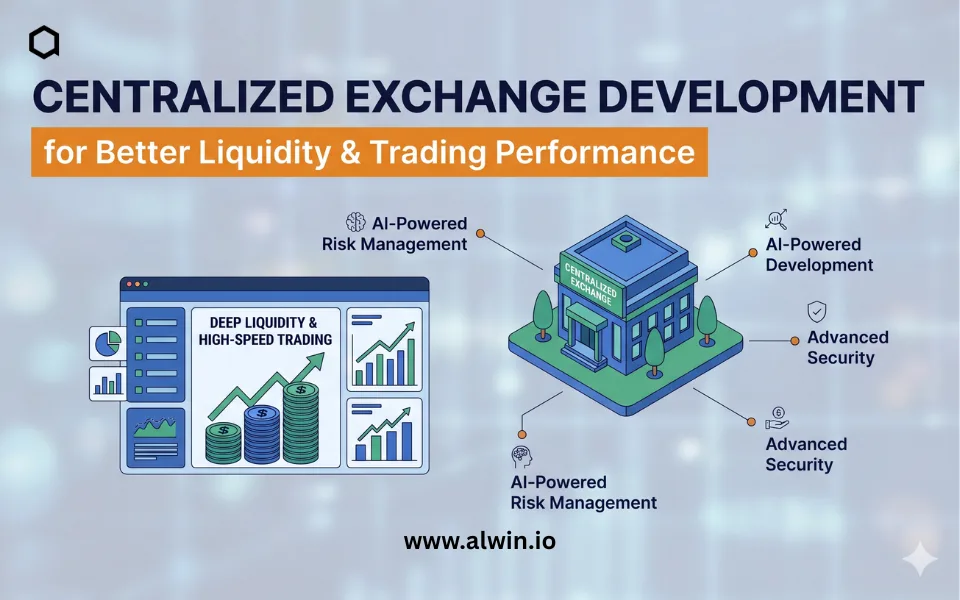
A centralized crypto exchange needs more than a strong trading interface to attract and retain users. Traders expect fast order execution, sufficient liquidity, stable market depth, and strong security across every transaction. Poor liquidity can create wider spreads, price slippage, and delayed order execution, which can reduce user activity and trading volume. A well-planned centralized exchange development strategy focuses on these areas from the beginning. This blog explains the major liquidity and performance challenges, the technologies that can improve trading efficiency, and the latest trends shaping modern centralized exchanges.
What Is Centralized Exchange Development?
Centralized exchange development is the process of creating a digital asset trading platform where users can buy, sell, and exchange cryptocurrencies through a centralized operator. The platform typically includes a trading engine, order book, crypto wallets, liquidity systems, user accounts, security controls, and administrative tools.
A modern exchange can also support multiple blockchain networks, fiat payment options, advanced order types, institutional trading features, and automated risk controls. The development approach should be based on the target market, supported assets, expected trading volume, regulatory requirements, and business model.
Why Liquidity and Trading Performance Matter in Centralized Exchange Development?
Liquidity determines how easily users can execute trades without causing significant changes in an asset's price. Strong liquidity generally supports tighter spreads, better order matching, and lower slippage. This is especially important for high-volume traders and markets with frequent price movements.
Trading performance focuses on how quickly and consistently the platform processes market activity. A responsive trading engine, optimized infrastructure, and efficient order matching can help reduce execution delays. When liquidity and performance work together, an exchange can provide a better trading environment and support higher user activity.
Common Liquidity Challenges in Centralized Exchanges
Liquidity can become a major challenge when an exchange enters a competitive market or lists assets with limited trading activity. Low order-book depth can cause large trades to move the market price, while fragmented liquidity can make it difficult to maintain consistent trading conditions.
Common challenges include:
- Low trading volume for newly listed assets
- Wide bid and ask spreads
- High price slippage on large orders
- Limited market-maker participation
- Fragmented liquidity across different trading pairs
- Sudden liquidity shortages during high market volatility
Addressing these issues requires a combination of liquidity partnerships, market-making strategies, trading infrastructure, and continuous market monitoring.
Key Factors Affecting Exchange Trading Performance
Several technical and operational factors influence the performance of a centralized exchange. The trading engine must process large numbers of orders without creating unnecessary delays. Database architecture, server capacity, network latency, API performance, and system design also affect how quickly trading operations are completed.
Other important factors include order-book management, matching algorithms, wallet processing, blockchain connectivity, and traffic management. Performance testing under normal and high-load conditions can help identify bottlenecks before they affect real users.
How to Improve Liquidity Through Centralized Exchange Development?
Improving liquidity starts with designing the exchange infrastructure around the expected trading activity. A strong liquidity strategy can combine internal order-book liquidity, external liquidity providers, market makers, and liquidity aggregation services.
The platform can also support multiple trading pairs based on user demand instead of listing a large number of low-activity markets. Real-time liquidity monitoring can help administrators identify weak markets and adjust liquidity sources when conditions change. These capabilities make liquidity management an important part of centralized exchange development.
High-Speed Trading Engines for Faster Order Execution
The trading engine is one of the most important components of an exchange because it handles order validation, matching, execution, and related trading events. A high-performance engine should process large order volumes with low latency while maintaining accurate order-book data.
Modern architectures can use optimized matching algorithms, in-memory processing, efficient data structures, and distributed infrastructure to improve throughput. The engine should also support different order types, real-time market data, API requests, and reliable recovery mechanisms. Strong testing is essential to verify performance during sudden increases in trading activity.
Liquidity Aggregation for Better Market Depth
Liquidity aggregation connects an exchange with multiple liquidity sources and combines available orders into a broader trading pool. This approach can increase market depth and provide traders with access to more competitive prices.
Aggregated liquidity may come from other exchanges, professional market makers, institutional providers, or internal trading pools. The system can route orders based on available prices, liquidity, and execution conditions. This helps reduce dependence on a single liquidity source and can improve trading conditions across selected markets.
AI-Powered Trading and Liquidity Management
Artificial intelligence can support exchange operators by analyzing market activity, order-book behavior, trading volume, and liquidity conditions. AI systems can identify unusual changes in trading patterns and provide signals for liquidity or risk management decisions.
AI can also support automated market monitoring, fraud detection, trading analysis, and liquidity forecasting. When integrated carefully, these capabilities can help operators respond to changing market conditions faster while reducing the amount of manual monitoring required.
Security and Risk Management in Centralized Exchange Development
Strong liquidity and fast trading are not enough if the exchange cannot protect user assets and trading operations. Security should be integrated across account access, wallet infrastructure, transaction processing, APIs, and administrative systems.
Important measures can include multi-factor authentication, multi-signature controls, cold and hot wallet separation, encryption, withdrawal monitoring, access controls, and real-time risk detection. Automated systems can also identify suspicious transactions, abnormal trading behavior, and potential account threats. Regular security testing and monitoring help reduce operational risks as the platform grows.
Business Benefits of Better Liquidity and Trading Performance
Better liquidity and trading performance can directly support the business goals of a centralized exchange. Traders are more likely to remain active when orders execute efficiently and prices remain competitive.
Key business benefits include:
- Higher trading activity
- Better user retention
- Lower price slippage
- Stronger market competitiveness
- Improved trading experience
- Greater support for institutional users
- Better opportunities for transaction-based revenue
A strong technical foundation can also make it easier to introduce new assets, trading pairs, and advanced market features as demand increases.
Latest Trends Shaping Centralized Exchange Development
Centralized exchanges are moving toward more advanced infrastructure that combines traditional trading technology with blockchain and AI capabilities. Multi-chain asset support is becoming increasingly important as users interact with assets across different networks.
Other notable trends include AI-assisted risk monitoring, institutional trading tools, real-world asset markets, stablecoin trading, proof-of-reserves systems, liquidity aggregation, and automated compliance technology. Exchanges are also focusing on faster APIs, stronger custody infrastructure, and more transparent trading operations. These developments are pushing centralized exchange development toward platforms that can support diverse assets and more sophisticated trading requirements.
Conclusion
Liquidity and trading performance are fundamental to the success of a centralized crypto exchange. Deep market liquidity can reduce slippage and improve order execution, while a high-performance trading engine can support faster and more consistent transactions. Technologies such as liquidity aggregation, AI-based market monitoring, advanced risk controls, and multi-chain infrastructure can further strengthen the platform. For businesses planning centralized exchange development, combining strong technical architecture with a clear liquidity strategy can create a more competitive and user-focused trading platform.