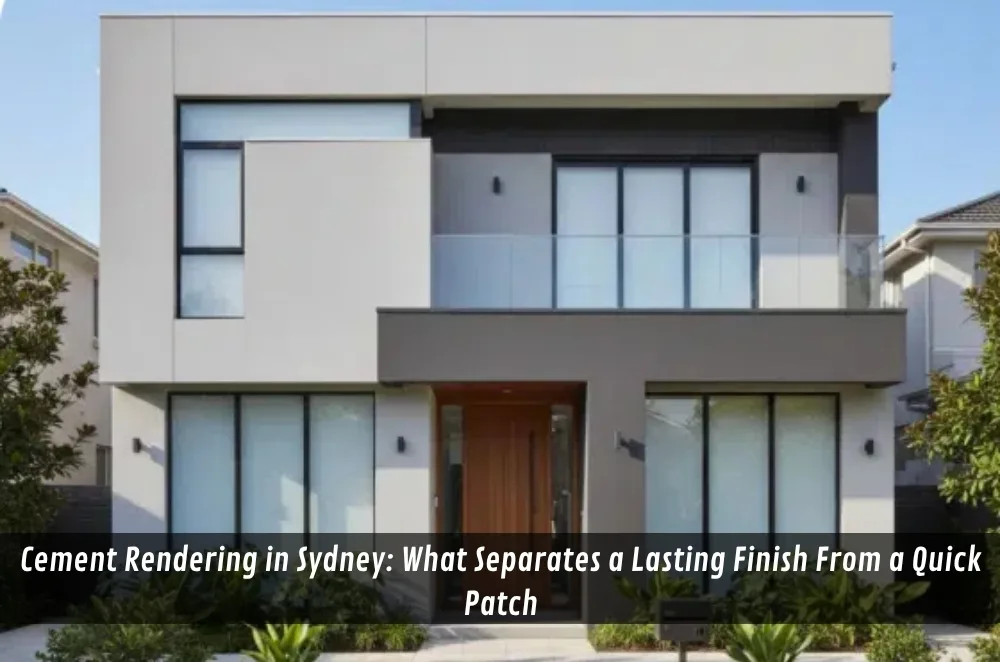
Cement rendering can make an older brick façade feel current again. Done well, it can also add a tougher “skin” to exterior walls that deal with Sydney’s mix of sun, coastal air, storms, and seasonal movement.
Done poorly, it’s one of those upgrades that looks great for a few months—then starts to telegraph problems: hairline cracking, drummy (hollow) spots, bubbling, or patches that never quite match. The hard part for homeowners is that the early stages of a job (cleaning, bonding, curing) often matter more than the final trowel work, and those steps are the easiest to cut when someone is rushing.
If you’re searching for a reliable Sydney cement render team, it helps to know what “reliable” looks like in practice—before you compare quotes.
Why cement render jobs fail early
Most premature failures trace back to the wall underneath, not the finish you can see. Common culprits include:
- Poor substrate assessment: Brick, block, concrete and existing render don’t behave the same way. Some surfaces need specific primers or bonding agents; others need repairs before any render goes on.
- Inadequate preparation: Dirt, salts, flaking paint, algae, or old failing render can all interfere with adhesion.
- Incompatible systems or mixes: A “one mix fits all” approach can be a false economy if the wall moves or has mixed materials.
- Rushing cure times: Render can look dry on the surface while still being vulnerable underneath. Curing guidance matters if painting is planned, too.
A reliable team is usually the one that talks most about prep and sequencing—not just the final texture.
The practical markers of a reliable Sydney rendering team
You don’t need to know trade jargon to assess quality. Look for these real-world signals instead.
They start with an on-site inspection, not a guess
A dependable renderer will typically want to see the walls, measure areas, check access, and note existing coatings and cracking—because that’s what makes a scope accurate. When a provider says the job is quoted on-site and planned around what they find, that’s a good sign you’re dealing with process, not guesswork.
They can explain the “why” behind each step
A strong team can describe the job in plain language:
- what needs cleaning and why
- whether bonding/priming is required
- how many coats are planned and what each one does
- what finish options suit the home and existing style
- what cure time to allow before painting
On the cement rendering page for cement rendering services , for example, the scope is described as assessment → preparation → bonding/priming where required → base and finish coats → finish selection → curing guidance, with clear notes about what’s excluded unless specifically scoped.
They’re upfront about what render can’t “guarantee”
Any renderer promising a “forever” finish is overselling something that’s exposed to weather, movement, and maintenance realities. One green flag is seeing language that explicitly pushes back on unrealistic expectations (and on the idea of a cheapest-possible patch with no prep).
They treat repairs as a cause-and-effect problem
If you’re seeing cracks or bubbling, a reliable approach is to work out why—movement, moisture, prior prep, failing patches—before simply smoothing over it. Some projects are better handled as targeted repairs first, then a broader façade finish later.
When cement rendering makes sense (and when it doesn’t)
Cement rendering is often a good fit when:
- brickwork looks patchy after renovations or extensions
- you want a modern finish without fully recladding
- small cracks are appearing and you’d rather address them early
- you’re seeing bubbling, flaking, or water staining and need a repair plan
It’s less ideal when the underlying issue is structural movement that hasn’t been assessed, or when the goal is a cosmetic cover-up without fixing moisture entry points. In those cases, “render now” can just move the problem forward in time.
Questions that make quotes easier to compare
When two quotes are far apart, it’s usually because the scope isn’t actually the same. These questions help you compare apples with apples:
- What preparation is included? (Cleaning method, removal of loose material, minor patching.)
- Is bonding/priming included where required—and on which surfaces?
- How are existing cracks or drummy areas handled? (Cut-out and rework vs skim over.)
- What finish is included? (Smooth, textured, bagged—plus how matching works on repairs.)
- What’s excluded unless scoped? (Painting, major structural rectification, unrelated repairs.)
- What curing guidance will you provide if painting is planned?
If someone can answer those quickly and clearly, reliability usually follows.
A note on scheduling, access, and “urgent” situations
Sydney homes vary wildly—tight side access in the Inner West, steep blocks in the Hills, coastal exposure near the Beaches. The more complex the access, the more planning matters for a neat finish and fewer surprises.
If your issue involves active water entry or failing patches that present a safety concern, some teams offer after-hours options where practical—but it’s still reasonable to expect that quality render work often needs daylight conditions for proper prep and application.
What “good” looks like after the job is done
A strong cement render outcome is less about being perfectly trendy and more about being consistent and stable:
- edges and corners look crisp, not wavy
- the finish is consistent across elevations (especially on larger façades)
- repairs blend in rather than standing out
- there are no obvious hollow-sounding sections
- you receive clear guidance on cure time and next steps if painting follows
If you’re aiming for resale presentation, the “quiet details” matter: tidy transitions, aligned textures, and a finish that suits the home rather than fighting it.
Key Takeaways
- Reliability in cement rendering usually shows up in prep, bonding, and curing, not just the final texture.
- A trustworthy team will inspect on-site, explain the scope in plain language, and clarify what’s excluded.
- Be cautious of “cheapest quick patch” approaches and “guaranteed forever” promises.
- Cracks and bubbling often need a cause-first repair plan, not a skim over the top.
- Comparing quotes gets easier when you ask about prep, priming, coats, finish, and cure guidance.