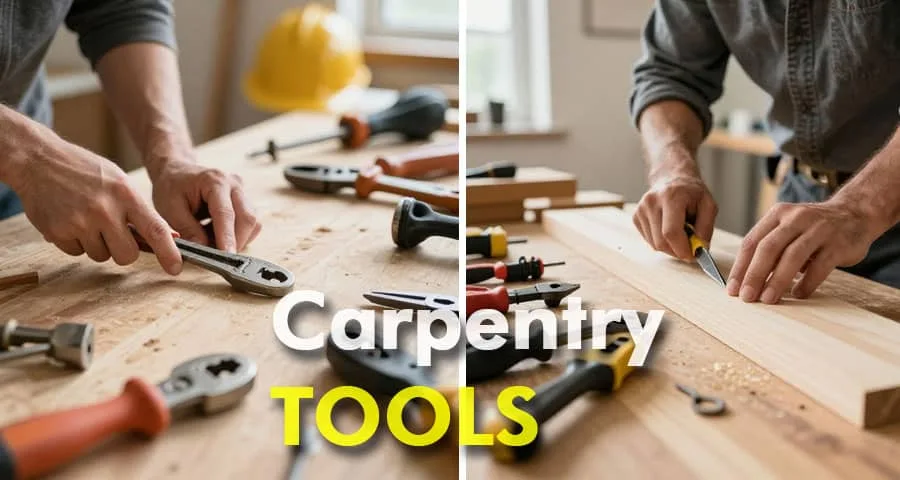
Carpentry is an essential part of building construction, renovation, interior work, furniture installation, and structural finishing. Whether we are constructing a residential house, commercial building, industrial facility, roof structure, staircase, door frame, or custom woodwork, the quality of the finished work depends greatly on using the right carpentry tools.
Professional carpenters use a combination of hand tools, power tools, measuring instruments, cutting tools, fastening tools, and finishing equipment. Each tool serves a specific purpose, and selecting the appropriate equipment helps us achieve greater accuracy, productivity, safety, and consistency on construction sites.
In modern construction projects, carpentry tools have evolved considerably. Traditional hand tools remain important for detailed work, while electric and cordless power tools allow us to complete demanding construction activities more quickly and efficiently.
Importance of Carpentry Tools in Construction
We rely on carpentry tools for almost every stage of construction-related woodworking. Accurate measurement, cutting, drilling, joining, shaping, and finishing are difficult to accomplish without appropriate equipment.
The major advantages of using suitable carpentry tools include:
- Improved measurement accuracy
- Precise cutting and shaping
- Faster construction work
- Better quality of joints
- Reduced material wastage
- Improved productivity
- Consistent finishing
- Greater control over woodworking operations
- Improved job-site safety when used correctly
A professional carpenter does not simply need a large collection of tools. We need to understand which tool should be used for a particular construction task and how it should be operated safely.
Measuring and Marking Tools for Carpentry
Accurate measurement is the foundation of quality carpentry. Even a small measurement error can result in improperly fitted doors, windows, cabinets, roof members, or structural timber.
Tape Measure
A tape measure is one of the most frequently used carpentry tools. We use it to measure the length, width, height, and depth of timber, openings, rooms, framing components, and other construction elements.
A durable tape measure should have clear graduations, a strong locking mechanism, and a reliable hook.
Steel Rule
A steel rule is useful for short and highly accurate measurements. We commonly use it for marking smaller timber components, joints, cabinet parts, and finishing work.
Combination Square
A combination square helps us check and mark 90-degree and 45-degree angles. It is particularly useful when preparing joints and marking cutting lines.
Try Square
A try square is primarily used to determine whether an edge or corner is perfectly square. It is particularly valuable when preparing timber for framing and joinery.
Chalk Line
A chalk line allows us to create long, straight reference lines on timber and construction surfaces. It is useful when marking framing layouts and long cutting lines.
Spirit Level
A spirit level helps us check whether a component is horizontal, vertical, or correctly aligned. We use it during the installation of doors, windows, frames, cabinets, partitions, and other construction elements.
Hand Saws Used in Carpentry
Cutting timber accurately is one of the most fundamental carpentry operations. Different saws are designed for different types of cuts.
Hand Saw
A traditional hand saw is suitable for cutting timber quickly without electrical equipment. We can use it for general construction cutting, framing, and rough carpentry.
Back Saw
A back saw has a reinforced upper edge that provides additional rigidity. We commonly use it for accurate and controlled cuts, particularly in joinery applications.
Coping Saw
A coping saw has a narrow blade that allows us to make curved and intricate cuts in wood. It is useful for decorative carpentry and detailed joinery.