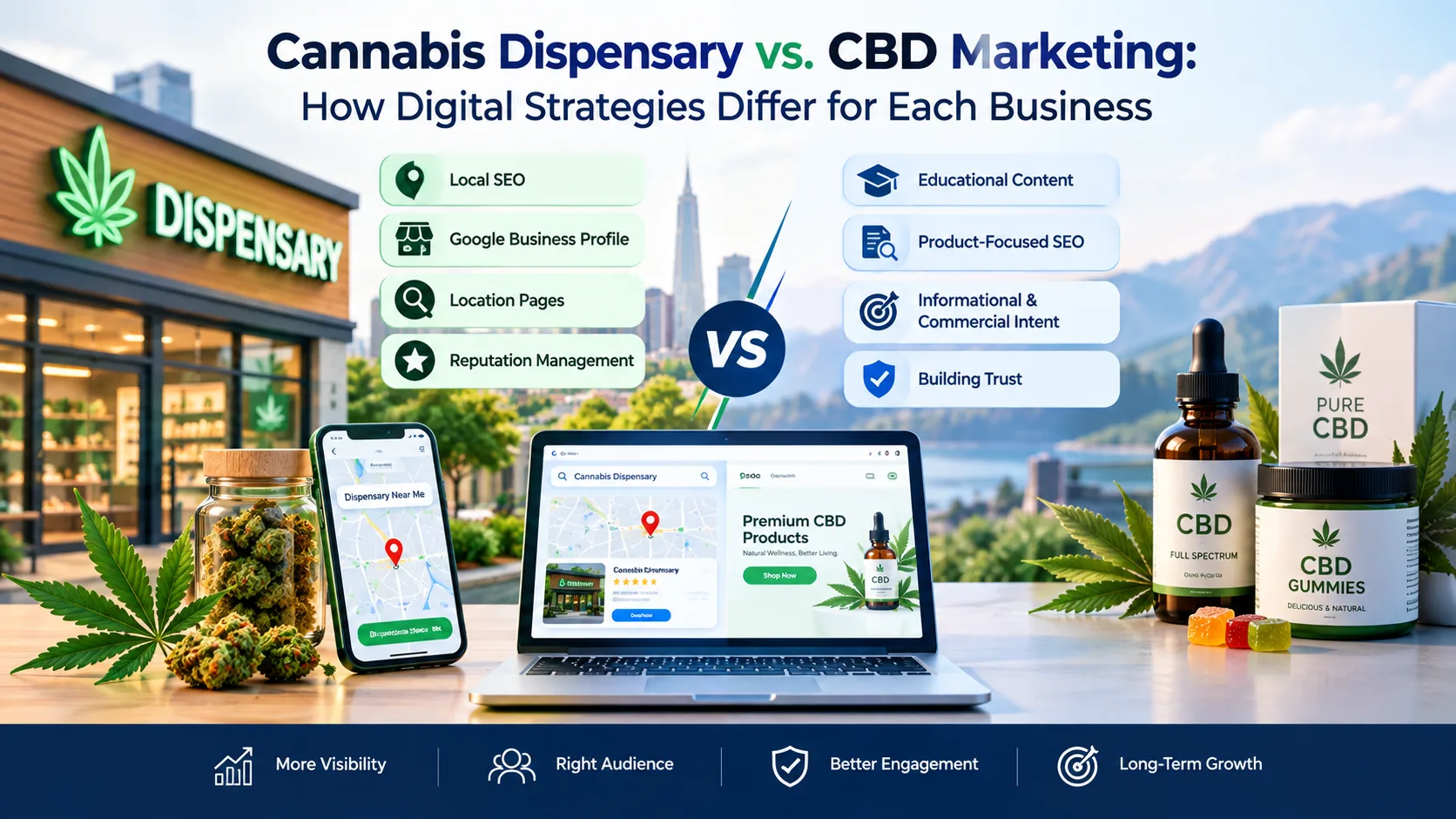
Cannabis dispensaries and CBD brands operate in related markets, but their digital marketing needs are not the same. A dispensary typically serves customers within a specific geographic area, while a CBD brand may attract shoppers from a much broader market through eCommerce and organic search.
That difference affects everything from SEO and website structure to content strategy, customer acquisition, and marketing-channel selection.
Why Dispensary and CBD Marketing Are Different
The biggest difference comes down to local demand, geographic targeting, and customer journeys.
Local Dispensary Demand vs. Broader Product Discovery
A dispensary often depends on customers who are physically close enough to visit the store or use available local purchasing options. Searches such as "cannabis dispensary near me" or "dispensary in Los Angeles" can indicate strong local intent.
CBD brands can potentially reach customers across a much wider geographic area, depending on their products, applicable regulations, shipping availability, and business model. Their customers may discover products through informational searches, product comparisons, social content, or branded searches.
Geographic Targeting
For dispensaries, location can be central to the SEO strategy. City, neighborhood, and service-area relevance may influence what pages need to be created and optimized.
CBD companies may focus more heavily on product categories, educational topics, and broader commercial searches rather than individual physical locations.
Different Customer Journeys
A dispensary customer may follow a relatively direct journey:
Search → Find local dispensary → Check products/information → Visit or order where permitted
A CBD customer may have a longer research process:
Question → Research → Compare products → Evaluate brand → Review product information → Purchase
These different journeys require different website structures, content, and conversion paths.
1. SEO Strategy for Cannabis Dispensaries
For a dispensary, SEO should help potential customers discover the business when they are searching for relevant products or local stores.
A specialized cannabis dispensary digital marketing agency can build its strategy around local search behavior while accounting for applicable industry and platform requirements.
Local SEO
Local SEO can help a dispensary improve visibility for searches connected to its service area.
Important activities can include:
- Optimizing location-specific pages
- Maintaining accurate business information
- Building relevant local citations
- Managing customer reviews where permitted
- Developing useful local content
- Improving internal linking
- Monitoring local search visibility
The objective is not simply to add "cannabis dispensary" and a city name repeatedly. The website should provide genuine information that helps local customers make decisions.
Google Business Profile Considerations
Google Business Profile can be an important local search asset for eligible businesses, but cannabis-related businesses need to pay close attention to Google's current policies and eligibility requirements.
Businesses should verify the latest platform rules before creating, modifying, or promoting a profile. Requirements can also differ based on business type and location.
The same principle applies to other directories and local platforms: never assume that a tactic allowed for an ordinary local business automatically applies to a cannabis business.
Location and Service Pages
A dispensary serving multiple areas may benefit from clearly structured location and service pages when those pages provide unique value.
A useful location page could include:
- Store information
- Areas served
- Available services
- Relevant product categories
- FAQs
- Directions or contact information where appropriate
- Local customer information
Creating many near-identical pages with only the city name changed provides little value. Each page should have a genuine purpose.
"Near Me" and Local-Intent Searches
Searches containing phrases such as "near me," "in [city]," or neighborhood names often indicate geographic intent.
Rather than stuffing these phrases into content, marketers should build pages that naturally answer the questions behind those searches.
For example, users may want to know whether a store serves their area, where it is located, what information is available before visiting, and how to contact the business.
2. Digital Marketing for CBD Brands
Digital marketing for CBD often requires a stronger educational component because customers may have questions about products before they are ready to purchase.
Educational Content
CBD brands can create useful resources around:
- CBD terminology
- Product formats
- Ingredients
- Product labeling
- Frequently asked questions
- General product education
- Storage information
- Product comparisons
Educational content can attract users earlier in the buying journey and introduce them to the brand before they search for a specific product.
However, content should remain factual and avoid unsupported health or medical claims.
Product-Focused SEO
CBD eCommerce websites should make product and category pages easy for both users and search engines to understand.
A product page might clearly communicate:
- Product type
- Ingredients
- Size or quantity
- Product specifications
- Available variations
- Usage information where appropriate
- FAQs
- Purchasing and shipping information
Category pages can target broader commercial searches while individual products address more specific queries.
Informational and Commercial Search Intent
CBD search behavior can include several different types of intent.
Informational: "What is CBD?"
Educational: "CBD product types"
Commercial: "CBD oil vs CBD gummies"
Transactional: "[specific CBD product]"
Each intent should lead to a page designed for that stage of the customer journey.
A common SEO mistake is trying to rank a product page for every informational question or using a blog post to target a highly transactional query.
Building Trust Around Products
Trust matters when customers are evaluating unfamiliar products.
CBD brands can strengthen trust through:
- Transparent product information
- Clear ingredient details
- Authentic reviews
- Accessible policies
- Accurate FAQs
- Brand information
- Relevant third-party documentation where appropriate
The objective is to give customers enough reliable information to make an informed purchasing decision.
3. Website Strategy
The website should reflect how customers interact with the business.
Dispensary Websites
A dispensary website may prioritize:
- Store locations
- Hours
- Menus or product availability information where permitted
- Product categories
- Contact details
- FAQs
- Ordering or pickup information where applicable
The most important local information should be easy to find, particularly on mobile devices.
CBD Websites
A CBD eCommerce website may require stronger emphasis on:
- Product pages
- Category pages
- Ingredients
- Product education
- Usage information
- FAQs
- Shipping
- Returns
- Customer reviews
Both website types need strong navigation, mobile usability, page speed, clear calls to action, and technically sound SEO foundations.
4. Content That Builds Search Visibility
Content should serve a purpose beyond increasing the number of pages on a website.
Educational Guides
Guides can answer common questions and attract people early in the research process.
FAQs
FAQs can address specific questions customers repeatedly ask and reduce friction during the decision-making process.
Comparison Content
Comparison articles can help users understand differences between products, formats, or options.
For example, a CBD brand could create content comparing two product formats while keeping the information factual and appropriately qualified.
Product and Category Content
Product and category pages can target commercial searches while giving customers the information needed to evaluate their options.
A strong content strategy connects these formats rather than publishing unrelated articles.
5. Compliance-Aware Marketing
Cannabis and CBD marketing requires greater attention to platform rules and applicable laws than many ordinary industries.
Advertising availability can vary by platform, product type, jurisdiction, and campaign format. Policies can also change over time.
For this reason, businesses should not assume that a marketing tactic used by another company is automatically permitted for them.
Before launching campaigns, marketers should review the current requirements of relevant platforms and applicable local, state, federal, or other jurisdictional rules.
This is particularly important for:
- Paid advertising
- Product claims
- Promotional messaging
- Social media campaigns
- Email marketing
- eCommerce activities
- Business listings
Compliance should be treated as part of marketing planning rather than something checked only after a campaign has been created.
6. How to Choose the Right Marketing Partner
The right agency should understand both digital marketing fundamentals and the specific challenges of the cannabis or CBD market.
Consider these factors before hiring a provider.
Industry Experience
Ask whether the agency has experience working with cannabis, dispensaries, CBD, or other regulated industries.
Local SEO Capability
For dispensaries, the agency should understand geographic targeting, local search intent, location pages, and relevant business listings.
SEO and Content Expertise
Look for a team that can connect keyword research, search intent, technical SEO, content, internal linking, and conversion strategy.
Analytics and Reporting
Reports should explain more than rankings and traffic. Depending on the business model, useful metrics can include qualified organic traffic, inquiries, conversions, product engagement, and revenue-related indicators.
Compliance-Aware Processes
Ask how the agency handles platform restrictions and changes in applicable marketing requirements. A responsible partner should be willing to verify current rules rather than promise that every marketing channel will be available.
Final Thoughts
Cannabis dispensary marketing and CBD marketing share several SEO and digital marketing fundamentals, but the strategies should be built around different customer journeys.
Dispensaries often need stronger local search visibility, geographic targeting, location information, and reputation management. CBD brands may benefit more from educational content, product-focused SEO, broader search visibility, and eCommerce optimization.
The most effective approach is not to copy another company's strategy. Start with the customer, understand the search intent, identify the channels available to the business, and build the website and content around those realities.
Whether a business works with a cannabis dispensary digital marketing agency or develops digital marketing for CBD internally, the goal should remain the same: create useful digital experiences that help customers find accurate information, evaluate their options, and take the next appropriate step.