
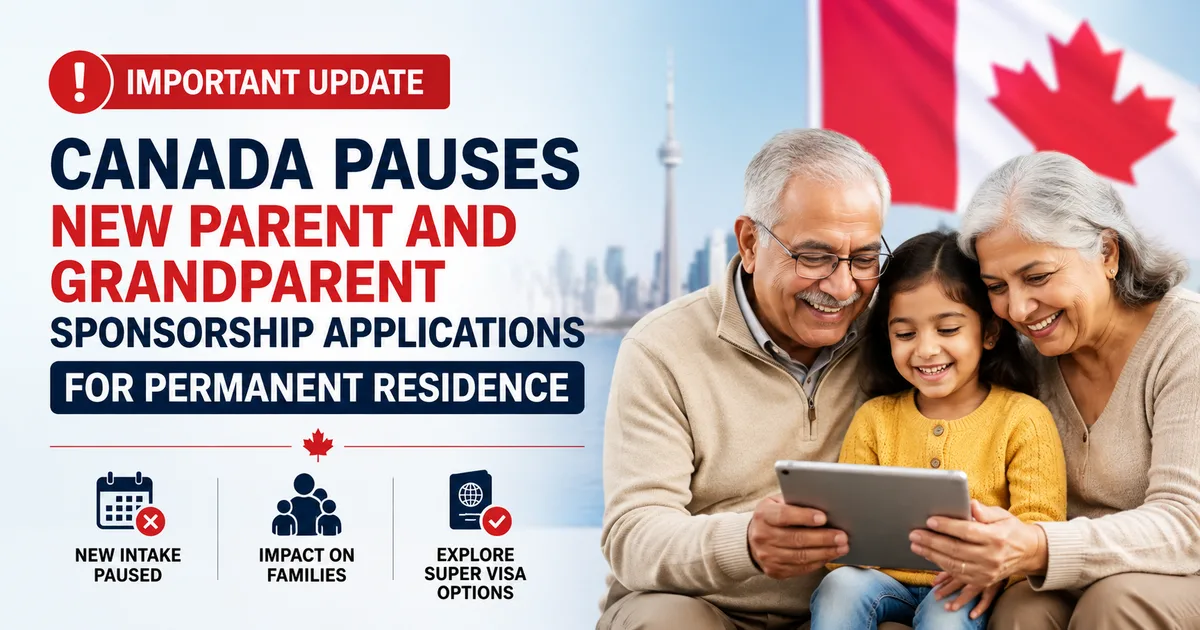
If you've been hoping to bring your mom, dad, or grandparents to Canada permanently, there's an important update you need to know about. On July 15, 2026, Immigration, Refugees and Citizenship Canada (IRCC) announced that it is pausing the intake of new applications under the Parents and Grandparents Program (PGP). In plain terms, this means the department will not be issuing new invitations to apply, and it will not accept new interest-to-sponsor forms, until further notice.
This is a significant development for families across the country, and it's understandably raising a lot of questions. Let's break down what's actually happening, why it's happening, and what your options look like going forward.
What Exactly Did IRCC Announce?
In a notice titled "Canada takes steps to responsibly manage the Parents and Grandparents Program (PGP)," IRCC confirmed that it is pausing new intake as part of a broader effort to keep the immigration system "well-managed" and "sustainable." The goal, according to the department, is to reduce processing backlogs and bring more predictability to how long families actually have to wait.
This pause doesn't mean the program is cancelled outright. IRCC says it will keep processing the applications already sitting in its inventory, with a target of approving up to 15,000 people for permanent residence through the PGP in 2026. That target holds steady at 15,000 for both 2027 and 2028 as well, based on the government's 2026–2028 Immigration Levels Plan.
To put the scale of the demand in perspective, there were roughly 50,900 PGP applications already in the queue at the time of the announcement - about 40,400 for applicants settling outside Quebec and 10,500 for those headed to Quebec. With only 15,000 spots available per year, it's easy to see why the government decided to press pause rather than add more names to an already long list.
Why This Matters: Understanding Canada Parent and Grandparent Sponsorship 2026
The Parents and Grandparents Program has always been one of the most sought-after routes for family reunification in Canada. But it's also been one of the most competitive. The program last opened for new interest-to-sponsor submissions back in 2020, when the government received a staggering 203,213 submissions in just a three-week window. Since then, IRCC has been drawing from that same 2020 pool each year, randomly inviting a portion of those who submitted forms to move ahead with a full application.
In other words, nobody has been able to submit a fresh interest-to-sponsor form since 2020. The July 2026 announcement effectively confirms that this drought will continue for the foreseeable future - there simply isn't a new intake window on the horizon right now.
If you submitted an application after receiving an invitation in a previous round, don't worry - your file is still being processed. IRCC has stated it will continue working through the existing PGP Canada applications already submitted. For those who applied around July 2025, the current expected processing time is approximately 18 months for applicants settling outside Quebec, and considerably longer - around 54 months - for those settling within Quebec.
What This Means If You Were Hoping to Sponsor Parents to Canada
For Canadian citizens, permanent residents, and registered Indians who were still holding out hope for an invitation from the 2020 pool, or who were waiting for a fresh intake to open, this news is disappointing. Right now, there is no active pathway to submit a new interest-to-sponsor form under the Parent Sponsorship Canada 2026 framework. IRCC has been clear that this will remain the case "until further notice," which means there's no confirmed date for when applications might reopen.
This is where it helps to have a realistic understanding of your options rather than waiting indefinitely.
The Super Visa: A Practical Alternative
While permanent sponsorship is on hold, IRCC is actively encouraging families to consider the super visa as a way to keep loved ones close in the meantime. The super visa isn't permanent residence, but it's a meaningful alternative for families who want their parents or grandparents physically present in Canada for extended periods.
Here's what makes it worth considering:
- Long stays, not short visits. A standard visitor visa typically allows a stay of up to 6 months. The super visa, by contrast, allows holders to remain in Canada for up to 5 years at a time.
- Multiple entries for up to 10 years. The visa itself can be issued with validity of up to a decade, meaning parents and grandparents can travel back and forth without reapplying every year.
- Updated requirements for 2026. IRCC has made changes to the Super Visa's financial and health insurance requirements. Families considering this option should review the new Super Visa rules and income requirements for 2026 before applying.
To apply, the hosting relative in Canada needs to provide a letter of invitation, meet minimum income thresholds, and commit to financially supporting the visiting parent or grandparent. The applicant, in turn, must purchase adequate health insurance for their stay and satisfy standard entry requirements for temporary residents, including demonstrating an intention to leave Canada at the end of their authorized stay.
It's not a replacement for permanent residence, but for many families, it offers real, immediate relief; the ability to have grandparents present for a child's early years, or aging parents nearby for extended periods, without waiting years for a lottery invitation that may never come.
What Should You Do Now?
If you're a Canadian citizen or permanent resident hoping to eventually pursue Canada Permanent Residence Sponsorship for your parents or grandparents, here are a few practical steps:
- Check your application status if you've already applied - If you have a PGP application in the queue, it's still being processed — track it through your IRCC account and keep your documents up to date.
- Explore the super visa in the meantime - If reunification can't wait, this remains a legitimate and increasingly accessible option.
- Stay informed on official channels - Since IRCC hasn't provided a timeline for reopening intake, relying on rumours or outdated forum posts can lead to confusion. Check IRCC's official notices directly for updates.
- Talk to a licensed immigration professional - Given the complexity of family sponsorship rules and the shifting nature of program intake, personalized advice can help you plan realistically rather than guess. Canadian immigration lawyer Navratan Singh Fateh can help families review their circumstances and understand the immigration options that may be available to them.
Conclusion
The pause on the Parent and Grandparent Program Canada intake reflects a broader trend: IRCC is trying to bring immigration levels, processing capacity, and public expectations into better alignment. With admission targets fixed at 15,000 per year through 2028, and tens of thousands of applications already waiting in line, it's likely that new intake will remain closed for some time.
That said, family reunification remains a stated priority for the government, and past PGP cycles have shown that intake windows do eventually reopen, even after long gaps. Until then, the super visa stands out as the most viable route for keeping families together, while existing applicants continue moving through the system.
If you're navigating this process, patience and preparation go a long way. Keep your documentation ready, stay updated through official government sources, and don't hesitate to seek professional guidance to make the most informed decision for your family's situation. The team at Fateh Law Corporation can help you review your options, whether that means tracking an existing PGP application, applying for a super visa, or planning ahead for when intake eventually reopens, so your family's sponsorship journey stays on the right track.
Frequently Asked Questions About the PGP
1. Is Canada accepting new Parents and Grandparents Program applications in 2026?
No. IRCC paused new PGP applications on July 15, 2026, and is not currently accepting new interest-to-sponsor forms or issuing new invitations.
2. Will existing PGP applications still be processed?
Yes. IRCC has confirmed that applications already submitted will continue to be processed despite the pause on new applications.
3. When will the Parents and Grandparents Program reopen?
IRCC has not announced a date for reopening new PGP intake. New applications will remain paused until further notice.
4. Can parents and grandparents still come to Canada while PGP is paused?
Yes. Eligible parents and grandparents can consider the Super Visa, which allows extended stays in Canada and can provide an alternative while PGP intake is paused.
5. What is the difference between PGP sponsorship and the Super Visa?
The PGP is a pathway to permanent residence, while the Super Visa is a temporary resident visa that allows eligible parents and grandparents to stay in Canada for extended periods.