
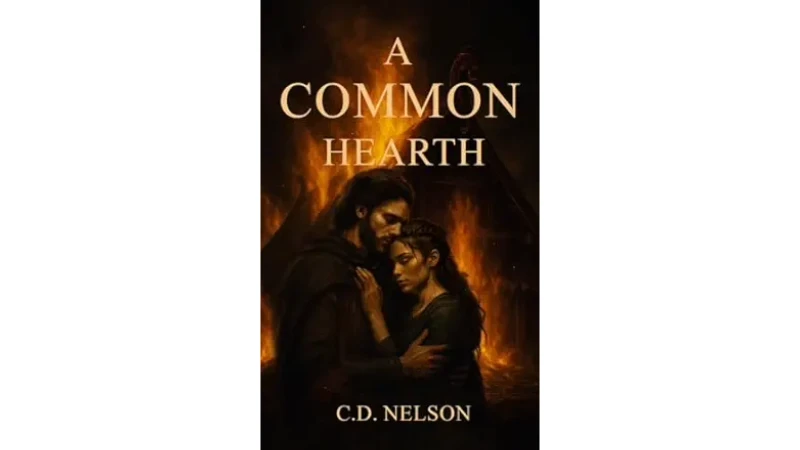
When we think of Viking and Saxon history, we often picture clashing swords, longships on dark waters, and gods at war with saints. But in A Common Hearth, C.D. Nelson gives us something far more intricate, a portrait of two vibrant cultures not only in conflict, but in dialogue, brought to life through deeply human characters and the quiet, brutal beauty of the late 800s.
The novel offers a striking comparison between the Norse and Saxon worlds, painted through the lived experiences of its protagonists. Rather than flattening history into caricature, it presents two fully realized societies, each with its own strengths, flaws, and soul.
The Norse: Survival as Creed
In the fjord-edge village of Njardarheimr, the Norse people live by grit and adaptability. Life is a knife’s edge: brutal winters, empty bellies, rival raiders, and the raw demands of the land. Children are trained not just to farm or mend, but to fight. Even girls, like Asa and Astrid, learn the bow and axe, becoming hunters and defenders in their own right.
Jarl Gunnar leads not from a throne but through earned trust. His role is survivalist, strategist, and father. Their gods are many, Odin, Freyja, Thor, and their myths are not mere tales, but living guides that shape choices and fortify the spirit. For the Norse, destiny is not a distant idea but a relentless current: one does not escape it, but meets it with resolve. Honor lies not in avoiding death, but in facing life’s hardships with unflinching strength.
Even in victory, the cost is felt. Asa and Astrid do not raise weapons in search of glory; they fight because to stop fighting is to lose everything. And when Asa carries both a child and a bow through the wilderness, her endurance shows that strength is not only measured in battle, but in the weight of what she must protect.
The Saxons: Order Through Faith
Across the sea in Wessex, the Saxons live under the Christian God’s eye and the King’s law. Their society is more structured: kings, thegns, and household warriors, the hearthweru, operate in a hierarchy that grants privilege, demands loyalty, and leaves little room for disorder.
Winchester’s timber halls and quiet chapels contrast sharply with the Norse longhouses. Boys learn to read Latin Psalms while training with swords. It’s a world of rules and reverence, where even physical intimacy is cloaked in modesty.
Aedelric, a thegn’s son, is trained to be both pious and deadly. But his world is not without pain, his battles are just as bloody, and the fear of Viking raids looms large. Still, there is pride in his shield wall, and a kind of defiance in every prayer whispered on the battlefield.
Worlds Divided, Lives Entwined
What makes A Common Hearth unforgettable isn’t just how different these cultures are, but how their people find common ground. Through Asa and Aedelric, we witness a Norse-Saxon romance that transcends the divide. Their relationship, forged in the wild after a catastrophic shipwreck, is not just love; it’s survival. They must teach, protect, and learn from one another, even as centuries of hatred whisper otherwise.
Their growing bond, hesitant, complex, and fiercely earned, shifts the narrative from a tale of war to one of reluctant intimacy and shared humanity. It is not a quick-burning passion, but a fire built slowly in the snow: a true slow-burning historical romance.
More Than Battle and Belief
The world of A Common Hearth is built with reverence for detail. You can feel the weight of mail over raw skin, hear the thud of boots on dirt floors, and sense the quiet despair in a whispered order to protect the children “at all costs.” These aren’t just warriors; they are mothers, sons, believers, and mourners.
In a genre often filled with spectacle, this book grounds its power in people. It blends the grit of Wessex historical fiction with the emotional urgency of survival and love, creating a narrative that is as tender as it is ruthless.
For anyone drawn to Viking historical romance books, or simply longing for a tale where history feels human, A Common Hearth doesn’t just invite you into another time—it makes you live there.