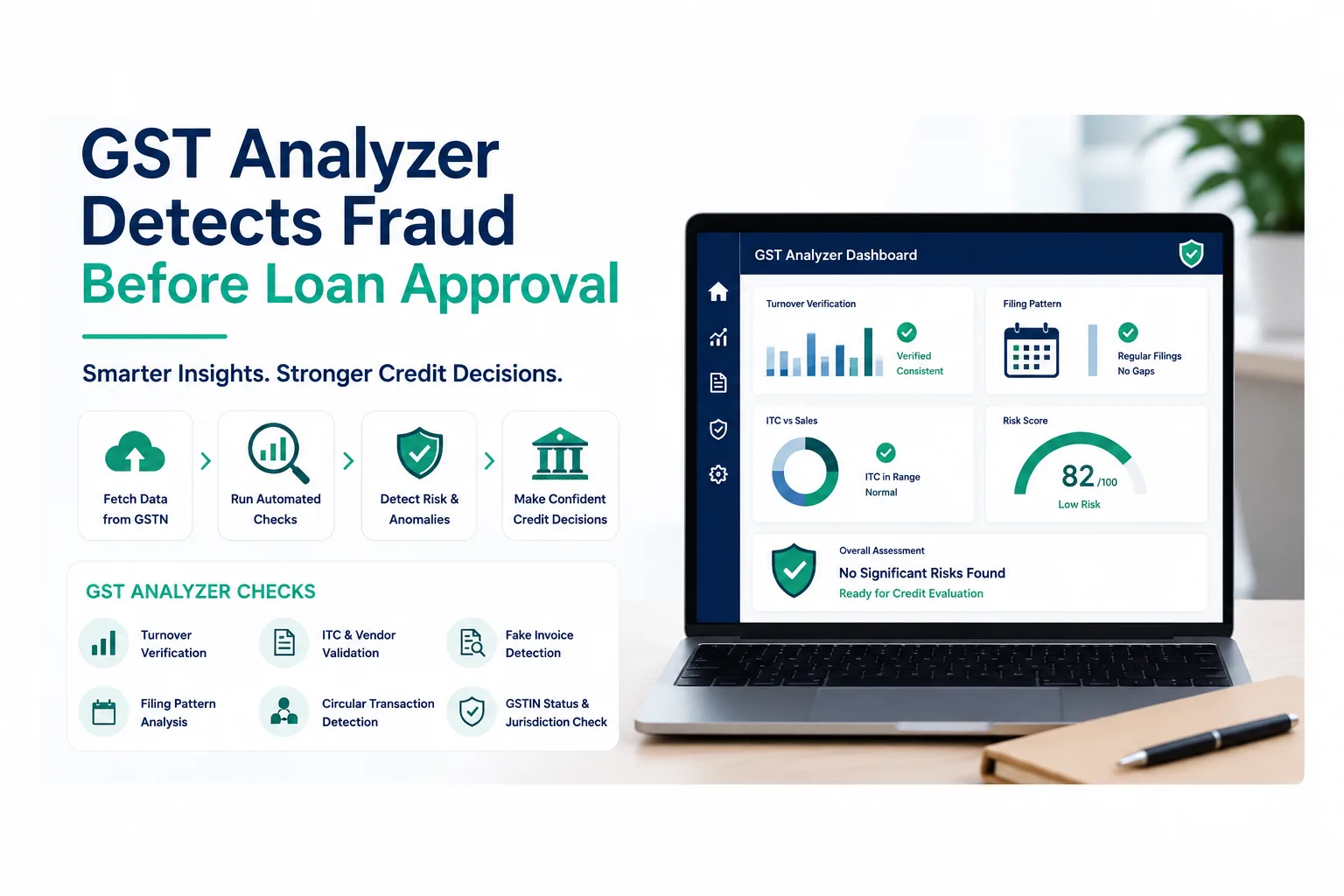
A GST Analyzer can identify fraudulent loan applications before disbursal by cross-referencing GSTR-1, GSTR-3B, and GSTR-2B filings for mismatches, nil return patterns, and circular transactions that borrowers cannot easily fabricate.
Most fraud in MSME lending does not show up as missing documents - it hides inside the ones that look complete. GST data catches what bank statements alone cannot.
What Does a GST Analyzer Actually Do?
A GST Analyzer pulls return data directly from the GSTN portal using a borrower's GSTIN, then runs automated checks across multiple return types to assess filing behavior, turnover consistency, and tax liability patterns.
It does not rely on borrower-submitted documents. The data comes from the government's own servers.
For Indian lenders, this matters because GSTR filings are government-verified records of actual business activity. A company that reports Rs. 2 crore in monthly turnover on its loan application but shows Rs. 40 lakh in GSTR-1 sales across the same period has a problem it cannot explain away. A GST Analyzer surfaces that gap in seconds, before any credit officer spends time on the file.
How the Detection Process Works?
GST analysis runs a structured sequence of checks against live GSTN data. The process works like this:
- The lender submits the borrower's GSTIN through the analyzer's API. The tool fetches GSTR-1, GSTR-3B, GSTR-2B, and annual returns directly from the portal — no manual download, no borrower-supplied PDFs.
- The system compares GSTR-1 (outward supply declarations) against GSTR-3B (tax paid). A consistent gap between declared sales and tax paid is a red flag. It can indicate either suppression of tax liability or inflated sales figures on the loan application.
- Filing frequency and regularity are checked next. A business that filed monthly returns on time for 18 months and then went silent for four months before applying for a loan warrants a closer look.
- ITC claims in GSTR-2B are validated against purchase patterns. Unusually high input tax credit claims relative to sales volume can indicate fake invoice fraud, a known method used to inflate apparent business activity.
The entire GST analysis sequence typically completes in under 60 seconds via API.
Why Lenders Use It
- Turnover verification cuts the most common inflation tactic: borrowers reporting higher revenue to qualify for larger loan amounts than their actual business supports. GST Analysis cross-checks stated turnover against tax-filed figures with no manual reconciliation.
- Filing gap detection identifies businesses that stopped filing or switched to nil returns without explanation — a pattern that often appears before financial stress becomes visible in bank statements.
- Circular transaction flags catch related-party sales loops where two or more entities invoice each other to manufacture apparent revenue. GST Analysis traces counterparty GSTINs and flags concentrated B2B invoice flows between linked entities.
- Fake ITC detection surfaces shell vendors used to generate false input tax credits, which inflates net tax positions and masks actual profitability from credit analysts.
- Jurisdiction and status checks confirm that the GSTIN is active, registered in the correct state, and matches the business address provided in the loan application.
Where This Sits Within RBI's Compliance Framework
RBI's guidelines on digital lending, updated in 2022, require regulated entities to conduct thorough due diligence on borrower financials before loan sanction. Using government-sourced data for verification is explicitly preferred over self-certified documents. A GST Analyzer pulls data at source — directly from GSTN — which satisfies the requirement for independent data validation without relying on what the borrower provides.
Manual GST verification, by contrast, asks borrowers to upload their own return PDFs. A sophisticated borrower can alter a downloaded PDF before submission. The difference between manual and automated GST analysis is not one of efficiency — it is one of data integrity.
Under the DPDP Act 2023, fetching GST data via API also requires borrower consent, which most analyzer integrations now collect as part of the loan application flow. This keeps the process both compliant and audit-ready.
What Happens Without It
Lenders who skip automated GST analysis take on risks that manual review does not catch at scale.
- Inflated turnover goes undetected: A borrower submits forged or manually edited GSTR PDFs. Without direct API verification against GSTN, the credit officer has no way to confirm accuracy. The loan gets sanctioned based on numbers that do not reflect real business activity.
- Nil-return borrowers pass through: A business that has been filing nil returns for six months before the loan application still looks legitimate on a CIBIL check and a bank statement review. GST analysis would have caught the filing drop immediately.
- Circular transactions create phantom revenue: Related-party invoice loops produce GST-taxed sales records that look genuine. Without counterparty GSTIN analysis, the revenue appears real. Most lenders do not catch this until three months post-disbursal, when repayment stops.
- Fake vendor networks go unnoticed: Shell companies used to claim fraudulent ITC show up as registered GSTINs. Without filing behavior analysis on those counterparties, the fraud is invisible at the application stage.
Conclusion:
Fraud patterns in MSME lending have grown more sophisticated, and most are not visible at the document surface. A GST Analyzer works because it goes to the data source — the GSTN portal — rather than accepting what the borrower chooses to share. For lenders processing high volumes of business loan applications, the question is not whether to add GST analysis to the underwriting stack. It is whether the current process can catch what it is currently missing. GST analysis answers that directly.
Frequently Asked Questions
What does a GST Analyzer check that a bank statement does not?
A GST Analyzer verifies government-filed tax data: declared sales, purchases, tax paid, ITC claimed, and filing history. Bank statements show cash flows but cannot confirm whether reported turnover matches what was actually filed with the tax authority. The two sources catch different fraud patterns and are more effective when used together.
How does GST analysis help detect fake invoices?
The tool cross-references GSTR-2B purchase data against the supplier's own GSTR-1 filings. If a supplier shows no corresponding outward supply in their returns, the invoice the borrower submitted is likely fabricated. This counterparty check is only possible with direct access to GSTN data, which a GST Analyzer provides.
Is GST data verification compliant with RBI digital lending guidelines?
Yes. RBI's 2022 digital lending guidelines require regulated entities to use independent, verifiable data sources for borrower assessment. Fetching GST return data directly from the GSTN portal via API satisfies this requirement. Borrower consent must be collected before accessing the data, in line with the DPDP Act 2023.
How much time does automated GST analysis add to the underwriting process?
It adds almost none. API-based GST Analyzer tools typically return full return analysis within 60 seconds of GSTIN submission. Compared to manual PDF review, which can take 30–90 minutes per application, automated GST analysis cuts document verification time significantly while producing more reliable output.