A common question often arises in discussions about accessibility: Can deaf people drive? The answer is a resounding yes. In fact, deaf and hard-of-hearing (D/HH) individuals have been legally driving for decades, proving that the ability to hear is not a prerequisite for being a safe, skilled driver.
This guide explores the legal landscape, the technology that assists deaf drivers, and why statistics often show they are among the most attentive people on the road.
The Legal Reality: Rights and Requirements
In the United States, United Kingdom, Australia, and Canada, it is perfectly legal for deaf individuals to hold a driver’s license. Under laws like the Americans with Disabilities Act (ADA), government agencies cannot deny a license based solely on a disability.
Standard Licenses vs. Commercial Licenses
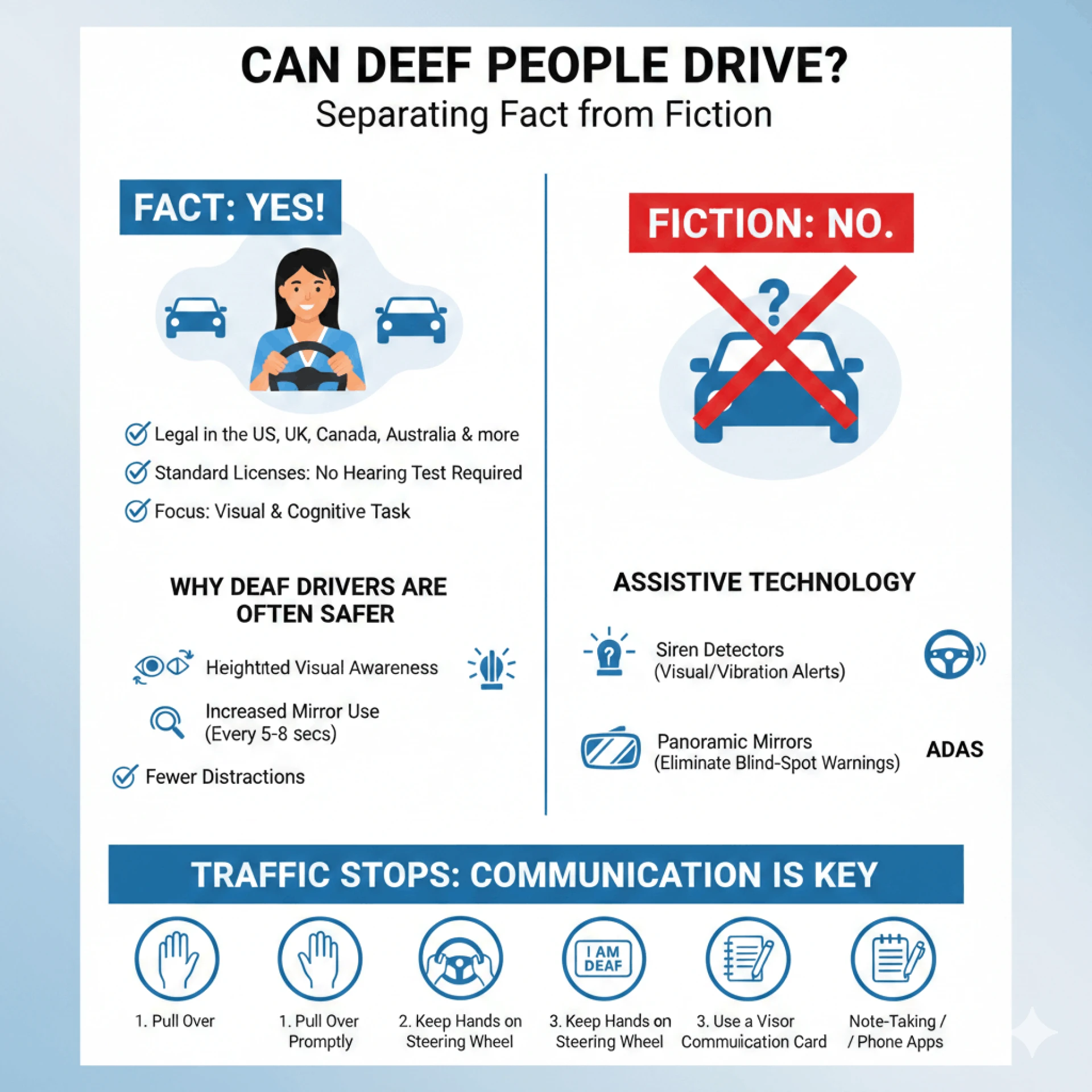
- Standard (Personal) Licenses: Most countries do not require a hearing test for a standard car or motorcycle license. Driving is recognized primarily as a visual and cognitive task.
- Commercial Driver’s Licenses (CDL): For vehicles like trucks or buses, there are often minimum hearing standards (e.g., the "forced whisper" test). However, in many regions, including the US, drivers can apply for a hearing exemption or waiver if they demonstrate a safe driving record.
Why Deaf Drivers are Often Safer
It might seem counterintuitive to those who rely on hearing, but deaf drivers often develop heightened visual awareness to compensate for the lack of sound.
- Increased Mirror Use: Deaf drivers are taught to scan their mirrors more frequently—often every 5 to 8 seconds—to stay aware of their surroundings.
- Better Peripheral Vision: Research suggests that the brains of deaf individuals may reassign "real estate" from the auditory cortex to the visual cortex, leading to superior peripheral processing.
- Fewer Distractions: Without the distraction of a loud radio or complex auditory stimuli, many D/HH drivers maintain a higher level of focus on the road.
Did You Know? Passenger-side mirrors were once a specialized requirement for deaf drivers. Today, they are standard safety equipment on every car because they proved beneficial for everyone.
Assistive Technology for the Road
Technology has bridged many gaps, making it easier for deaf drivers to navigate and respond to emergencies.
Visual and Tactile Alerts
- Siren Detectors: Dash-mounted devices or smartphone apps can listen for the specific frequency of emergency sirens and alert the driver via flashing lights or vibrations.
- Panoramic Mirrors: Extra-wide mirrors provide a full view of the rear and sides, virtually eliminating blind spots.
- ADAS (Advanced Driver Assistance Systems): Features like lane-departure warnings (vibrating steering wheel) and blind-spot monitors (flashing icons on side mirrors) are perfect for D/HH drivers.
Interacting with Law Enforcement
One of the biggest concerns for deaf drivers is a traffic stop. Because police officers often approach vehicles from the rear while speaking, they may mistake a lack of response for non-compliance.
Communication Tips for Traffic Stops:
- Pull Over Promptly: Use your blinker to show you’ve seen the officer.
- Visible Hands: Keep your hands on the steering wheel (at 10 and 2) until the officer arrives.
- Use a Visor Card: Many states offer "Communication Cards" that clip to your sun visor. You can point to this card to immediately inform the officer: "I am deaf or hard of hearing."
- Note-Taking: If you don't use sign language or the officer doesn't, exchanging notes on a pad of paper or a phone app is a common and effective method.
Conclusion
Deafness is not a barrier to the freedom of the open road. Through visual vigilance and modern assistive tools, deaf drivers continue to prove that road safety is about awareness, not just audition.
Would you like me to find a template for a Deaf Driver Communication Card that you can print out?
Deaf Drivers: Myths vs. Reality