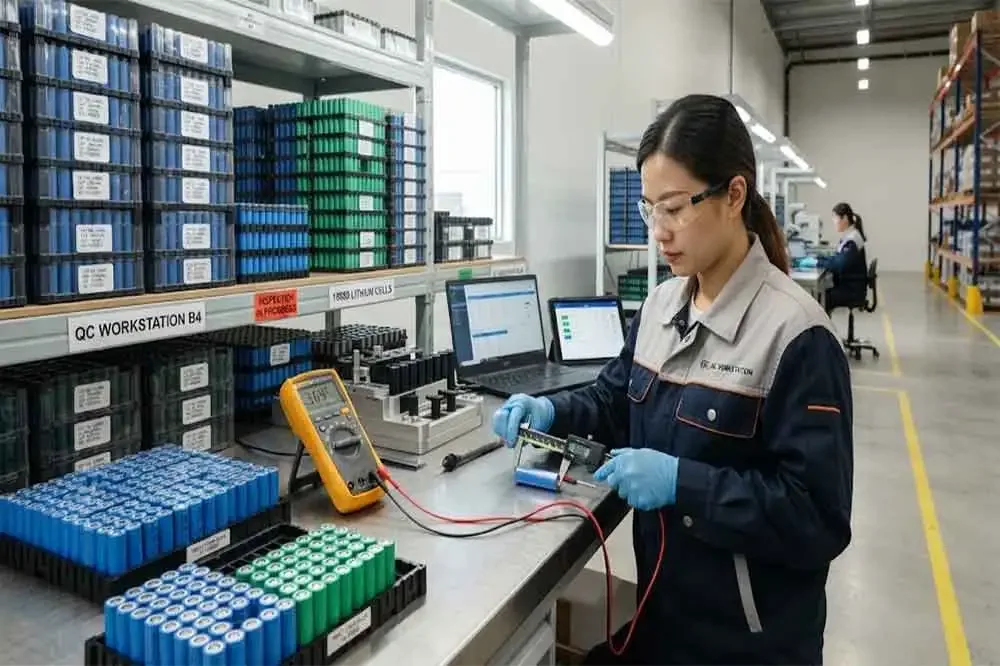
Buying few 18650 cells for testing is very different from buying thousands for production.
A sample order can help confirm dimensions, capacity, discharge performance, and compatibility. A bulk order introduces another set of questions: cell consistency, production batches, documentation, packaging, lead time, quality control, and long-term supply.
For wholesalers, battery pack manufacturers, distributors, and OEM buyers, these details can affect the final product just as much as the cell specification itself.
This guide explains what to check when buying 18650 batteries in bulk, from the first sample to repeat production.
1. Define the Cell Specification Before Asking for a Quote
A common mistake is starting with a simple request such as:
“Please quote 18650 batteries, 3000mAh.”
That specification is not complete enough for a serious bulk purchase.
A supplier needs to know what type of 18650 cell is required and how it will be used.
2. Decide Whether You Need Cells or Complete Battery Packs
“Buying 18650 batteries in bulk” can mean two different things.
The first is purchasing loose 18650 cells.
The second is purchasing assembled battery packs containing 18650 cells.
These require different purchasing specifications.
3. Know the Exact Capacity You Are Buying
Capacity is one of the most important specifications when purchasing 18650 cells.
Common specifications may include 2000mAh, 2500mAh, 2600mAh, 3000mAh, 3200mAh, and 3500mAh.
However, the number printed in a quotation should not be treated as the only evidence.
4. Check Discharge Current Carefully
Capacity and discharge current are different specifications.
A 3500mAh cell is not automatically suitable for a high-current application.
A power tool, motor system, industrial device, or high-output product may require a cell with a much higher discharge capability.
5. Ask for the Cell Datasheet
A professional bulk quotation should be supported by technical information.
6. Confirm the Cell Model and Manufacturer
Before placing a bulk order, confirm exactly what cell is being supplied.
7. Sample Testing Should Come Before Bulk Production
A sample is not only for checking whether the battery looks correct.
It is an opportunity to verify the cell against the actual application.
8. Check Cell Matching for Bulk Battery Pack Production
Buying thousands of cells does not mean putting any four cells together and building a pack.
Cell matching becomes important when cells are assembled into multi-cell battery packs.
9. Ask About Internal Resistance
Internal resistance is often overlooked during purchasing because capacity is easier to understand.
But resistance can have a significant effect on high-current applications.
10. Understand Batch Consistency
A sample from one production batch does not automatically represent every future batch.
This is particularly important for long-term OEM projects.
11. Check Production Date and Storage Conditions
Lithium-ion cells are not normally treated like a product that can be stored indefinitely without consideration.
Production date and storage conditions can matter, especially for large purchases.
12. Packaging Matters in Bulk Orders
A bulk shipment may contain hundreds or thousands of cells.
Packaging should protect the cells during handling and transportation.
13. Ask for the Required Compliance Documents
The exact documents depend on the market, product, transportation method, and application.
14. Understand MOQ Before Planning Your Purchase
Minimum order quantity can vary significantly between suppliers and products.
15. Compare the Total Purchase Cost
The unit cell price is important, but it is not the entire purchasing cost.
16. Check Lead Time Before Placing the Purchase Order
Lead time can be very different for stocked cells and custom production.
17. Ask How Repeat Orders Are Controlled
Long-term OEM purchasing is not a one-time transaction.
The first order may be used to validate the product. Later orders need to maintain the same basic specification.
Discuss how repeat orders are controlled.
18. Build a Simple Bulk Purchasing Checklist
Before confirming an order, buyers can review the following list.