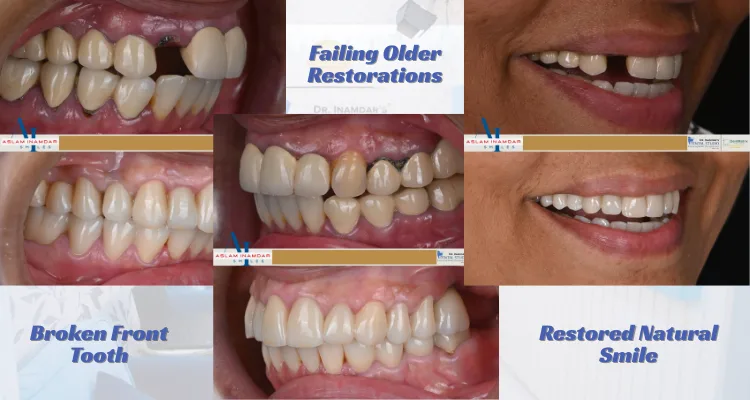
A broken front tooth can sometimes be repaired in a single visit, but in other cases it is the first sign of a wider problem. A woman came to Dr. Inamdar’s Dental Studio in Mumbai for a quick fix before her son’s wedding. Her examination showed old restorations that were failing, a bite problem and a chewing habit she had not noticed. This article explains what we found and why we planned her treatment the way we did.
One Broken Tooth, One Wedding a Month Away
She wanted a fast, reliable repair so she could smile confidently at the family event. That was a fair request, and we took it seriously. Before choosing a repair, though, we wanted to understand the condition of the rest of her teeth.
What the Examination Showed
Three things stood out.
Failing older restorations. Several earlier fillings and crowns were no longer in good condition. Old restorations can leak, crack or wear over time, and decay can start underneath them without much warning.
An anterior open bite. This means the front teeth do not meet when the back teeth are closed. Open bite treatment depends on the cause, so understanding it was important.
Mostly right-sided chewing. She used one side far more than the other. Over time, this can overload certain teeth and tire the chewing muscles on that side.
Why a Quick Repair Alone Was Not Enough
Bonding the broken tooth would have solved the immediate problem. But a chipped tooth in a bite that is already unbalanced can break again, and the old restorations would have kept ageing. Her immediate concern mattered, and so did the condition of everything around it. We explained this to her and discussed the options openly.
Planning First: How We Assessed Her Face, Teeth and Bite
Before any treatment, we collected photographs, facial videos, intraoral scans and the appropriate imaging. These help us study her face, teeth, bite and the health of the supporting tissues together.
We used facially driven Natural Shape 3D planning and AI Smile to support the process. These tools help us visualise the result and plan the steps. The decisions themselves came from a clinical examination and a discussion of options with the patient.
The Treatment Plan
For her, a full mouth rehabilitation plan included:
- Replacing failing restorations where it was indicated, instead of leaving them in place
- Dental implants at tooth positions 12, 14 and 26, to replace missing teeth on the upper right and upper left
- Guided crown lengthening where needed, to improve tooth proportions and the gum line
- A carefully planned bite position, with the bite adjusted at the front by 2 mm in her case
- Preserving her four lower front teeth, because healthy natural teeth are worth protecting
- Natural-shaped, multi-shaded monolithic zirconia crowns, made from a single block of material to resist chipping and match the colour variation of real teeth
One Design, Coordinated Care
Her approved 3D design acted as a shared reference. The surgeon, the periodontist and the restorative dentist all worked from the same plan, so each stage fitted the next. In a case with implants, gum work and crowns, this matters more than any single procedure.
The Result at Six Months
At her six-month review, we saw better balance in how her teeth came together. The enlarged chewing muscle on her right side had visibly reduced in size. This is consistent with chewing forces being shared more evenly.
What We Are Honest About
- This was one patient. Muscle changes and bite improvements vary from person to person.
- Changing the bite is a serious decision. It is done only when the diagnosis supports it, and it needs careful planning and review.
- Implants need healing time and enough bone, and not every patient qualifies without extra preparation.
- Zirconia is strong but not permanent. Regular check-ups still matter.
- Not every chipped tooth needs this much. Many cases need only a simple repair.
When a Chipped Tooth Deserves a Closer Look
It is worth asking for a full assessment if:
- Your front teeth do not touch when you bite down
- You chew mostly on one side
- Old fillings or crowns look worn, dark or loose
- Your jaw or cheek muscles feel tight or tired
The extent of treatment should follow the diagnosis and your needs. You may need only a small repair. Some patients need more, and a few need a plan like this one. Let our friendly team look at your teeth, explain what they see in plain words and talk through your options. There is no pressure to decide at the first visit.
This case is shared for education and awareness. Treatment depends on each person’s diagnosis.
About the clinic
Dr. Inamdar’s Dental Studio is a patient-centric dental clinic in Mumbai, combining advanced dental technology, clinical expertise, and personalised care to deliver a high standard of dental treatment. Led by Dr. Aslam Inamdar, the clinic offers comprehensive dental solutions, including dental implants, cosmetic dentistry, smile makeovers, root canal treatments, orthodontics, clear aligners, and full-mouth rehabilitation. Equipped with advanced diagnostic and treatment technologies, including CBCT imaging, 3D scanning, digital X-rays, microscope-assisted procedures, and an in-house dental laboratory, the clinic brings precision, comfort, and convenience together under one roof. Every treatment is planned around the patient’s individual needs, with a focus on oral health, aesthetics, and lasting results.
For emergency care, call +91 91373 77820/9820551749.
And to schedule a visit email [email protected] or visit dentalstudio.co.